I love music's ability to rally our emotions, and take us on a journey. When I got out of my 16 days of detention in Japan, the only one who could really understand what I had been through was Jónsi Birgisson, the frontman of Icelandic quartet Sigur Rós. It didn't matter that I had never met him, it was obvious that he understood. It doesn't matter that his songs are mostly wordless, it is the emotion that counts. In fact, his music speaks of the realm beyond language which we inhabited before incarnation, and

Memoirs of a Nomadic Soul Clawing His Way, One Mile at a Time, Around the World!
Showing posts with label Iceland. Show all posts
Showing posts with label Iceland. Show all posts
Wednesday, October 30, 2019
Remember the One Who Left
I like music which reminds me of places that I have been, or places that I want to go. Listening to Drum&Bass I feel like I am back in London in a council flat, bass-bins throbbing, high hats crackling, the air heaving with hashish. Vietnamese love songs transport me to Mũi Né on a languid evening, waves crashing on a nearby beach, a radio crooning in a fisherman's hut. Vietnamese music always sounds so sad, it must be because they had a tragic history...
I love music's ability to rally our emotions, and take us on a journey. When I got out of my 16 days of detention in Japan, the only one who could really understand what I had been through was Jónsi Birgisson, the frontman of Icelandic quartet Sigur Rós. It didn't matter that I had never met him, it was obvious that he understood. It doesn't matter that his songs are mostly wordless, it is the emotion that counts. In fact, his music speaks of the realm beyond language which we inhabited before incarnation, andseparation... (To listen to my curated playlist of music from around the world, click here.)
I love music's ability to rally our emotions, and take us on a journey. When I got out of my 16 days of detention in Japan, the only one who could really understand what I had been through was Jónsi Birgisson, the frontman of Icelandic quartet Sigur Rós. It didn't matter that I had never met him, it was obvious that he understood. It doesn't matter that his songs are mostly wordless, it is the emotion that counts. In fact, his music speaks of the realm beyond language which we inhabited before incarnation, and

Saturday, June 30, 2007
Greenland's Vikings, Victims of Climate Change
I have been reading a lot lately about the vanished Vikings of Greenland, how they just disappeared from the history books in the Middle Ages, never to be heard of again. I have been thinking a lot about them recently, those Europeans who for a couple of centuries eked out a civilization on the edge of the Arctic, trading in walrus ivory, worshipping in churches... they seemed to be flourishing and then one day they went MIA like the crew of the Marie Celeste, or those jet fighters swallowed by the Bermuda Triangle. It is worth pointing out at this point that I am in fact Australian, and thus hail from another European colony which was transplanted with all things Christian and European onto a barren, alien land, and left there to fend for itself. The Australian experiment worked, however -- the Greenland experiment didn't (at least not for the Vikings LOL!) Interestingly enough, Climate Change was the major culprit in the Greenland Vikings' demise -- not the Anthropogenic Global Warming we are (apparently) confronting now, but rather the Global Cooling of the Middle Ages (whose cause is still a matter of conjecture). Southern Greenland, once as verdant as its name suggests, presently chilled, then got snowploughed beneath a slowmotion avalanche of ice. The Vikings were snapfreezed out of existence; their neighbors the Inuit, who had migrated into the region at about the same time, somehow managed to adapt, and survived. Perhaps a similar fate awaits Australia in the future -- the white civilization which has ruled the roost for 200+ years will be forced to retreat from waves of heat and drought and searing fire, and the longsuffering Aborigines will crawl out from the margins to repossess their beloved homeland. History has a strange way of working like that. You never can really tell who is going to win the race, and revolutions are all too frequent. Gods hold grudges, and patiently plot their revenge. The laws of physics cannot be ignored, and neither can the science of Symbolic Exchange. Thus we have been warned! Thus we will be warmed.
Anything can happen in life, and history is full of sudden reversals. Global Warming could well be just a beat-up, the latest strain of the Armaggedonist virus whose DNA was identified in the Year 2000 bug, SARS and the Bird Flu Epidemic, and which has consistently frightened more people than it has actually harmed (infecting them not through physical germs but rather exposure to sensationalist reports on TV and the like.) I believe these hysterias are in fact media viruses, and mark a mutation of the virus from the physical world in which it has proliferated for billions of years, into the Baudrillardian mediaswamp we humans now inhabit. We're going to have a lot more media viruses in the future, that's my theory at least! Some people just love to think the world is about to end, and indeed such a deathwish is built into the mythology of the capitalist system itself. How it works is like this: somewhere in the "real" world (eg, China, Vietnam, Africa, anywhere Third World) a new virus arises in animals and kills a handful of people, triggering a pandemic alert. The media, ever hungry for a good scare story, jumps on to the case, and proclaims that the end of the world is nigh. What WHO fears is that the virus will jump the species barrier, but actually a more profound evolutionary leap is taking place: the virus is becoming digital. Panic takes on a life of its own, and becomes viral... this is how the pandemic spreads, this is what gives it energy. There's a run on flu vaccines... everyone on the streets of East Asian megacities are suddenly wearing surgical masks. Little do the masses know that it's too late, they are already infected! Their masks aren't protecting anyone, they are in fact amplifying the fear, broadcasting the infection! The best response would actually be to chill out, and ignore the doom. Or at least maintain a skeptical distance. That's what I would do, but then someone would accuse me of being irresponsible...
Look, what I am trying to say is this: Climate Change could be real, and could well be hype... but the extinction of the Greenland Vikings is a historical fact, and I find myself strangely haunted by their disappearance. Recently I thought to myself: imagine if the colonies had survived and the fjords of Greenland were now sprinkled with colorful, asymmetrical cafes and bulging nightclubs and bars; imagine if every young Greenlander today dreamed of being a poet or an anarchist or an artist or a rock musician? In other words, what if Greenland had developed into a New Iceland or a somewhat edgier, more tribal take on the Faroe Islands? Wouldn't that have been awesome, wouldn't that have been totally cool? Not politically correct to contemplate, but an interesting thought experiment nonetheless. I must confess though that Inuit Greenland has turned out pretty swinging in its own way, and the music scene is just as vibrant there as it is in Iceland, from what I hear. Nonetheless, I can't help myself from thinking: imagine if the Vikings had survived, imagine what Greenland would be like today? And I wonder: maybe the green days of Greenland are on their way back, after a long bitter winter? Spring is dawning in the Far North of the planet, and the Day of the Inuit is arrived. How I'd love to be part of it somehow. If I had any money, that is where I would be investing it!
 |
| Greenland is on the path to independence from its colonial master Denmark, and now has its own flag and a new name, Kalaallit Nunaat |
Look, what I am trying to say is this: Climate Change could be real, and could well be hype... but the extinction of the Greenland Vikings is a historical fact, and I find myself strangely haunted by their disappearance. Recently I thought to myself: imagine if the colonies had survived and the fjords of Greenland were now sprinkled with colorful, asymmetrical cafes and bulging nightclubs and bars; imagine if every young Greenlander today dreamed of being a poet or an anarchist or an artist or a rock musician? In other words, what if Greenland had developed into a New Iceland or a somewhat edgier, more tribal take on the Faroe Islands? Wouldn't that have been awesome, wouldn't that have been totally cool? Not politically correct to contemplate, but an interesting thought experiment nonetheless. I must confess though that Inuit Greenland has turned out pretty swinging in its own way, and the music scene is just as vibrant there as it is in Iceland, from what I hear. Nonetheless, I can't help myself from thinking: imagine if the Vikings had survived, imagine what Greenland would be like today? And I wonder: maybe the green days of Greenland are on their way back, after a long bitter winter? Spring is dawning in the Far North of the planet, and the Day of the Inuit is arrived. How I'd love to be part of it somehow. If I had any money, that is where I would be investing it!
Thursday, October 12, 2006
Reykjavik Record Shops
Iceland's musical scene is legendary, and for such a tiny country, the island sure manages to produce an enormous amount of talented artists and bands -- not to mention the occasional superstar. How do they manage it? According to the Kimono guitarist I chatted with in my most recent visit to Reykjavik: "The scene here is so small that musicians have nothing to gain, and nothing to lose. People end up doing whatever they want to do." So Icelanders don't go seeking fame, I get that -- but oddly they receive it, on the international stage no less. Lately I have been wondering: is it not the originality of the Icelandic musician that is critical here, but rather the exoticness of the Icelandic sound? In other words, Icelanders don't mean to sound so quirky, that is just the way they are. The strange thing is that even when Icelanders try to emulate something mainstream (say, Foo Fighters), it nonetheless ends up sounding alternative (like Whool). This is the process by which the B52's is transmuted to the Ice Cubes, and Radiohead is transformed to Sigur Rós...
Much as they would like to be Anglo-American clones, eating pizza and hamburgers, playing drums in the garage, Icelanders are simply not fated to be so mundane. They have something in their background which might be boring to them, but is fascinating to the outside world. Some kind of idiosyncrasy, some singularity is crystallized in their DNA and that is refracted in their literature, their music and their fashion sense, and obviously their art. Where does it spring from, though, this mutation, this mysterious X Factor? The geography? geology? The Sagas and the mythology? I am not quite sure, but I know that it is there.
PLACES TO SHOP
There are basicaly three main record shops (plötubúðir) in Reykjavik -- wait, four if you count the big book store (Mál og Menning) who have CDs and DVDs and stuff on the first floor (self published Icelandic poetry and mystery novels on the second floor.) There may be more than this, but in my opinion there are only good three record stores (þrjár góðar plötubúðir) in Reykjavik worth going to. At one, you can relish the knowledge that you are walking on Björk's sacred space. Or something like that.
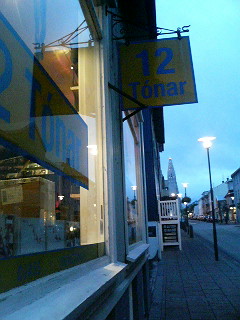 12 Tónar: Skólavörðustígur 15 | 101 Reykjavík | Sími: 511 5656 | Web: http://www.12tonar.is/.
Tone means "music" in Icelandic, and 12 Tónar refers to the 12 tones of the musical alphabet, from Aflat to Gsharp. Whenever I am in Iceland, 12 Tónar is one of the first places I head to, to update my knowledge of Icelandic rokk. To get there you must climb the mild incline of Skólavörðustígur from the groovy underground Kofi Tómosar cafe, up towards the big Viking statue and church, and stop off when you see the yellow and blue sign. The first time I visited Iceland, I walked straight past 12 Tónar without thinking it was anything more than a used knickknacks outlet. What a fool I was! On my latest trip, I did my homework, and earmarked this store for the first full day of explorations. Though it may be small, this is the best place to shop for local tunes. The staff are incredibly friendly. Head downstairs, and you can peruse the racks bathed in footlevel sun. Staff serve you coffee, you can listen to the latest Icelandic releases on headphones on a a comfy old couch while browsing art magazines from Japan (that is what I did the last time I was there, anyway.) The staff are no doubt musicians themselves and there are plenty of in-house events, such as free concerts held every Friday at five. While I didn't make it to the concert, I did manage to pick up some CDs here on my last visit, each costing around 1000 Kronurs a disk. One was Anarchists Are Hopeless Romantics, by My Summer As A Salvation Soldier (otherwise known as Þórir). That record really resonated with me in the humid, horrid Tokyo summer of 2006, as I lamented the breakup with C, and the general collapse of my life. A rather depressing album, to be sure, but Þórir has also put out some more upbeat numbers, for example the euphoric Canada Oh Canada (Land of the Free), and he is also apparently the lead singer of a folk/punk band called Deathmetal Supersquad. A most versatile chap, all in all...
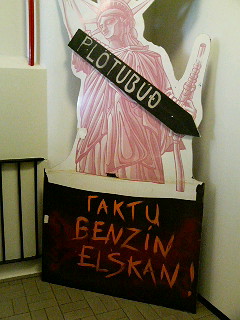 Bad Taste Record Store: Laugavegur 35 | 101 Reykjavík | Sími: 511 5656 | Web: http://smekkleysa.net/.
More than just a record store, Bad Taste (Smekkleysa) is a museum dedicated to the history of Icelandic music and art. It is also the shopfront of a music label, Bad Taste Records, which started as an arts collective in 1986. It became famous as the label which launched Bjork and her former band, The Sugar Cubes. Since that time many Icelandic greats have been signed by this label including Quarashi, Singapore Sling, and of course Sigur Rós. Given the history of the place, I was surprised by the limited selection of music here. You can, for example, order Bad Taste's entire back catalogue on their website. Why they don't have the music on sale at the record store as well is beyond me. Anyway, there are supposed to be performances put on here sometimes. Smekkleya isn't the only record label in Iceland: there is also the Bedroom Community. Just letting you know!
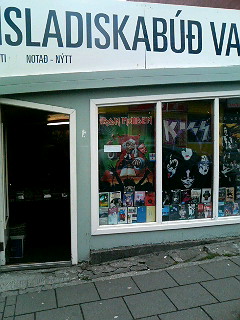 Geisladiskabúð Valda: Laugavegur 64 | 101 Reykjavík | Sími: 562 9002.
If the window display is anything to go by, this store seems to be devoted to the hard stuff: Heavy Metal, Death Metal, and hard rock. I must confess I have never stepped inside this place, as Metal is not really my thing. It is a genre that seems popular in the North, however, and has worked its influence into the indigenous sound. Jónsi claims to have liked Iron Maiden as a teenager. Listen to the climax of Glósóli, and the fruits of this infatuation are clearly audible. Albeit, obviously, channelled through a thick Icelandic filter. Which is, incidentally, just the way I like it! Geisladiskabúð Valda apparently stocks games and DVDs too.
THE GREAT UNSIGNED
As with anywhere, those bands with labels are just the tip of the iceberg. Beneath the ocean lies a great vault of untapped talent. How about these unsigned bands in Iceland, where do you find them? There are a number of websites to facilitate your search. Here are some of my favourites:
Hugi (Íslensk tónlist)
Jon.is
Rokk.is (defunct)
Much as they would like to be Anglo-American clones, eating pizza and hamburgers, playing drums in the garage, Icelanders are simply not fated to be so mundane. They have something in their background which might be boring to them, but is fascinating to the outside world. Some kind of idiosyncrasy, some singularity is crystallized in their DNA and that is refracted in their literature, their music and their fashion sense, and obviously their art. Where does it spring from, though, this mutation, this mysterious X Factor? The geography? geology? The Sagas and the mythology? I am not quite sure, but I know that it is there.
PLACES TO SHOP
There are basicaly three main record shops (plötubúðir) in Reykjavik -- wait, four if you count the big book store (Mál og Menning) who have CDs and DVDs and stuff on the first floor (self published Icelandic poetry and mystery novels on the second floor.) There may be more than this, but in my opinion there are only good three record stores (þrjár góðar plötubúðir) in Reykjavik worth going to. At one, you can relish the knowledge that you are walking on Björk's sacred space. Or something like that.
12 Tónar: Skólavörðustígur 15 | 101 Reykjavík | Sími: 511 5656 | Web: http://www.12tonar.is/.Tone means "music" in Icelandic, and 12 Tónar refers to the 12 tones of the musical alphabet, from Aflat to Gsharp. Whenever I am in Iceland, 12 Tónar is one of the first places I head to, to update my knowledge of Icelandic rokk. To get there you must climb the mild incline of Skólavörðustígur from the groovy underground Kofi Tómosar cafe, up towards the big Viking statue and church, and stop off when you see the yellow and blue sign. The first time I visited Iceland, I walked straight past 12 Tónar without thinking it was anything more than a used knickknacks outlet. What a fool I was! On my latest trip, I did my homework, and earmarked this store for the first full day of explorations. Though it may be small, this is the best place to shop for local tunes. The staff are incredibly friendly. Head downstairs, and you can peruse the racks bathed in footlevel sun. Staff serve you coffee, you can listen to the latest Icelandic releases on headphones on a a comfy old couch while browsing art magazines from Japan (that is what I did the last time I was there, anyway.) The staff are no doubt musicians themselves and there are plenty of in-house events, such as free concerts held every Friday at five. While I didn't make it to the concert, I did manage to pick up some CDs here on my last visit, each costing around 1000 Kronurs a disk. One was Anarchists Are Hopeless Romantics, by My Summer As A Salvation Soldier (otherwise known as Þórir). That record really resonated with me in the humid, horrid Tokyo summer of 2006, as I lamented the breakup with C, and the general collapse of my life. A rather depressing album, to be sure, but Þórir has also put out some more upbeat numbers, for example the euphoric Canada Oh Canada (Land of the Free), and he is also apparently the lead singer of a folk/punk band called Deathmetal Supersquad. A most versatile chap, all in all...
Bad Taste Record Store: Laugavegur 35 | 101 Reykjavík | Sími: 511 5656 | Web: http://smekkleysa.net/.More than just a record store, Bad Taste (Smekkleysa) is a museum dedicated to the history of Icelandic music and art. It is also the shopfront of a music label, Bad Taste Records, which started as an arts collective in 1986. It became famous as the label which launched Bjork and her former band, The Sugar Cubes. Since that time many Icelandic greats have been signed by this label including Quarashi, Singapore Sling, and of course Sigur Rós. Given the history of the place, I was surprised by the limited selection of music here. You can, for example, order Bad Taste's entire back catalogue on their website. Why they don't have the music on sale at the record store as well is beyond me. Anyway, there are supposed to be performances put on here sometimes. Smekkleya isn't the only record label in Iceland: there is also the Bedroom Community. Just letting you know!
Geisladiskabúð Valda: Laugavegur 64 | 101 Reykjavík | Sími: 562 9002.If the window display is anything to go by, this store seems to be devoted to the hard stuff: Heavy Metal, Death Metal, and hard rock. I must confess I have never stepped inside this place, as Metal is not really my thing. It is a genre that seems popular in the North, however, and has worked its influence into the indigenous sound. Jónsi claims to have liked Iron Maiden as a teenager. Listen to the climax of Glósóli, and the fruits of this infatuation are clearly audible. Albeit, obviously, channelled through a thick Icelandic filter. Which is, incidentally, just the way I like it! Geisladiskabúð Valda apparently stocks games and DVDs too.
THE GREAT UNSIGNED
As with anywhere, those bands with labels are just the tip of the iceberg. Beneath the ocean lies a great vault of untapped talent. How about these unsigned bands in Iceland, where do you find them? There are a number of websites to facilitate your search. Here are some of my favourites:
Hugi (Íslensk tónlist)
Jon.is
Rokk.is (defunct)
Monday, June 26, 2006
Midsummer Magic
Call me naïve, call me paranoid even, but I used to worry that it would be hard meeting people in Iceland. I used to get obsessed about it, back in the planning phase of this trip, and to combat my fears I would conduct rituals, Paper Burning ceremonies in fact, in my dingy sharehouse in Tokyo. Granted, I had met plenty of nice people on my previous visit here in 2003, among them Akiko a Japanese girl who turned into a lover, and Rodolphe the freak from the Alps who ambushed me in the mossy canyons of Þingvellir, and tried to seduce me. Great folk they all were, but they weren't locals, and it was the locals that I was really yearning to make my acquaintances with. Cute Asian girls are always a pleasure to encounter, but I can encounter plenty of them in Asia. It might well be easier hooking up with Japanese women outside of Japan than it is in their homeland, but truth be told I am over Japan after all my recent conflicts, and I want to take a break from it all. I need time out from all that stress, that Bushido bullshit! And visiting Iceland is such a rare luxury for me right now, I want to make the most of it. Icelanders are the rarest of species, anyway: how often do you see them in your home town, or at your nearest airport even? You don't see any, that's the thing... they are as elusive as elves. Apart from the staff at my youth hostel and the odd waiter or bartender downtown, I don't think I interacted with any real Icelanders on my 2003 trip -- and I was in their own country no less, in their capital city! This time around, having forked out so much for airfares and ripoff hotels, flown halfway across the world, etc, this time around I wanted to do things right, and meet the people who actually live here, rather than fellow travelers like myself. That of course can be hard when you are staying in a dorm in a youth hostel on the edge of town, and you only have six days to spend on the island. To maximize my chances of adventure, I concluded, I needed to have some kind of plan, a little piece of insurance up my sleeve. Obviously, I could have resolved to go out and network hard as soon as I touched down at Keflavíkurflugvöllur and that is indeed what I have been doing these past few days, networking my ass off so to speak! But, back in the planning phases of this trip, I required something more immediate to soothe my anxieties, something a little bit magical perhaps, something vindictively voodoo even. That is where Paper Burning came in. Call it irrational, call it superstitious nonsense, but Paper Burning seems to work. It can make your wishes come true, whether you believe in it or not. It is my key to manifestation.
The process is so simple it's silly: in essence, Paper Burning is the transformation of psychic energy into its physical equivalent, the alchemy of -E into the "E" of Einstein's famous equation. Fire and prayer serve as the interface, the gate between the two worlds. You might liken it to mining Jung's realm of indestructible energy, or sparking a cluster of coincidences, summoning them into existence, and hoping they will play out to your advantage! That's one way of looking at it. Another way is to consider it the recycling of past events: episodes which have happened to someone else, somewhere, at sometime; episodes which you seek to recreate in your own life, right here, right now. In order for the process to work something connected to that past event, something linked to it by psychic energy, needs to be destroyed so that the psychic pattern it represents can cross the threshold into the physical realm, and (re)manifest. When I Paper Burn I first hunt down some person describing, in their own words, an experience they have had, usually online on blogs and forums and the like. Anything that looks genuine and authentic is good for me, for example stories about lucky windfalls, falling in love, ecstatic epiphanies, sex with supermodels, that kind of thing. Or for this particular occasion, the experience of going to Iceland, meeting tons of nice people, making lifetime friends here! Those are the experiences I wanted to manifest this trip: longterm friends and wanton sex! Paper Burning manifested my relationship with C., and it got me a kiss out of the blue with Akiko on the lawns of Shinjuku Gyouen (新宿御苑), so surely it could mine me a few babes and buddies in Reykjavík, and guarantee me a rollicking time here. Truth be told, however, my soul has been longing for something more luminous than just babes and buddies and rollicking fun recently, and I find myself hungering for an accomplice instead of a mere acquaintance, a Twin Flame rather than just a girlfriend, a collaborator or collaborators who can allow me to attain the Divinity in the flesh that I have sometimes glimpsed in my dreams... in short, post C. I yearn for no less than a soulbuddy or coterie of soulbuddies from another dimension, Rock star friends to deliver me the Rock star lifestyle I deserve, and dearly await! Listening to Icelandic music always gives me the suspicion that I am missing out, alienated from the art and adventure which ought to be my birthright. "Born in the wrong family, the wrong town, the wrong country," as I might have complained as a kid, growing up in regional Australia. Back then I used to call this malaise the "Goonie Feeling", and I fantasized about escape through all manner of exotic means: becoming a writer or a famous artist, a child actor, a pop star, a global citizen, etc. Assuming that my misplaced birth was the root of my woes, I figured that all I needed to do was to change my abode, and my dream life would develop around me, spontaneously. Thus my life of wandering commenced, the search for belonging in farflung lands: interestingly, the Promised Land I sought was always overseas, north not south, temperate not arid, erudite and articulate, emotionally intelligent, savvy and sophisticated, youthful but wiser than its years. The quest led me to Japan but much to my dismay, Utopia was not waiting for me there, alas. Japan is cool and all, I love the trains and vending machines, the endless concrete jungles, but it is not the social Promised Land that I was expecting it to be. If my cousin Kellie had been there to join me then perhaps it might have turned out differently, we could have established our colony. But Kellie flaked out on me, she ditched me, and after several years of life in the Far East I was compelled to resume the search for my (now) private Zion, my (personal) Canaan. Almost immediately, I settled my sights on Iceland, a country I have always held a fascination for, ever since I was a wee bairn. I booked a flight here in 2003, and stayed about six days. Amazingly, the place exceeded my expectations, it was even better than I dared to hope it would be. For the first time in my life, it seemed I had finally found the place to call home. If only it wasn't so hard to get to, and to emigrate to!
Sometime last year I had a dream in which I was in an interior space, a long room of some kind, which was supposedly in Iceland. I can't really remember what was going on; while I often dream of being in huge parties, the atmosphere here felt sedate, more like a library than a nightclub. I was chilling on a couch, and presently I became aware that I was sitting next to this yellowhaired guy. We started talking about life and the universe, philosophy and politics and poetry, and I soon I realized that this man was going to change my life, or at least encourage me to become the real me, whatever that might mean. When I woke up, I knew it was an important dream, it was a dream with meaning. It was an inspirational dream, no less, and I used to think about it a lot during my relationship with C., when I should have been infatuated with her. I didn't know whether it would actually come true or if it was just symbolic of my Icelandic hopes: Freudian or Jungian, wish fulfillment or astral traveling, who knows. But I did remember it, and it did stay with me. That was one dream which crossed the threshold, always so foreboding and forbidding, from the unconscious, to the conscious mind...
Memories of this dream played through my mind as I readied the Paper Burning apparatus for action, a few months before my recent flight. I had found a choice snippet to burn, which was now printed out on a pristine leaf of white paper, and which read beguilingly: "Though I can say that if you are doing the pub crawl around Reykjavik after 1 am on a Friday or Saturday, you will end up with lots of new friends who are very talkative and outgoing." This read, in fact, like the perfect fodder for a Paper Burning spell: disposable, just an anonymous quote from the Internet, but the way it had been appropriated gave it an edge of sorcery, of the sort you might encounter in Bronisław Malinowski, or vintage Harry Potter. I installed the sheet of paper atop a vessel crusted from the detritus of previous fires, and ignited a cigarette lighter. The vessel was actually a mini altar bell given to me by Soka Gakkai (創価学会), that mad Buddhist order to which I belong (and doubtless they would accuse me of sacrilege if they knew how I was about to treat it!) I settled on to the floor in front of the bell in my bedroom, crouched seiza style, and lit the edge of the page. Flame crept around the perimeter of the page, browning it, bending it, and lifting it with a draft of warm air. For a moment I was worried the blazing leaf might lift itself out of the bell and drop on to the wooden floor of my room. As previously related, my sharehouse is made of tatami mats and paper walls and wood, and it would burn down in a flash if it was set alight. I have to be careful with this shit, so I poked the page back into the center of the bell with a pen, ready to extinguish the flame if things got out of hand. Peak flamage subsided shortly enough, however, and the sheet curled up onto itself, disintegrating into flakes of ash and puffs of gray smoke. I bowed towards my Soka Gakkai gohonzon (sacred scroll) hanging on the wall, and chanted through the smoke three times: "Nam myou hou ren ge kyou" ("南無妙法蓮華経"). I'm not really sure why I do this, since I don't really believe in Nichiren, the Lotus Sutra, and all that jazz associated with the gohonzon. Maybe you could call this "hedging your bets": if Paper Burning didn't work, then at least Nichiren might do the trick, and grant me my wishes. That was probably my motivation. My Soka Gakkai friends would probably be appalled, but this is the system I employ, and it works for me. Freestyling forever... that is the way I play! You can't pin me down to any one style... no way.
I used to worry about meeting people in Iceland, but it turns out that this was a misguided fear. The reality of the social scene in Reykjavík is, the city is so small, it is really easy to get to know people. After just a few nights downtown doing the Runtur, I have started to notice and recognize the same old faces -- the Reykjavík gang. And because the city is so isolated, people are interested in you as a newcomer. This is the kind of place where you don't need to exchange phone numbers or business cards -- if you meet someone cool, chances you will bump into them again pretty soon, just walking down the street. And they will remember you. On Friday afternoon, while the wind blew, and I wandered around town checking stuff out, I popped into a corner store to buy a burger for lunch -- and who else was standing there at the counter but my old cocainehunting buddy from Thursday night! I have forgotten what his name was, and perhaps he never gave it to me, but he has become my first true friend in Iceland, my first Icelandic Goonie. Gods willing, more are on their way!
Saturday was Midsummer's Day and I was back down in the Miðbær (midtown) at the Cafe Rosenburg, nursing a hangover from the previous night, and submitting it to my usual hair of the dog therapy (ie, I was drinking another beer!) The Cafe Rosenburg was decorated with model ships, an old piano, and jazz instruments hanging from the walls. Outside was a beautiful day: brilliant blue sky, sunshine and a hearty North Atlantic breeze. I was drinking my beer, and to pass the time (which often seems to expand so enormously here in Iceland, especially when I am wandering around) I flipped through a copy of the Reykjavik Mag which I had discovered on one of the tables. I paused to read an article about a young cartoonist and playwright named Hugleikur Dagsson. According to the article and other stuff I have seen on the Web since then, Hugleikur is famous for his stage play Forðist okkur ("Avoid Us") and his comic books Elskið okkur ("Love Us"), Drepið okkur ("Kill Us") and Ríðið okkur ("Fuck Us"). And he also wrote another work called Bjargið okkur ("Save Us"). There was a photo of the guy in the magazine with short hair and slacker T-shirt and horn-rimmed glasses, looking uncannily like my old mate Dave Harris from Palm Beach in Sydney. (Dave is also an artist and an activist, although I haven't heard from him in years. I wondered what he would think of Reykjavík if he ever made it here.)
I ordered another beer, stuffed the Reykjavik Mag into my slingbag as a souvenir, and picked up a copy of the ever informative Reykjavik Grapevine newspaper, which the Rosenberg was kind enough to stock. Leafing through it, I stumbled upon an article about Midsummer's Day, which was being marked today. It stoked my interest, so I started to read the report which follows, quietly, as I sipped my beer:
Well, I am sorry to report that I didn't roll around in the dew naked on Midsummer Day 2006, but I did pick up some interesting lava stones down by the waterfront, and perhaps more importantly, I had in my credit a number of Paper Burning spells conducted in Japan which were doubtless swirling out there in the ether, biding their time, just waiting for their chance to do their thing and manifest. And manifest they did, in spectacular form! As I wrote above, June 24 had developed into a wonderfully sunny and beautiful summer's day, and it was the weekend (Saturday no less), with everybody in the mood to party. Thursday had been incredible, Friday had been sensational, and while Saturday had only just begun I could already sense that Saturday was resonating at a higher dimensional vibration altogether than all the other days... in short, Saturday was otherwordly. And who knows, perhaps it was all from the feminine Freyja energy in the air? I put the newspaper in my slingbag, drained my glass, and left the Rosenberg. After walking around for a while I landed at the Sirkus, the site of my adventures on Thursday night. As I approached the bar to buy a drink, I realized that the aforementioned Hugleikur Dagsson was standing at the other end of the counter, beer in hand. I quickly dug out the copy of the Reykjavik Mag which I had confiscated as a souvenir, just to check that I wasn't hallucinating. It was, indeed, him -- the guy standing across the room with a beer in his hand was the same comic and writer and artist I had just been reading about at the Rosenberg. He looked like he had clawed his way out of the page of the magazine, complete with horn-rimmed glasses and slacker T-shirt, and a Dave Harris smirk. Scanning the article, I noticed that Dagsson had been asked: "What is your favorite bar in Reykjavik?" And he had replied: "Sirkus. It is the only bar in Reykjavik."
I will drink to that.
I ordered myself a beer, and walked upstairs to the loft, where they were showing the soccer World Cup. When I entered the loft I thought to myself: Wow, this is the place from the dream, the dream set in the long interior room. This is where I am going to meet that guy, the guy that changes my life! I sat down, and this feeling of déjà vu intensified... the mood, lighting, dogeaten couches, carpet on the floor, and my own state of mind were all the same as they had been in the original dream. I thought: If that dream really was a premonition, I just have to sit back and let it happen! I don't have to force anything. So I reclined in my couch, and tried to concentrate on the game for a while, gripped in a rising excitement. From time to time I looked around, to see if anything truly luminous was going on. There wasn't, just guys slouched in couches all around me, some of them with trainershod feet sprawled on coffee tables, watching the World Cup. I was almost starting to lose hope, when finally this yellowhaired guy walked in from behind me and said. "Do you mind if I sit next to you?" I looked up and realized: Oh my God, that's the guy from the dream! Its really him! A yellowhaired guy in jeans and slacker T-shirt and bright trainers, flopping down into the seat next to me. He looked like he had just emerged out of my dreams, to grace real life.
We started talking and after some formalities, he announced that he was the guitarist from Kimono, a band I have been listening to since 2003. I'm not sure he told me his name but based on stuff I have read online since, I am pretty sure he is Alex. Been touring for years, now back in Iceland. I told him that their Japanese Policeman in Scandinavia was one of my favorite songs and he remarked, "Wow, I didn't know we had that much of a following." We talked about earthquakes and life on the road, the Berlin rock scene, the Reykjavik rock scene, and so on. I asked him if there were any other musicians in the room with us right now, anyone I might know. "Yeah, there are a few," he replied, tantalizingly.
The game ended, Alex made his leave, and not long after I bailed as well. I headed out on to the street thinking to myself: Man, this is one magical place. Everytime I come here, something extraordinary happens to me here! I wonder what will happen next?
After that epiphany at Sirkus, the rest of the day was an anti-climax. I wandered down into the eastern reaches of the city, down to the water where the wind blew hard, and the gulls wheeled low. I could have spent a lifetime there just photographing the houses, the cars, the dwarf trees. I read National Geographic magazines in Kofi Tómasar Frænda ("Uncle Tom's Cabin") in the evening, waiting for something to happen. Nothing did. Finally, I got up, and commenced roaming again. Gatecrashed what seemed to be a private party at Hressó, sometime around 9pm. Plenty of people there, but it wasn't luminous. Eventually I left and moved on to Nelly's, which was rammed to the rafters. This was where the party was at: everyone was going crazy on the dancefloor upstairs, shaking their hands around like they just didn't care, etc. I got so drunk I fell down the stairs, and then decided it was time to call it a night. I returned to my youth hostel along the waterfront, watching the play of light on Esjan, and the sun orbiting the cold horizon. I could have spent the rest of the night out there, sitting on a rock, gazing into the grim hinterlands, that vast country of which Reykjavík serves as just an introduction. I remembered Alex saying that The Vines are pretty popular in Iceland, and that Nick Cave is actually a frequent visitor to the island. He apparently wrote the music for an Icelandic movie recently. Looking up at Esjan as I resumed my long trudge, I imagined I was Nick walking by himself on the lava beach in the middle of the night, striding home from a gig like a ghost in the mist. This is certainly the kind of country which would appeal to him, I thought to myself as I walked. Even more importantly, it is the kind of country which appeals to me!
 |
| Gateway between the worlds: an underpass, in Reykjavik (Iceland, 2006) |
 |
| Corner of Frakkastigur and Njalsgata, in Reykjavik (Iceland, 2006) |
Memories of this dream played through my mind as I readied the Paper Burning apparatus for action, a few months before my recent flight. I had found a choice snippet to burn, which was now printed out on a pristine leaf of white paper, and which read beguilingly: "Though I can say that if you are doing the pub crawl around Reykjavik after 1 am on a Friday or Saturday, you will end up with lots of new friends who are very talkative and outgoing." This read, in fact, like the perfect fodder for a Paper Burning spell: disposable, just an anonymous quote from the Internet, but the way it had been appropriated gave it an edge of sorcery, of the sort you might encounter in Bronisław Malinowski, or vintage Harry Potter. I installed the sheet of paper atop a vessel crusted from the detritus of previous fires, and ignited a cigarette lighter. The vessel was actually a mini altar bell given to me by Soka Gakkai (創価学会), that mad Buddhist order to which I belong (and doubtless they would accuse me of sacrilege if they knew how I was about to treat it!) I settled on to the floor in front of the bell in my bedroom, crouched seiza style, and lit the edge of the page. Flame crept around the perimeter of the page, browning it, bending it, and lifting it with a draft of warm air. For a moment I was worried the blazing leaf might lift itself out of the bell and drop on to the wooden floor of my room. As previously related, my sharehouse is made of tatami mats and paper walls and wood, and it would burn down in a flash if it was set alight. I have to be careful with this shit, so I poked the page back into the center of the bell with a pen, ready to extinguish the flame if things got out of hand. Peak flamage subsided shortly enough, however, and the sheet curled up onto itself, disintegrating into flakes of ash and puffs of gray smoke. I bowed towards my Soka Gakkai gohonzon (sacred scroll) hanging on the wall, and chanted through the smoke three times: "Nam myou hou ren ge kyou" ("南無妙法蓮華経"). I'm not really sure why I do this, since I don't really believe in Nichiren, the Lotus Sutra, and all that jazz associated with the gohonzon. Maybe you could call this "hedging your bets": if Paper Burning didn't work, then at least Nichiren might do the trick, and grant me my wishes. That was probably my motivation. My Soka Gakkai friends would probably be appalled, but this is the system I employ, and it works for me. Freestyling forever... that is the way I play! You can't pin me down to any one style... no way.
 |
| The Sirkus, the "only bar in Reykjavik!" (Iceland, 2006) |
Saturday was Midsummer's Day and I was back down in the Miðbær (midtown) at the Cafe Rosenburg, nursing a hangover from the previous night, and submitting it to my usual hair of the dog therapy (ie, I was drinking another beer!) The Cafe Rosenburg was decorated with model ships, an old piano, and jazz instruments hanging from the walls. Outside was a beautiful day: brilliant blue sky, sunshine and a hearty North Atlantic breeze. I was drinking my beer, and to pass the time (which often seems to expand so enormously here in Iceland, especially when I am wandering around) I flipped through a copy of the Reykjavik Mag which I had discovered on one of the tables. I paused to read an article about a young cartoonist and playwright named Hugleikur Dagsson. According to the article and other stuff I have seen on the Web since then, Hugleikur is famous for his stage play Forðist okkur ("Avoid Us") and his comic books Elskið okkur ("Love Us"), Drepið okkur ("Kill Us") and Ríðið okkur ("Fuck Us"). And he also wrote another work called Bjargið okkur ("Save Us"). There was a photo of the guy in the magazine with short hair and slacker T-shirt and horn-rimmed glasses, looking uncannily like my old mate Dave Harris from Palm Beach in Sydney. (Dave is also an artist and an activist, although I haven't heard from him in years. I wondered what he would think of Reykjavík if he ever made it here.)
I ordered another beer, stuffed the Reykjavik Mag into my slingbag as a souvenir, and picked up a copy of the ever informative Reykjavik Grapevine newspaper, which the Rosenberg was kind enough to stock. Leafing through it, I stumbled upon an article about Midsummer's Day, which was being marked today. It stoked my interest, so I started to read the report which follows, quietly, as I sipped my beer:
In pagan times, holidays were marked by the phases of the moon and the changing of the seasons. The longest day of the year, Midsummer (actually the first day of summer), was a celebratory holiday that revolved around the goddess Freyja, whose primary areas of expertise were sexuality and fertility. You can imagine the gusto with which this holiday was celebrated -- after the long, brutal winter, summer's finally here, and celebrations are in honor of the Goddess of Love? You bet it was a good time.
Not that things have changed very much since then. Even today, the arrival of summer is greeted with great enthusiasm, as you'll find that on the first remotely mild day of the year, Icelanders pour into the streets wearing skirts and t-shirts. But there are also a few superstitions surrounding Midsummer (due to begin on 21 June, 4:26AM) that have managed to survive.
One of the biggest ones is, you can roll around in the dew at dawn on Midsummer and any wish you make will come true. This is risky, particularly in an urban area like Reykjavik, but people still do this... Midsummer is also a great time to gather magical rocks and plants, as they're supposedly at the height of their power on this day. I'd suggest getting out of town that day, going for a walk down by the beach, or in a patch of woods, and looking around for small stones that look magical to you. Pick up this stone, put it in your pocket, and keep it -- you've got your new magic talisman.
 |
| Boulders, anchor and crane, beneath a blue midsummer sky (Iceland, 2006) |
I will drink to that.
I ordered myself a beer, and walked upstairs to the loft, where they were showing the soccer World Cup. When I entered the loft I thought to myself: Wow, this is the place from the dream, the dream set in the long interior room. This is where I am going to meet that guy, the guy that changes my life! I sat down, and this feeling of déjà vu intensified... the mood, lighting, dogeaten couches, carpet on the floor, and my own state of mind were all the same as they had been in the original dream. I thought: If that dream really was a premonition, I just have to sit back and let it happen! I don't have to force anything. So I reclined in my couch, and tried to concentrate on the game for a while, gripped in a rising excitement. From time to time I looked around, to see if anything truly luminous was going on. There wasn't, just guys slouched in couches all around me, some of them with trainershod feet sprawled on coffee tables, watching the World Cup. I was almost starting to lose hope, when finally this yellowhaired guy walked in from behind me and said. "Do you mind if I sit next to you?" I looked up and realized: Oh my God, that's the guy from the dream! Its really him! A yellowhaired guy in jeans and slacker T-shirt and bright trainers, flopping down into the seat next to me. He looked like he had just emerged out of my dreams, to grace real life.
We started talking and after some formalities, he announced that he was the guitarist from Kimono, a band I have been listening to since 2003. I'm not sure he told me his name but based on stuff I have read online since, I am pretty sure he is Alex. Been touring for years, now back in Iceland. I told him that their Japanese Policeman in Scandinavia was one of my favorite songs and he remarked, "Wow, I didn't know we had that much of a following." We talked about earthquakes and life on the road, the Berlin rock scene, the Reykjavik rock scene, and so on. I asked him if there were any other musicians in the room with us right now, anyone I might know. "Yeah, there are a few," he replied, tantalizingly.
The game ended, Alex made his leave, and not long after I bailed as well. I headed out on to the street thinking to myself: Man, this is one magical place. Everytime I come here, something extraordinary happens to me here! I wonder what will happen next?
 |
| Walking the streets of Reykjavik under a blue midsummer sky, looking for some action (Iceland, 2006) |
Monday, April 10, 2006
Skogar Treks (Iceland)
The village of Skógar might comprise just a few farms and a museum and some Tolkiensian Hobbit holes poking through the grass, but it has also become a gateway to one of Europe's last great wilderness areas, the huge, threatening Eyjafjallajökull ice cap in south Iceland, as well as the terminus of one of the world's top 10 treks. Not that I have ever trekked it... not yet, anyway. Later this year I will go to Iceland and if I have money and the time, I will definitely go to Skógar. From what I have read online, the name of the village means "forest", so it is probably the former site of a forest, although there don't seem to be many trees there now, they were chopped down centuries ago. I've heard the village is also close to the beautiful waterfall Skógafoss, which presumably means "forest waterfall", and is a major tourist attraction. There is another waterfall close to the ring road called Seljalandsfoss, which I would like to partake as well if I can make it. In the village itself, one can find a museum displaying the evolution of Icelandic houses and technical devices such as old aircraft and cars. The founder of the museum, Þórður Tómasson, is said to like showing guests around and has interesting stories to tell.
Since I haven't been to Skógar yet, I have to delve into the blogosphere, to see what the fuss is about. The thing about the Internet, it is almost like travelling, as well as going back in time (if you look at the older sites.) Some of the bloggers you read come across as travellers you might share a room with, and they all are interesting characters. Take the Australian blogger Danny Yee, for example. Danny is just one of the many hikers and trekkers who have arrived in Skógar to take on the cunning walk. He trekked up to Þórsmörk ("Thor's Field"), a waystation on the trip to Landmannalaugar near the Hekla volcano.
Danny wrote of his trekking experience:
Rowan Castle's Landmanalaugar to Skogar Trek
 |
| Seljalandsfoss, just off the ring road near Skogar in south Iceland. |
Danny wrote of his trekking experience:
The morning was bright and clear. "Fossbuin" was closed, so we could neither shower nor pay for the campsite. We packed everything ready for our hike, but then went to check out the Skógar Folk Museum. This consists of a number of buildings: old farmhouses, many of them with turf walls, a reconstructed church and schoolhouse, a large modern building housing the folk exhibits, and a brand new Technology and Transport Museum. Þordur Tomasson, the curator who inspired the museum, is still going strong, and he performed for us on one of the little organs, singing along, and on a dulcimer.After checking out the museum and the amazing houses with grass growing on their roofs (just like the Hobbit Holes in The Shire!), Danny and his team trekked on to Þórsmörk. This is actually a short trek by Skógar standards -- the standard walk is a whopping 70+km long, up to Landmanalaugar (although people usually follow the route in reverse, from Landmanalaugar down to Skógar, possibly because it is easier as it is mostly downhill.) If you are interested in reading the accounts of some trekkers who have taken on this trek and won, visit these following sites (eds. note: these are so old they are in the archives now!):
Nir Halman's Landmanalaugar to Skógar Trek
A good web-blog from the days when web-blogs didn't even exist. This site will give you a good introduction to travel in Iceland, especially if you of the pennypinching disposition. But first, allow me to get an anti-Semitic rant off my chest: If you have ever been to Thailand or India you will have probably come across Israeli backpackers and been shocked by their aggressive bargaining tactics. It seems that Israelis have an almost allergic reaction to spending money while they are on holiday, and they will do anything -- anything -- to avoid coughing up the cash. I have even seen them bargaining in fixed price places like Kodak film development clinics (Bangkok), provoking the wrath of both fellow customers and staff. Some restaurants and hotels in Thailand and the subcontinent now refuse to admit Israeli customers for this reason -- to spare themselves the grief of a 3-hour argument about the bill. I haven't seen any "No Israelis Allowed" signs in Iceland yet, but they could start appearing, if the frigid island attracts more visitors of the ilk of Nir Halman.
If you ever wondered what goes on in the mind of an Israeli backpacker, check out Nir's site. This is one of the older Iceland adventure blogs on the Net -- it dates from 2001, and describes a visit Nir and his girlfriend made to Iceland in 1999. I enjoyed reading about how they try to save money by eating in supermarkets or BBQing their meals outside -- I should add that there is a bit of Nir in me, the last time I went to Iceland I was so short of money I was forced to sleep at the airport and hitch a ride to Blue Lagoon. One of the cool things Nir and his girl manage to do while in Iceland, is make the Landmannalaugar to Skógar trek. As Nir writes:
A good web-blog from the days when web-blogs didn't even exist. This site will give you a good introduction to travel in Iceland, especially if you of the pennypinching disposition. But first, allow me to get an anti-Semitic rant off my chest: If you have ever been to Thailand or India you will have probably come across Israeli backpackers and been shocked by their aggressive bargaining tactics. It seems that Israelis have an almost allergic reaction to spending money while they are on holiday, and they will do anything -- anything -- to avoid coughing up the cash. I have even seen them bargaining in fixed price places like Kodak film development clinics (Bangkok), provoking the wrath of both fellow customers and staff. Some restaurants and hotels in Thailand and the subcontinent now refuse to admit Israeli customers for this reason -- to spare themselves the grief of a 3-hour argument about the bill. I haven't seen any "No Israelis Allowed" signs in Iceland yet, but they could start appearing, if the frigid island attracts more visitors of the ilk of Nir Halman.
If you ever wondered what goes on in the mind of an Israeli backpacker, check out Nir's site. This is one of the older Iceland adventure blogs on the Net -- it dates from 2001, and describes a visit Nir and his girlfriend made to Iceland in 1999. I enjoyed reading about how they try to save money by eating in supermarkets or BBQing their meals outside -- I should add that there is a bit of Nir in me, the last time I went to Iceland I was so short of money I was forced to sleep at the airport and hitch a ride to Blue Lagoon. One of the cool things Nir and his girl manage to do while in Iceland, is make the Landmannalaugar to Skógar trek. As Nir writes:
This trek is considered the best (but also the most difficult) in Iceland. It starts in Landmannalaugar, the site of a rather big hot water spring at an altitude of 600m. It is a remote and exposed place in the highlands bordering a big lava field from which Hekla volcano can be seen. This place is obviously popular with the tourists who visit it during the summer time. In the winter time, when a thick layer of snow covers the surroundings, it is left alone for the locals, who come to bath naked in the hot springs. The trek to Skogar is 70km long, and usually takes a week to walk. It is considered unique in the world as it passes through lava fields, volcanoes, hot springs, geysers as well as genuine alpine scenery of eternal glaciers, a high snow-covered mountain-pass and numerous snow fields.The other great thing about this trek is that the route is lined with well maintained and cozy huts where hikers can stay the night. Payment for accommodation at these huts is, well, optional. And you can assume that your typical Israeli, passing through this beautiful part of the world, will option out of paying if payment is only optional. The loyalty system doesn't work for every nationality, I am afraid. Nir's website is proof of that. One of the classic parts of Nir's adventure happens when they come across a group of Icelandic folks having a BBQ at a popular mushroom picking place en route:
They are eating huge amounts of BBQ meat and freshly grilled potatoes while we eat pasta and mashed potatoes made out of dried potatoes powder. We look at them with eager eyes and then with surprise when we see the amount of leftovers they throw in the garbage cans. We don't understand why they ignore us. They are so many and we are only 4 "poor" tourists. They could have offered us some of their food... Only when they see our mashed potatoes powder they start to talk with us, and offer to us the remaining 3 pieces of the cake that they have eaten. What a pity they didn't talk with us before and offered to us the meat...I too know what it is like to be a poor tourist in Iceland, forced to subsist on packets of dry noodles from Japan and cans of Asahi Blue, and tins of sardines and old bread. Next time I go to Iceland (June this year) things will be different -- I am going to live like a King. Lamb and roast pork and hotdogs for me every day -- I can hardly wait. Bring on the adventure!
Rowan Castle's Landmanalaugar to Skogar Trek
Rowan Castle visited Iceland in 2002 because he needed to get away from work and reckoned that the Landmanalaugar to Skógar trek would be the perfect place to unburden the stresses of modern life. In the process, he traded the burdens of workaday living for the burden of a 56-pound backpack! On his website Castle wrote:
That's why I love Iceland -- I just can't get enough of those alien landscapes! And if you want to plunge yourself into one alien landscape after another, go read Rowan Castle's site. Even if it doesn't formally exist any longer!
This route is rated as Iceland's premier walk, and some guidebooks even claim that it is one of the best treks in the World! It starts in the South Central Highlands, amongst the colourful rhyolitic mountains and geothermal vents of Landmanalaugar. These mountains were laid down by volcanic action, and then dramatically eroded to create undulating hills of multi-coloured mineral deposits. As the path loses altitude, it descends out of these hills and crosses a bleak lava desert of black ash, punctuated by pyramidal mountains and raging glacial rivers. At the other side is the wide valley of Thorsmork (Woods of Thor), which has stunning views of two of Icelands huge ice caps - Eyafjallajokul and Myrdalsjokul. The route then climbs out of the valley, along a sharp ridge and crosses the Fimmvorthuhals Pass between the two ice caps. From there, it descends sharply to the North Atlantic coast, finishing at the sixty metre high Skogafoss waterfall at the small settlement of Skogar.Castle describes the long trek from Landmanalaugar to Skógar in gruelling prose, with blocks of text interspersed by links to his photo gallery. I liked some of the little incidental touches, like the discovery of some little Arctic flowers in a crevice somewhere, their fragile beauty contrasted against the massive glacier stretching for miles and miles into the distance -- the microcosm within the macrocosm. Castle described some mud he had found on his trek thus: "a stream at the bottom (of the ravine) emerged from a perfectly formed tunnel under the ice, but the stream had deposited strange bright orange mineral deposits onto the black ash. The contrasting colours of orange, white and black looked like they belonged to an alien landscape."
That's why I love Iceland -- I just can't get enough of those alien landscapes! And if you want to plunge yourself into one alien landscape after another, go read Rowan Castle's site. Even if it doesn't formally exist any longer!
Tuesday, September 27, 2005
Regaining My Hope in Sigur Rós
I must confess that I had lost hope in Sigur Rós after () came out. In comparison to Ágætis Byrjun, Sigur Rós' first major release, the () album was harder to get into: austere, funereal, blank as a pair of empty parentheses. While Ágætis Byrjun grabbed you from the get-go, and took you on a glorious adventure, () was downbeat, and deliberately intimidating. Not only did none of the tracks have names, but they all kind of sounded the same. It was disappointing, because I fancied that I had finally met my kindred spirits in this Reykjavík quartet. I feared that the Victorious Rose had withered, and died, just as I was starting to dig them. That was two years ago, and a lot of water has flowed under the bridge since then, to abuse an old cliche... I have been to Iceland, and discovered plenty of fresh talent in that creative powerhouse. Sigur Rós had played their part in my life, or so I thought, but now I required them no more. How wrong was I: all of a sudden, Sigur Rós are back, happier and more accessible than ever! Frontman Jónsi Birgisson is actually singing, in Icelandic at least! And in gratitude, I have to bow deeply, and say: Thank you. Or, more succinctly: Takk..., which is the title of their new album.
Last Sunday I bought the latest Sigur Rós installment Takk... and consumed it, captivated, at the old school desk in my sharehouse. It was such an exhilarating experience, I literally couldn't get out of my chair until it finished. From the opening moments of mesmerizing feedback, which suggest a sun rising over a field of lush lupines, you sense that this is going to be an upbeat record. The sun slowly morphs into the sweep of a North Atlantic lighthouse, slicing through the fog. A beam from that lighthouse swivels your way, sending out fluctuating waves that just melt you, instantaneously. All at once, I felt the melancholy of () blown away, and the curtain rise on a whole new act in the Sigur Rós saga. It was an introduction that, for me at least, called for an instant rewind. So let's rewind it, and do it properly, in this review... one track at a time! With the occasional YouTube video or other media file thrown in, once they become available.
Track 1: Takk... ("Thanks...")
Like a ray of scintillating sunshine, Takk... penetrates deep into your soul, to grant you a Higher Grace. I believe there are saints in India who can enlighten you just by uttering a couple of words in your earshot, or staring you in the eye. Sigur Rós also seem to possess this ability, this Shamanic power, and all you have to do is hear their music, and be transformed! As the introduction begins, it feels like a baby is being born, descending into Being (in the fringes, meanwhile, the sonic equivalent of angelic heraldry hangs.) Why do the introductions to Sigur Rós albums always sound like childbirth? I marveled, hearing this tune play out, the second time I rewound it. Not the birth of an ordinary baby, of course, that would be too mundane. Here we are talking of angel birth!
Track 2: Glósóli ("Glowing Sole")
Glosoli carries forward the euphoria of the intro, but the Fafner-frustrated bass, and restless percussion, suggests some discord... it appears our angel child has taken form, but finds her/himself forsaken in this cold world. Inexplicably, the sun has disappeared (then again, it might just be midwinter in the Land of Fire and Ice!) The bass frets round and around, locked in a holding pattern. The strings do manage to lift off though and before too long we have Jónsi ululating too, yodeling almost, his voice higher than I have ever heard before, almost operatic you might say. He sings, sweepingly:
At 3:47 the bass guitar grinds into a countdown, lead guitar joining in, cascading into a crescendo which can only be called Heavy Metal, Iron Maiden in slow-mo. Jónsi rides atop the sonic blast, rejoicing:
On cue, the kids charge up a steep grassy slope, overtaking gulls which bob on the breeze, to the high cliff which towers over the sunlit beach. As Jónsi hollers they leap off the edge, one by one -- not to fall to their grisly deaths but rather to soar, angelic, into the citrine sky. There is an angel inside everyone of us, that is one of Sigur Rós' recurring motifs... and these kids have lights in their soles. We are Homeric heroes all, living in our own personal saga. Therefore, everything we do is worthy of epic treatment.
Track 3: Hoppípolla ("Jumping in Puddles")
In an interview recently aired on MTV Japan, band members declared Takk... to be their "happy album". Critics have been predictably quick to label the record as too optimistic and orgasmic, and to question the band's sincerity. I think they are missing the point: the thing about Sigur Rós is that they do emotional music -- their range encompasses everything from ecstasy to sorrow and existential dread. That said, Hoppipolla manages to push it to 11 on the ecstasy scale, which is no mean feat. It is, allegedly, the story of some kids splashing around in a puddle and having fun (once again, a simple theme turned into an opera of epic proportions.) The result is the most beautiful song on the album, or at least one of the most accessible.
In the video posted above, homage is paid to such juvenile pursuits as tagging buildings, throwing water-bombs, and playing knock-and-run. Typical of Sigur Rós, normal roles get reversed, and the perpetrators of said acts are senior citizens, while the victims are young dudes played by the members of the band (at 1:19, for example, you can see Jónsi working behind the counter in a shop.)
Track 4: Með Blóðnasir ("With a Nosebleed")
The continuation of the previous song by other means, this is also a very inspirational piece in its own right. According to an interpretation I have read online, one of the kids splashing around in Hoppipolla has injured himself/herself and gotten a nosebleed, but nobody cares because everyone is having so much fun. Loops of guitar, keyboards and glockenspiel are tossed around, with Jónsi surfing over the top. Casper on the Sigur Rós message board said: "Með Blóðnasir is just wild! if it were an actual song it'd be the best thing they've ever done!" I just wonder whether by separating this and Hoppípolla into two units, Sigur Rós have deliberately tried to make it harder for both to get commercial radio playtime. Instead of selling out, the band seem to be trying to goad commercial radio into breaking a few of its own rules, and become a bit more experimental.
Track 5: Sé Lest ("Train")
Building straight off of Með Blóðnasir, the glockenspiel is isolated, playing a repeated melody that moves up in fifths all while bouncing in 16th notes. A whimsical vocal line comes over and is followed by bass, percussion and feathery strings (apparently provided by fellow Icelanders amiina). At this stage it is all starting to sound very mid-1990s Björk, as soothing as a lullaby. Near the five-minute mark, multiple tonal instruments balance against each other, with on odd bowed instrument over the back. At 6:30, curiously, we are full-fledged into a night-time polka. That's right, a freaking polka! This is cool -- only Sigur Rós could pull off a transition like that. It leaves me wondering: Is there anything this band can't do?
Track 6: Sæglópur ("Sea Nitwit")
After the whimsical folly of Sé Lest, Sæglópur erupts with a surprising force... you could describe it a power ballad with its piano intro, geyser blasts of bowed guitar, multiple climaxes, and the endless cries of "þú" ("you"). The trademark Sigur Rós strategy of old was to build up songs over a long time to a devastating climax, like an Mid Atlantic cataclysm. Usually they would start off sluggish and serene and at the 6th minute mark or so, the breakout would take place. That was well and good, but with this new album they have taken things to the next level. Instead of sprawling songs which turn hyper at the end, Sigur Rós have amped up the intensity... they can now pull off multiple climaxes. 11 out of 10, in the Spinal Tap tradition. And as any pornographer will tell, nothing beats milking that money shot multiple times...
Track 7: Milano ("Milan")
Listening to Sigur Rós, you might find yourself wondering: What planet does this music come from? I met an American in Mumbai this year who joked that Jónsi's voice was "out of this world." I agree with him -- Jónsi is indeed an alien, an emissary from another galaxy... but that ain't surprising considering his pedigree. The truth is that Iceland itself is an alien and otherworldly place. Going to Iceland is in fact the next best thing to visiting another planet. It is built atop a dimensional fault line, a gateway between the 'branes. What happens then when Sigur Rós leave their homeland, and vacation in, say, Milan? Well, this song could be the result! It starts off slowly, as you might expect after the dramatic heights of the previous track. There is tender strings action, and a bit of piano too, revolving like a music box. As in Með Blóðnasir there is a circular structure to this song, each bar measured by a Fafner bass, which ever so slowly accelerates. Tension accumulates, as tension is wont to do. At 3:45 we finally reach bursting point, guitars thrashing, but this is a minor eruption. I guess there wasn't that much energy to release after Sæglópur. All that climaxing will exhaust you, sometimes.
Track 10: Svo Hljótt ("So Quietly")
When we are lost at sea and the sun refuses to shine, we embodied beings need a guiding star. Suddenly I realize that () was our communal long night of the soul, the wilderness we had to traverse in order to arrive at Takk..., this oasis of plenty. With Jónsi as our mad Pied Piper (or the drummer who can shatter glass with his voice.) As the magnitude of this revelation sinks in, my only rational response is to bow low and proclaim, "Thank you Sigur Rós, for the hope you gave me. Thank you for the joy." I leaned on you, and you leaned on me. What goes around comes around, and every tribute is returned.
Track 11: Heysátan ("Hay Stack")
Heysátan unfolds like a hymn, each note constructing a church stone by stone, wall by wall, pew by pew. Inside this sacred place, the atmosphere is that of a wake (albeit a rather jubilant one). Jónsi is either playing the role of a priest, or a demonic choirboy. Grapevine has the last word on this fitting finale: "A refrain of key notes of one chord, we hear horns, plucked guitar and keyboards all combining for airy but understated effect. Jónsi is most clear in the vocals here, sounding, dare we say it, like an Icelandic Billy Corgan..."
Takk... is one serious mindtrip, more of a drug than an album, and it is reminiscent of the Múm works that I have reviewed on this site. The cover of the CD (pictured above), designed to resemble a yellowed Victorian novel, also recalls Múm's album covers. Difficult to say though whether Sigur Rós directly imitated Múm in this respect, or whether both bands are merely reflecting the current trends in Nordic graphic design. Whatever, this is a very Icelandic album, and for lovers of Iceland such as myself, it is great to notice all the indigenous touches on this production.
 |
| Takk, the third album released by Sigur Rós. |
Last Sunday I bought the latest Sigur Rós installment Takk... and consumed it, captivated, at the old school desk in my sharehouse. It was such an exhilarating experience, I literally couldn't get out of my chair until it finished. From the opening moments of mesmerizing feedback, which suggest a sun rising over a field of lush lupines, you sense that this is going to be an upbeat record. The sun slowly morphs into the sweep of a North Atlantic lighthouse, slicing through the fog. A beam from that lighthouse swivels your way, sending out fluctuating waves that just melt you, instantaneously. All at once, I felt the melancholy of () blown away, and the curtain rise on a whole new act in the Sigur Rós saga. It was an introduction that, for me at least, called for an instant rewind. So let's rewind it, and do it properly, in this review... one track at a time! With the occasional YouTube video or other media file thrown in, once they become available.
Track 1: Takk... ("Thanks...")
Like a ray of scintillating sunshine, Takk... penetrates deep into your soul, to grant you a Higher Grace. I believe there are saints in India who can enlighten you just by uttering a couple of words in your earshot, or staring you in the eye. Sigur Rós also seem to possess this ability, this Shamanic power, and all you have to do is hear their music, and be transformed! As the introduction begins, it feels like a baby is being born, descending into Being (in the fringes, meanwhile, the sonic equivalent of angelic heraldry hangs.) Why do the introductions to Sigur Rós albums always sound like childbirth? I marveled, hearing this tune play out, the second time I rewound it. Not the birth of an ordinary baby, of course, that would be too mundane. Here we are talking of angel birth!
Track 2: Glósóli ("Glowing Sole")
Glosoli carries forward the euphoria of the intro, but the Fafner-frustrated bass, and restless percussion, suggests some discord... it appears our angel child has taken form, but finds her/himself forsaken in this cold world. Inexplicably, the sun has disappeared (then again, it might just be midwinter in the Land of Fire and Ice!) The bass frets round and around, locked in a holding pattern. The strings do manage to lift off though and before too long we have Jónsi ululating too, yodeling almost, his voice higher than I have ever heard before, almost operatic you might say. He sings, sweepingly:
"Nú vaknar þúAllt virðist vera breyttÉg gægist útEn er svo ekki neitt..."
Now you wake up, to find all is different. I look out, but see nothing. Tie my shoes so, and head for the door. Outside on the lava plain, a boy stands waiting. He is decked out in period costume, and carrying a drum. Part Pied Piper, part pirate dwarf, he seems like he's on a mission. He is on a Crusade, no less, and he is calling for volunteers. The drummer boy assembles a posse of kids as the song advances, constructing cairns, sleeping on moss beds, traversing the dark and steaming landscape, before the sun is finally located hiding over what must be the black beach of Vík in southern Iceland. The sound wells, bowed guitar building, and surging through it all is an epic feel, an incredibly epic feel, the kind you might encounter in a Homeric poem, or an Old Norse saga.
At 3:47 the bass guitar grinds into a countdown, lead guitar joining in, cascading into a crescendo which can only be called Heavy Metal, Iron Maiden in slow-mo. Jónsi rides atop the sonic blast, rejoicing:
"Og hér ert þú, fannst mér!Og hér ert þú, Glósóli!"
On cue, the kids charge up a steep grassy slope, overtaking gulls which bob on the breeze, to the high cliff which towers over the sunlit beach. As Jónsi hollers they leap off the edge, one by one -- not to fall to their grisly deaths but rather to soar, angelic, into the citrine sky. There is an angel inside everyone of us, that is one of Sigur Rós' recurring motifs... and these kids have lights in their soles. We are Homeric heroes all, living in our own personal saga. Therefore, everything we do is worthy of epic treatment.
Track 3: Hoppípolla ("Jumping in Puddles")
In an interview recently aired on MTV Japan, band members declared Takk... to be their "happy album". Critics have been predictably quick to label the record as too optimistic and orgasmic, and to question the band's sincerity. I think they are missing the point: the thing about Sigur Rós is that they do emotional music -- their range encompasses everything from ecstasy to sorrow and existential dread. That said, Hoppipolla manages to push it to 11 on the ecstasy scale, which is no mean feat. It is, allegedly, the story of some kids splashing around in a puddle and having fun (once again, a simple theme turned into an opera of epic proportions.) The result is the most beautiful song on the album, or at least one of the most accessible.
In the video posted above, homage is paid to such juvenile pursuits as tagging buildings, throwing water-bombs, and playing knock-and-run. Typical of Sigur Rós, normal roles get reversed, and the perpetrators of said acts are senior citizens, while the victims are young dudes played by the members of the band (at 1:19, for example, you can see Jónsi working behind the counter in a shop.)
Track 4: Með Blóðnasir ("With a Nosebleed")
The continuation of the previous song by other means, this is also a very inspirational piece in its own right. According to an interpretation I have read online, one of the kids splashing around in Hoppipolla has injured himself/herself and gotten a nosebleed, but nobody cares because everyone is having so much fun. Loops of guitar, keyboards and glockenspiel are tossed around, with Jónsi surfing over the top. Casper on the Sigur Rós message board said: "Með Blóðnasir is just wild! if it were an actual song it'd be the best thing they've ever done!" I just wonder whether by separating this and Hoppípolla into two units, Sigur Rós have deliberately tried to make it harder for both to get commercial radio playtime. Instead of selling out, the band seem to be trying to goad commercial radio into breaking a few of its own rules, and become a bit more experimental.
Track 5: Sé Lest ("Train")
Building straight off of Með Blóðnasir, the glockenspiel is isolated, playing a repeated melody that moves up in fifths all while bouncing in 16th notes. A whimsical vocal line comes over and is followed by bass, percussion and feathery strings (apparently provided by fellow Icelanders amiina). At this stage it is all starting to sound very mid-1990s Björk, as soothing as a lullaby. Near the five-minute mark, multiple tonal instruments balance against each other, with on odd bowed instrument over the back. At 6:30, curiously, we are full-fledged into a night-time polka. That's right, a freaking polka! This is cool -- only Sigur Rós could pull off a transition like that. It leaves me wondering: Is there anything this band can't do?
Track 6: Sæglópur ("Sea Nitwit")
After the whimsical folly of Sé Lest, Sæglópur erupts with a surprising force... you could describe it a power ballad with its piano intro, geyser blasts of bowed guitar, multiple climaxes, and the endless cries of "þú" ("you"). The trademark Sigur Rós strategy of old was to build up songs over a long time to a devastating climax, like an Mid Atlantic cataclysm. Usually they would start off sluggish and serene and at the 6th minute mark or so, the breakout would take place. That was well and good, but with this new album they have taken things to the next level. Instead of sprawling songs which turn hyper at the end, Sigur Rós have amped up the intensity... they can now pull off multiple climaxes. 11 out of 10, in the Spinal Tap tradition. And as any pornographer will tell, nothing beats milking that money shot multiple times...
Track 7: Milano ("Milan")
Listening to Sigur Rós, you might find yourself wondering: What planet does this music come from? I met an American in Mumbai this year who joked that Jónsi's voice was "out of this world." I agree with him -- Jónsi is indeed an alien, an emissary from another galaxy... but that ain't surprising considering his pedigree. The truth is that Iceland itself is an alien and otherworldly place. Going to Iceland is in fact the next best thing to visiting another planet. It is built atop a dimensional fault line, a gateway between the 'branes. What happens then when Sigur Rós leave their homeland, and vacation in, say, Milan? Well, this song could be the result! It starts off slowly, as you might expect after the dramatic heights of the previous track. There is tender strings action, and a bit of piano too, revolving like a music box. As in Með Blóðnasir there is a circular structure to this song, each bar measured by a Fafner bass, which ever so slowly accelerates. Tension accumulates, as tension is wont to do. At 3:45 we finally reach bursting point, guitars thrashing, but this is a minor eruption. I guess there wasn't that much energy to release after Sæglópur. All that climaxing will exhaust you, sometimes.
 |
| Sigur Rós, somewhere in Iceland. |
Track 8: Gong ("Gong")
Mournful strings commence this journey, which are presently joined by guitars, drums, bass and finally a frantic piano. Jónsi is like a wolf howling at the sky, supported by a ghostly choir (quite probably, a choir of one.) Grapevine considers that this is "close to a melodic rock song, until it breaks into the big drama after the four-minute mark." In my own opinion, Gong is one kick-ass track -- a new direction for the band, a climax upon a climax, and another highlight of an album so crammed full of highlights.
Track 9: Andvari ("Zephyr")
Reviewers haven't cottoned on to it, but I swear this is another version of the same dirge which dragged on eight times on the () album. This is the 9th rendition of the song if I am correct, and I in my opinion it is the best. It is also the most moving moment of an already powerful album. As Gong retreats, guitars, music box and glocks pick up a sentimental melody, joined by the bass. At length Jónsi enters the fray, droning in what, suspiciously, sounds like Hopelandic, Uh-oh! you might think, remembering the bleak days of ()... Are we back on that kick? To be honest though, you don't need to understand Sigur Rós' lyrics to feel the meaning, and there sure seems to be a lot of emotion crammed into his wailing. At 1:50, Jónsi surprises me by singing (in English!) the short phrase, "I love you." Hackneyed perhaps, but it brought tears to my eyes on the first and second hearings, for there is a gratitude in his admission -- I could imagine that he was addressing me personally, or at the very least the loyal fans of the band. Giving thanks, in the true spirit of this record. I might be wrong... others claim this is a love song dedicated to his new boyfriend. I didn't even know he was gay!
Mournful strings commence this journey, which are presently joined by guitars, drums, bass and finally a frantic piano. Jónsi is like a wolf howling at the sky, supported by a ghostly choir (quite probably, a choir of one.) Grapevine considers that this is "close to a melodic rock song, until it breaks into the big drama after the four-minute mark." In my own opinion, Gong is one kick-ass track -- a new direction for the band, a climax upon a climax, and another highlight of an album so crammed full of highlights.
Track 9: Andvari ("Zephyr")
Reviewers haven't cottoned on to it, but I swear this is another version of the same dirge which dragged on eight times on the () album. This is the 9th rendition of the song if I am correct, and I in my opinion it is the best. It is also the most moving moment of an already powerful album. As Gong retreats, guitars, music box and glocks pick up a sentimental melody, joined by the bass. At length Jónsi enters the fray, droning in what, suspiciously, sounds like Hopelandic, Uh-oh! you might think, remembering the bleak days of ()... Are we back on that kick? To be honest though, you don't need to understand Sigur Rós' lyrics to feel the meaning, and there sure seems to be a lot of emotion crammed into his wailing. At 1:50, Jónsi surprises me by singing (in English!) the short phrase, "I love you." Hackneyed perhaps, but it brought tears to my eyes on the first and second hearings, for there is a gratitude in his admission -- I could imagine that he was addressing me personally, or at the very least the loyal fans of the band. Giving thanks, in the true spirit of this record. I might be wrong... others claim this is a love song dedicated to his new boyfriend. I didn't even know he was gay!
Track 10: Svo Hljótt ("So Quietly")
As its name might imply, Takk...'s penultimate track starts off restrained, with somber aspirations. but soon builds into one final banger -- a tornado, geyser, or the tractor beam from a UFO in a cornfield somewhere (draw your own allusions here.) The rock bible NME claimed: "Choice cut Svo Hljótt sounds like the bit in Lord Of The Rings when Gandalf dies reinterpreted by operatic mythical winged beasts." Translated into English, the lyrics are more prosaic, but also quite revealing:
"I thank you for the hope you gave me
I thank you for the hope..."
Track 11: Heysátan ("Hay Stack")
Heysátan unfolds like a hymn, each note constructing a church stone by stone, wall by wall, pew by pew. Inside this sacred place, the atmosphere is that of a wake (albeit a rather jubilant one). Jónsi is either playing the role of a priest, or a demonic choirboy. Grapevine has the last word on this fitting finale: "A refrain of key notes of one chord, we hear horns, plucked guitar and keyboards all combining for airy but understated effect. Jónsi is most clear in the vocals here, sounding, dare we say it, like an Icelandic Billy Corgan..."
Takk... is one serious mindtrip, more of a drug than an album, and it is reminiscent of the Múm works that I have reviewed on this site. The cover of the CD (pictured above), designed to resemble a yellowed Victorian novel, also recalls Múm's album covers. Difficult to say though whether Sigur Rós directly imitated Múm in this respect, or whether both bands are merely reflecting the current trends in Nordic graphic design. Whatever, this is a very Icelandic album, and for lovers of Iceland such as myself, it is great to notice all the indigenous touches on this production.
Friday, May 21, 2004
101 Reykjavik (By Hallgrimur Helgason)
Every now and then you read a book or watch a movie which changes the way you want to live your life. It's the ultimate compliment to a work of art if it makes you want to start talking like its lead character, or model your own life on theirs. It doesn't happen very often. The last time it happened to me was when I watched Pulp Fiction in the cinema on a quiet sunny Sunday in Sydney, NSW, Australia, and I knew I had found something which connected with me. All those cheesy jokes and cheap suits and retro references! Such brutality, such splendid banality! From then, my way of living was forever changed. Recently I came upon a book which seems like an Icelandic version of Pulp Fiction, minus the gangsters and gore. Strip away Tarantino's violence and what do you get -- endless witty jokes about rock bands and TV shows. Life in the media age. This is the style of writing which dominates Hallgrímur Helgason's 1996 novel 101 Reykjavik. It is kind of like a Tarantino take on day-to-day life, like going to the shops for milk or hanging out with your buddies in the bar, and packed with thousands of reference-dropping commentaries. Ashing a cigarette leads to a reference to David Bowie, "ashes to ashes". Characters don't leave a house, but make an "Elvis exit". 101 Reykjavik is the kind of novel packed with so much 90s-style referential wordplay that, when you're finished reading, you think: "Hey, this would make a good movie." In fact, it has already been made into a movie, directed by Baltasar Kormakur, and starring Victoria Abril.
Other reviewers have described this novel as the "pathetic narration" of an "emotionally retarded slacker whose most intimate relationship is the one he cultivates with his porn collection" (Baltimore City Paper Online.) A little bit harsh, I think -- the lead character, Hlynur Björn Hafsteinsson does indeed enjoy porn, like many folk, but that is no reason to crucify him. He is no doubt a voyeur, but I think Hlynur's absolute obsession -- his core obsession if you like -- is what he calls the "theater of the real". He likes movies, but not to follow the stories -- just to check up on what the actors are doing these days. In one scene he watches a video of live births in American hospitals. In another episode he sneaks into a bedroom where two young people are having sex, pulls up a chair and begins offering critiques! This is how he describes it:
The story is basically this: Hlynur is living in Reykjavík, one of my favorite cities, with his mother, who later turns out to be a lesbian. His mother gets a sexy new live-in girlfriend, who Hlynur also sleeps with. "I guess now we're fucks-in-law," he muses. Apart from that, Hlynur's life revolves around going to pubs and parties, and regular trips to the unemployment office. One of the reasons I decided to buy this book was to get an insight into Iceland's storied nightlife, since I was unable to go out when I was there last. Once I started reading, I discovered that Hlynur lives an idyllic, if aimless life, just like me. But what is wrong with being lackadaisical, what's wrong with going with the flow? That's the trouble with the world, there are no many people with aims, everybody aiming for the top... I'd rather be a bottomfeeder, fill the space that others leave behind. That is my ambition, if I must be forced to use such a term. So, I guess I have this in common with Hlynur: we're both bottomfeeders. The happiness of the unemployment lines; our freedom urgent as a blue sky, as Hakim Bey might have put it. Corporate high-flyers will never understand the simple pleasures of being alive. They can have their money, and I will take my precious moments, wherever I can find them. One day I will be dead, and they will mean no more to me.
Reykjavik 101 unloads on you like a stand-up-comedian; it is dark and cynical at times, but relentlessly clever in the wordplay department. Here is a typical extract:
Here is how Reykjavik in the winter is depicted by Hallgrímur Helgason:
 |
| Smoking in the snow: 101 Reykjavik, by Hallgrimur Helgason. |
I gradually realize this is the first documentary I've seen about the Icelandic species. And I've got to say it reminds me a bit of Icelandic movies. CHILDREN OF NATURE. There's no plot in it. No angle variation whatsoever. Looks like we're in for an epic feature. Talk about dragging it out. Start to think about the zapper in my inside pocket. Saw a nature documentary the other day about those cameramen who make wildlife movies. Some British pony-tailer who dug himself into a hole for a fortnight in the hope of catching a shot of a hare shag. But he didn't even so much as get a hard-on in those two weeks. Maybe I just don't have the patience.The Guardian writes: "this lusciously deadpan narrative - dazzlingly translated by Brian Fitzgibbon - is more than funny. It is not so much peppered with gags as infused with a wild, anarchic take on the world that is caustically, worryingly truthful." According to this other site I found: "Hlynur (the protaganist) is a true product of our postmodern global culture. Well beyond slackerdom, he lives at home with his mother and depends on social welfare. He's a quick-witted and articulate young man, and there's nothing wrong with him -- other than a total lack of ambition, an off-kilter sense of morality, and a nagging set of existential woes. Against the backdrop of Reykjavik's storied nightlife and amid the swelling global presence of Icelandic culture, Helgason portrays with brutal honesty and humor a young man who takes uselessness to new extremes, and for whom redemption may not be an option. 101 Reykjavik is a spectacularly inventive, darkly comic tale of depraved and inspired humanity."
The Castle at midnight. Not exactly wicked. Despite the name, it is just a cellar. "The Dungeon" might have been more apt. You step down into the past. A dire bluesy little piss hole: a murky cave, phoney brickwork on the walls, complete with (fake?) swords and armour. Prehistoric rock music spurting through the speakers, a tinny sound, like the records have been dug up in some archaeological find: Black Sabbath, Deep Purple, Led Zeppelin. "Eye of the Tiger", as it happens, when we walk in, myself, Throstur and Marri. A trip down mythology lane. Feel like I am in one of those QUANTUM LEAP episodes. Ancient Greece, except everyone's wearing jackets. Bacchus behind the bar cracking his whip, the old master torturer, fat and furious, thrashing the mob -- eternal slaves to alcohol with blistering wounds on their backs -- impressively equipped: the beer taps like levers on the torture rack, the thumbscrews tightening each time they're pulled. He can afford to laugh with the arsenal he has behind him: Hot Shots on the shelf, Black Death. Juggling his bottles like guns, he levels them at his victims, metallic spirit measures screwed to the nozzles like silencers. Uncapping the beer bottles with his teeth, he hurls them into the room like grenades, shakes Molotov cocktails. Pours boiling acids into poisoned goblets, and the customers sign their credit-card slips like they were signing their own death warrants. A highly combustible situation.One of the things I like about Iceland is that it is so small, it is easy to get the hang of it. If you have been to Reykjavík, if even for a weekend, you have probably visited half of the sites visited in this book. It is the kind of place where everybody knows everyone, and everybody experiments with everybody else's scene. After spending some time in the heavy metal Castle, Hlynur and his crew move on to a place with a totally different scene and style of music -- Duran Duran is being played. Can you imagine young people in England or America being so promiscuous about their choice of music? It doesn't happen. Later, Hlynur confesses a love of Lionel Ritchie's 80s ballad Hello. In Iceland they seem to give everything a try; they mix and match; it's a big melting pot of influences and creativity. There is none of the genre snobbery I was brought up with in Australia: "I like techno -- there's no way I am going to that headbanger crap!" contrasted with "I can't stand that techno shit. Give me music with a bit of guitar in it!" Anyway, here are some of the cooler extracts from the book, the ones which struck me as particularly funny:
We're in a queue in front of the K-bar. There's a new bouncer who obviously hasn't done his homework. Doesn't know us. I've never seen him before, apart from the tattoo on his neck. A little bit more originality, please...
Guildy is telling the story about when he met Bryan Ferry in Amsterdam. Good story. Good music. Good view. There's a kind of Polaroid atmosphere here. One that calls for instant developments. If only Rosie would shut up. He's still trying to open himself to me:
"But I've always wanted to get back into costume design. I've done everything in hair now, everything I could do really, and I want to get out of hair and maybe work in theatre or something..."
"Yeah," I say, and manage to establish some eye contact with the video presenter sitting beside me. It works. He's obviously used to this from his TV work. I think it's what they call a cue. One glance and he knows he's on, he has to say something:
"But you HAVE actually worked in the theatre before, have you not?"
Good. We've slipped into the chat-show mode at last...I have only been to Iceland once -- it was in late summer. Very pleasant I thought it, if a little too windy at the time -- and it amazed me with the most amazing skies I have ever seen. I will always remember that crystal clear Icelandic sky -- the sun hanging like a jewel in the blue, the clouds whizzing by just hundreds of meters off the ground. One night I saw the aurora. Next time I go to Iceland (estimated late 2005 or early 2006) I want to go in the middle of winter, like January or something. I have already started my saving campaign. I want to see what real Arctic dark and cold is all about, and I want to stay a long time -- at least six weeks. Plenty of time for hanging round boozy pubs and hotsprings -- I can hardly wait!
Here is how Reykjavik in the winter is depicted by Hallgrímur Helgason:
Reykjavik on a dark winter morning: a small town in Siberia. Snow drifting in the glow of lamp posts under a dome of darkness, enshrouding a shivering salted sea of porridge and shorelines of milk curds. Masticated frozen mush around the darkness. The mountains -- heaps of ancient debris, forsaken refuse, a junkyard from heathen times, scrap iron from the Bronze Age. Hardened glacial diarrhoea, hideous mounds of mould, encircle this transient town of cards, a camping site littered with computers doomed to disappear in the next blackout.One other site I visited (from Sweden) also provided this pithy review: "En ung manns seksuelle følelser går når han oppdager at han har hatt sex med morens lesbiske elskerinne, og at hun antageligvis er blitt gravid." I am just trying now to guess what that this means. How about: "A young man's sexual fantasies run amok after he has sex with his mother's lesbian girlfriend." After Hlynur does eventually has sex with his mother's Spanish lover, he ponders: "I guess that makes us fucks-in-law." It's a witty remark, but also full of pathos, when you think about it. And when you think about it, there's plenty of great wit and pathos in this book! And so there should be.
Subscribe to:
Posts (Atom)
