I am not normally fond of meals wrapped in pastry (unless they happen to be highly meat & cheese specific, the ultimate being the famed burrito of Amexico, or the mighty kebap of the Trung-dong, or the Dong-trung, or however they call the Middle-East in Vietnamese!) When it comes to largely vegetable or roots & shoots spreads wrapped in pastry I am afraid you are going to have to count me out, as John Lennon once asserted, defiantly. It doesn't look good, it doesn't crunch good, and I am not exactly sure why. Maybe I had the odd bad experience with monjayaki in Japan, or a soggy okonomiyaki in some park somewhere beneath the cherry blossoms. My mother always used to make me soggy sandwiches with prefreezed thawed out on the kitchen sink in the morning sun white bread when I was at school, in hicksville Australia. The slices of bread would still be icy while she was buttering them up, coating them with Vegemite. However, no need to fear bad cooking here -- the Vietnamese have a knack for kicking life into the types of food which often taste bland in other countries (Vietnam style rice porridge being a prime example). So, bánh xèo may yet surprise me. Many claim it is the best food to be found in southern Vietnam, and its popularity has spread to other parts of the world. For the uninitiated, bánh xèo (literally "cake sizzling") are Vietnamese crepes stuffed with pork, shrimp, and bean sprouts. If the photos on the Internet are anything to go by, the bean sprouts sure do outnumber the bodies of shrimps of the pieces of pork, and that is what concerns me. I am disturbed by the thought of biting through pastry to discover limp vegetable matter, soggy waterlogged vegetable pastry mush... that makes me want to barf. To intensify the greens factor, bánh xèo are wrapped in vegetable leaves... for example, mustard leaf, lettuce leaves, etc. Wrapping food in leaves and then plonking the finished product into a dipping sauce is a big tradition in Vietnam...
Chefs sizzling at their wo(r)k, in Ho Chi Minh City (Vietnam, 2010)
Why do they give bánh xèo the fiery, explosive name that they do? Noodlepie the lonely food nerd and conqueror of Indochina says: "While the recipe itself might be a piece of piss, getting it right requires a deft hand, a frying pan as hot as the sun and a nibble touch with the batter." As if to echo my aforementioned sogginess fears, Noodlepie carries on: "Bánh xèo pancakes should be crispy on the outside and ever so slightly moist on the inside. Leaving it hanging around too long and you've got a soggy savoury crepe on your hands and you don't want that, believe me..."
I have watched a few videos of bánh xèo being cooked, and it seems the secret to its explosive crispiness lies in the way the chef swiftly swirls the batter around the hot wok. In the photo above you can see a bánh xèo chef at work on his wok, halfway through the swirl. That's how they do it, Saigon street style. In the video below, you can see how the pro's do it at home.
It was a wet and windy Christmas 2012, the rain often driving, and the general gloom more reminiscent of last year's La Niña than the wannabe El Niño we are experiencing now. Of course, Christmas in Australia is not meant to be cold, and in anticipation of a summer scorcher my Mum had scheduled a spread of seafood for lunch, to serve as an alternative to roast turkey and ham. The plan was to sit out in the shade by the lake, drinking cold beers and pigging out on oysters, cold prawns, Balmain bugs (a relative of the lobster), and barramundi. My Mum probably assumed all this chilled fare would chill us out, both physically and figuratively. What she didn't realize, however, was that some of these foods (such as the lobster) are actually considered warming foods in Traditional Chinese Medicine (TCM), and heat up the body even more than the oldschool Christmas turkey and baked potatoes and ham!
Cold prawns, oysters, lemon, and wakame (Australia, 2012)
In other words, you won't necessarily get a cooling effect from eating prawns and oysters on a hot day, no matter how long they've been kept in a fridge (according to TCM, at least!) That said, my Mum had got something right by dishing up a bowl of Japanese wakame seaweed salad, to complement the seafood. A type of seaweed, wakame is classed as a cold yin food, and is thus perfect for summer. Like many Japanese foods, wakame has some awesome health benefits, and is packed with valuable nutrients, making it a superfood. Even more astoundingly, wakame is purported to cleanse the body from toxins including radiation poisoning! Just before I left Tokyo last year, in the alarming aftermath of the nuclear meltdowns at Fukushima, there was a huge rush on seaweed products, everyone was stocking up on them in the belief that it would protect their thyroid glands from contamination. The ancient east Asians knew of seaweed's detoxifying powers, and made use of it in their medicine. As it turned out, Christmas Day was rainy and cold, so we didn't need any extra yin in our lunch this year. In fact, we could have done with a bit more yang! (For more on the yin/yang properties of food in TCM and how they can improve your health, click here.)
I attended a Soka Gakkai gathering this morning, and once it was finished Kobayashi-sensei (小林先生) invited me to inspect one of the apartments inside his newly constructed mansion, out in the backblocks of Shinozaki. Umesh joined me for the ride, and like myself he seemed pleased by the place, although he muddied the mood somewhat by categorizing it as a "room". It might well be just the size of a typical room in Nepal, but in my opinion there is a whole house condensed into that apartment, and a whole world of seductive pleasures. It is a monument to Japanese miniaturization, cunningly contrived, every square centimetre exploited for all it can yield, and then some. They need to do that in Japan, of course, because there is not much space. They need to be creative. Umesh doesn't get that, evidently.
Anyway, upon returning to Liberty House I sent this repot to my Mum and Dad, a glowing report you might say, complete with choice photos:
I went to have a look at my new apartment today and I was amazed by what I saw. It is one of the best apartments I have seen in Japan, brand new and already set up with high tech fixtures like airconditioning and climate control, a computerised bathroom, walk-in wardrobe, and so on. It doesn't seem like anyone has lived here before -- it all looks so new and clean. And it is only costing me $150 a week -- I don't think you could rent a brand new 3-room apartment in Sydney for $150 a week. But since my boss is the owner of the apartment block, I think he is giving me a substantial discount.
High-tech features, and a little cupboardy thing in the genkan (Japan, 2007)
There is no furniture but I don't need a bed, since I usually sleep on the floor these days Japanese style (but it might be hard on a wooden floor.)
Micro-kitchen, tucked into a corner (Japan, 2007)
I already have a TV and computer and from what my boss was saying, it sounds like Internet and cable TV is free at his apartment.
Pristine kitchen sink, and a green tiled wall (Japan, 2007)
I was planning to buy a fridge but I think my boss said he could lend me one of his.
I have been dreaming of an airconditioner since I first moved to Japan, and I might soon have one! (Japan, 2007)
The only thing I need is a washing machine but right next to the apartment block, there are a whole bunch of washing machines on the
street -- you can take your clothes there, put in some money, and wash your clothes right there on the street. I am also sure I saw some fridges sitting on the street when I was walking back to the train station, and some other furniture which people had thrown away.
Nifty little walk-in wardrobe (Japan, 2007)
All in all the new apartment is about 100 times better than the place I live now, and a big step forward. Even though I would rather be in Vietnam -- I feel like going back down later in the year to check things out. But at least I have a secure home in Japan to come back to.
A couple of days ago I found myself with a lot of hours to kill inside Hồ Chí Minh City Airport, and to pass the time I bought a little book on sale there called The Cuisine Of Viet Nam (Nourishing a Culture). A nourishing little book it turned out to be, indeed -- it got me through the layover at Tân Sơn Nhất, and provided me ample food for thought, regarding the rich world of Vietnamese cuisine. One essay in the collection, written by Nguyệt Biều, concerned the spicy relative of phở -- Bún bò Huế (otherwise known as Huế noodle soup.) I did not know this until I read this book, but Huế is the food capital of Vietnam, and represents the culinary perfection of the nation. It is to Vietnam, perhaps, what Kyoto is to Japan, or Yogyakarta is to Indonesia. It is the soul of the nation. Nguyệt writes:
If one had to pick a single food which is reminiscent of Huế, it would be rice noodle soup with beef and pork. Huế residents prefer to buy their bún bò from street vendors, rather than in restaurants. Street vendors carry soft, thin white noodles (bún) and slices of beef (bò) and pork with them in two bamboo baskets hanging from a pole balanced across their shoulders.
Consumers eat this noodle dish on the sidewalk, squatting on small stools right next to a pot of boiling broth. The intense fragrance rising from the pot is the greatest advertisement for this dish.
Most street vendors in Huế come from villages outside the city such as Thủy An, Phát Lát, and Vạn Vạn. In these villages, each household has one or two street vendors. Selling rice noodles is both a way of earning a living and of carrying on a family or village culinary tradition. In the morning vendors sell to regular customers, usually in small side streets or alleys. When lunchtime is almost over, they stop selling and shop for the ingredients for the next day.
Street vendors carry one pot of broth that they can put on a portable charcoal stove, to be heated immediately. Another pot contains additional ingredients such as stewed pig trotters, grilled ground pork, beef and pork tendon, grilled crab, pig and duck blood, and thin slices of beef. On the other side of the bamboo pole is a container of fresh rice noodles and seasonings like onions, scallions, chili peppers, fish sauce, bean sprouts, banana flowers and diced lettuce. Finally, the baskets contain bowls, spoons, chopsticks, a basin for washing, napkins, toothpicks, a tank of green ginger tea, and a few stools: truly a moveable feast.
Bún bò Huế is completely unpretentious. Its charm lies solely in its fragrance. According to the women who sell rice noodles at Bến Ngự Market, the broth must be delicious above all else: clear in colour with a balance between the salty and sweet flavours of stewed beef bones, pork bones, and chicken.
Vendors tailor each bowl to the customers' desires. In the winter, customers sit next to the red-hot stove and the boiling broth, covering their bowls with their hands, slurping the broth, skewering the noodles with their chopsticks, and biting into pieces of meat. Even food connoisseurs in Hà Nội and Hồ Chí Minh City admit to a love of bún bò Huế, especially when it is served in Huế.
One of my goals for the Great Shikoku Sojourn of 2005/06 was to enjoy a traditional Japanese New Year. As reported earlier, I passed New Years Eve last year in a sleazedive Roppongi club and while there is nothing wrong with that, this year I wanted to do things differently. Luckily for me, my adopted family in Shikoku always celebrate New Years the traditional way -- unlike a lot of Japanese these days who opt out for a vacation to Hawaii, or spend New Years Day eating take-out sushi or even Domino's Pizza. Actually, Pizza Hut now deliver their own New Years Day family meal in Tokyo, which costs an astonishing US$120 (as I recently discovered.) But I didn't want to eat anything from Pizza Hut this Japanese New Year, or do anything US military-related socially-wise. I wanted to do things the old school way, Bushi "Way of the Warrior" style. Luckily for me, the gods of Shikoku were on my side. They granted me my wish, and so I will remain forever in their debt, eternally. My newly adopted grandmother and grandfather are certainly old school in how they live -- they're up every day at 4am to do all the chores that need to be done, like picking vegetables or making presentations to the gods which live all around their country house. I decided to emulate them while I was on their island, for a couple of days at least. Well, I knew I would never be able to get up at 4am, but I wanted to enjoy all the clean-living fun of rural Japan -- working in the fields, taking the dog for a walk in the bamboo thickets, drinking warm sake under the warm warm kotatsu. On my first full day in Shikoku, I was able to participate in another chore, a particularly sacred one -- the making of mochi rice cakes.
Before we go on, I ought to explain... what are mochi rice cakes, exactly, and what do they mean to the Japanese people? Let's go to one of the popular sources of modern times: Wikipedia! Wikipedia says: "Mochi (Japanese 餅) is the Japanese variant of Chinese rice cake, which, like its Chinese origin, is made of glutinous rice, pounded into paste and molded into shape; however, unlike the Chinese variety, it is molded right after it is pounded, whereas the Chinese variety is baked once again after to solidify the mixture as well as sanitize it. Traditionally in Japan, it is made in a ceremony called mochitsuki. It may also be made in an automatic mochi machine, similar to a breadmaker. In Korea, a nearly identical food is called duk (also spelled dduk, duek, d'uk, or tteok)." (Ed's note: those Koreans have a knack of giving the same basic food a million different names -- see my Korean Dog Soup Page for more comfirmation of this!)
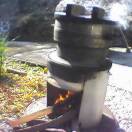
On the subject of Mochitsuki, which is the ceremony I was blessed to participate in, Wikipedia continues: "Polished glutinous rice is soaked overnight and cooked (eds note: see first picture in the series below: the rice is being steamed in a traditional mushiki here.) The rice is pounded with wooden mallets (kine) in a traditional mortar (usu). Two people will alternate the work, one pounding and the other turning and wetting the mochi. The mochi must be kept wet to keep it from sticking to the mallet. The sticky mass is then formed into various shapes (usually a sphere or cube)."
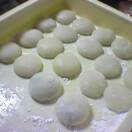
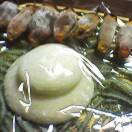
That's making mochi in a nutshell: a lot of steaming, a lot of pounding, and a lot of kneading into the desired usually moon-like shape. What you end up with a lump of soft, sticky, gooey, glutinous goodness. They taste somewhat bland perhaps, although you can spice them up coating them with various substances, or stuffing them with red bean paste or even ice cream (that last item is not particularly old school though!) In the photo block beneath you can see another variant being made -- grass mochi! Kusa mochi (Japanese: 草餅), also known as yomogi mochi, is a Japanese sweet, and despite the name is made not from grass but rather mugwort.
Yes sirree, the Japanese love cooking and eating these rice cakes at New Years Eve, although they are often eaten elsewhere in the year. Japanese also love presenting the mochi to the gods, to thank and honor them and to ensure good fortune in the following year. It is interesting that throughout human history, all over the world people have felt compelled to offer sacrifices to the Higher Beings, in order to win their appeasement and their approval. I was reading Homer's The Odyssey last year, and what impressed me the most, apart from the brutality of the climax, was how on almost every second page one of the heroes burnt up a pile of bovine thigh bones, or a rack of juicy steaks, to satisfy Zeus and his ilk. Now they don't practice animal sacrifice in Japan, but they do have plenty of reverence for the gods -- and there are literally millions of gods in this country. They don't sacrifice animals, but they do sacrifice food, which must have meant a big loss of resources back in the old days when there were a lot of hungry mouths to feed.
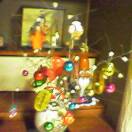
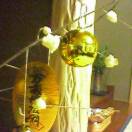
One thing I ought to point out right here is that New Years Day is celebrated in a completely different way in the East than it is in the West. In Japan/Korea/China/Vietnam New Years Eve/Day is kind of similar to the western idea of Christmas in that it is a day for family get-togethers, quiet reflection and acts of religious devotion, the consumption of vast quantities of food, dozing off in armchairs, getting up late and basically taking it easily. Ironically, Christmas Eve is the time to party in Japan, and many couples ask each other out on dates on this day; going to Kentucky Fried Chicken is especially popular. Go figure! So in other words, the Japanese New Year is our Christmas, and our New Year is their Christmas, in a manner of speaking! One of the things Japanese people do on New Years Day, apart from eating and drinking a lot of substances themselves, is that they make offering to the gods. At the home of my adopted family in Shikoku, they honor and partake in a particular tradition, which I call making mochi trees. Actually, it is only one tree they make, a small typically Japanese bonsai style fake tree, basically a stick skeleton hung with colorful shiny baubles and -- get this -- little pieces of mochi, rolled up to make what are called mochibana (rice cake flowers). The little stick tree is then propped up in front of the household altar, in the belief that the gods will come and eat the flour flowers, while the humans are off enjoying themselves devouring osechi ryori and sinking sake elsewhere in the house.
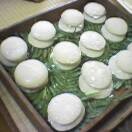
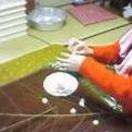
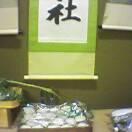
In the photo bar above, you can see mochibana being applied to the branches of the fake tree, by my girl C. In the photo bar beneath, you can see the mochi tree in all its colorful glory, before the household altar. The final photos display more substantial fare for the gods -- a full tray of shrinkwrapped rice cakes ready for Divine Degustation. There are also some dried kaki (persimmon) and a whole salted fish, if any spiritual beings take a fancy to that.
The idea of leaving fish and dried foods on an altar in your house for invisible beings to eat might seem strange to us westerners, but we do have some similar practices of our own. In a lot of countries people leave out glasses of warm milk (or cold beer, in Australia) for Santa Claus to drink on his annual visit, and there is a carrot in every house for the Easter Bunny. In some countries, children who have lost teeth put them in a glass of water beside their bed, and in the morning they are transformed into money! Perhaps Santa and the Easter Bunny and the Tooth Fairy are all we left of our pagan animist past. In Japan in the animist past lives on. In Japan animism never died.
Like many other things in Japan, mochi plays a spiritual role in life. Every village or town has its own special ways of using it in its religious rites and customs. In the small town of Aratano (Tokushima Prefecture) in Shikoku, for example, a festival is celebrated in the early New Year called Mochi Nage, or "Thrown Mochi". The idea behind Mochi Nage is disarmingly simple: people turn up at the local Shinto shrine, some shrine workers come out with bags of cooked (and I assume blessed) rice cakes, wrapped in plastic for hygiene, and proceed to hurl them at the assembled crowds. Little kids dash about, catching or picking up as many of the rice cakes as they can bundle into their arms. Old ladies push younger countrymen/women aside in the mad melee. Perhaps some fire works are discharged. At the Mochi Nage festival I attended at Aratano, I got pelted by a couple of the thrown cakes, which are actually quite hard and could easily "take an eye out", if you were hit the right way. I also managed to collect a big bag full of mochi, and this bag was eyed enviously by some of the local kids in attendance there. The gods were on my side; I managed to do a good job.
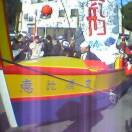
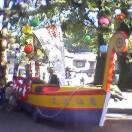
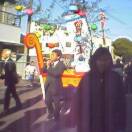
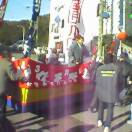
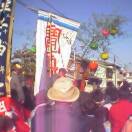
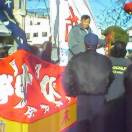
In the photo bar above, you can see photos from the Mochi Nage festivities at Aratano. In this town's version of Mochi Nage, a colorful boat-like vehicle (actually a converted car) is first rolled through the streets, attracting a crowd of eager scavengers. Like a Pied Piper, the car led us on to the local shrine where the proper rice cake chucking and catching sessions began -- and as I already mentioned, I ended up scooping up much of the venerable little goodies (attribute that to luck, or perhaps to favor of the mochi gods!)
Mochi Nage celebrations are also held to bless the construction of a new house, according to some reports I have read on the Internet. As Amy Chavez has reported: "Japan must be the only country where throwing food is not only acceptable but encouraged. Whole neighborhoods gather to throw food at each other in a tradition called Mochi Nage or, throwing rice cakes. No ceremony in Japan is complete without mochi, a symbol of happiness. In the old days, they probably threw only rice cakes, but these days they throw anything from packaged store-bought bread to bags of chips and instant ramen -- modern symbols of happiness..."
Whether we be human or animal or vegetable or god, all we want is the same thing in life: recognition for our existence and our efforts, and perhaps a bit of love and respect served on the top. That is what mochi encapsulates, and celebrates: the awareness that life is a ritual in which everyone must play their part, and in which every part is glorious. Witness the life cycle of this critter: pounded out of generous grains nurtured by the Four Elements, molded into moon shapes, then offered to the local deities, or tossed to little kids and grandmothers at the shrine... isn't this all just a celebration of the earth, a celebration of what the Earth can offer? We take from the earth and give back to it, and then it gives back to us, etc. The cycle keeps on repeating, endlessly. Creating abundance out of scarcity, rebirth out of decay, a New Year from the Old. The cycle never ends. The gods of Shikoku taught me all this, and more. In time, I might teach them a thing or two! In a couple of lifetimes or so.