Adsense Top Bar

Showing posts with label environment. Show all posts

Thursday, March 21, 2013

Floating Worlds

Sick of hanging round the house, I rose early and rode Busways #90 (ticket: AUS$4.60) over to Budgewoi, on the opposite side of the lake. The cops were arresting some dude at the interchange at Lake Haven while I was waiting for my bus... typical. There was a big mob of single mums and truant teens congregated round the commotion, rubbernecking, teeheeing, bumming cigarettes... standard. It seemed like it was going to be a warm day, which is usual in this part of the world, at this time of the year. Once the bus pulled up, however, it was all air-con chilled and comfy, if somewhat claustrophobic. Pushing through the scrum, I climbed the step, paid the driver, and took my favorite seat behind the midriff exit, the one fronted with its own perspex shield. Maybe it is because it is shielded that I like it so much, it seems to offer some protection against something, I don't know what. I pulled out my iPhone and was checking the news when I noticed my old Salvation Army mate Simon stepping up on to the transport, so I gestured him over to sit with me. He obliged me cheerfully, the bus took off, and we were on our way through the dewy, sun-sparkled, spider silk-strewn streets. A little bit later, on the approach to Toukley Bridge, my drinking partner Steve boarded, and took a seat in front of me. I am not sure if he recognized me or not, but I certainly recognized him. I am starting to build up a network of Negroes up here in the Wyong Shire, 18 months after moving here, I am getting to know the scene pretty well. People wave to me when I walk the streets, they beep their horns as they drive past me. It makes me think I have been here too long, and that it is probably time to roll the dice again, and jump to a new locale. Do another Quantum Leap, and materialize into a brand new life. I have still got a year to go before the jump, but the coordinates are already being plotted, the warpdrive readied for action! Soon I will be on my merry way, winging myself to a whole different city/country/civilization, and Australia will be just a memory (again.) Anyway, I had a bit of a chat to Simon before he got off, and told him some yarns from my time in Japan in exchange for a bit of his life story. He seems like a drifter to me, a natural nomad: originally from Leichhardt in Sydney, he now works at the supermarket at Lake Haven, and is looking for a decent place to live in the vicinity. He complained about all the hoops you need to jump through to make it with the landlords these days, the character references required by real estate agents, the proof that you have a job, etc. Listening to Simon talk, I felt my resentment rise. Why do they make it so hard for nomads like us? I wondered. What's up with all this Nanny State nonsense? It's discrimination, that's what it is! discrimination against those who don't fit the regular profile! Discrimination, in other words, against people like me. Simon bundled out once we hit Toukley to attend his interview with the real estate agents, and Steve disembarked shortly afterwards. I was all on my own in my fave seat as the bus lumbered on, through the backstreets of Norahville, taking me on a nostalgia trip of my early adulthood (I used to work at the newspaper here in 1994/95). Ahead of me, blonde-haired women were sharing tips on how to rort the Housing Department, while their blonde kids ran amok up and down the aisle. It is a very blond(e) blue-eyed part of the world here, and kind of a fascistic one... a welfare fascist state, if such a thing is possible. A whole lost tribe of Britons grown up feral among the gum trees and rainbow lorikeets, DNA bleached by the relentless sun. Flotsam and jetsam of a vanished Empire, washed up on to the Antipodean shore. Quite a few people up here are on the dole, myself included. Public transport in Australia seems reserved for folks like us. This is not Japan, where CEOs are humble enough to catch the train to work. Here in Oz humility is not a virtue anymore, and the CEOs probably get around town by helicopter. We turned on to Budgewoi Road and motored along past holiday homes, caravan parks, and even the odd golf course. Fibro shacks presently yielded on the right to a long, scrub-lined beach. This was Lakes Beach, in fact, and my mission for the day was to follow it homeward, back to Norah Head, where Wallarah Road would pick me up and carry me through Toukley to the Wallarah Bay Recreation Club. Where hopefully my Dad and a couple of beers were waiting! While in the area I also wanted to have a peek at Lake Munmorah, which the satellite pics claim is up here. I like to get a mental map of the geography, wherever I am living; I like to know my way around on foot, just in case I get lost and can't find my way back home.
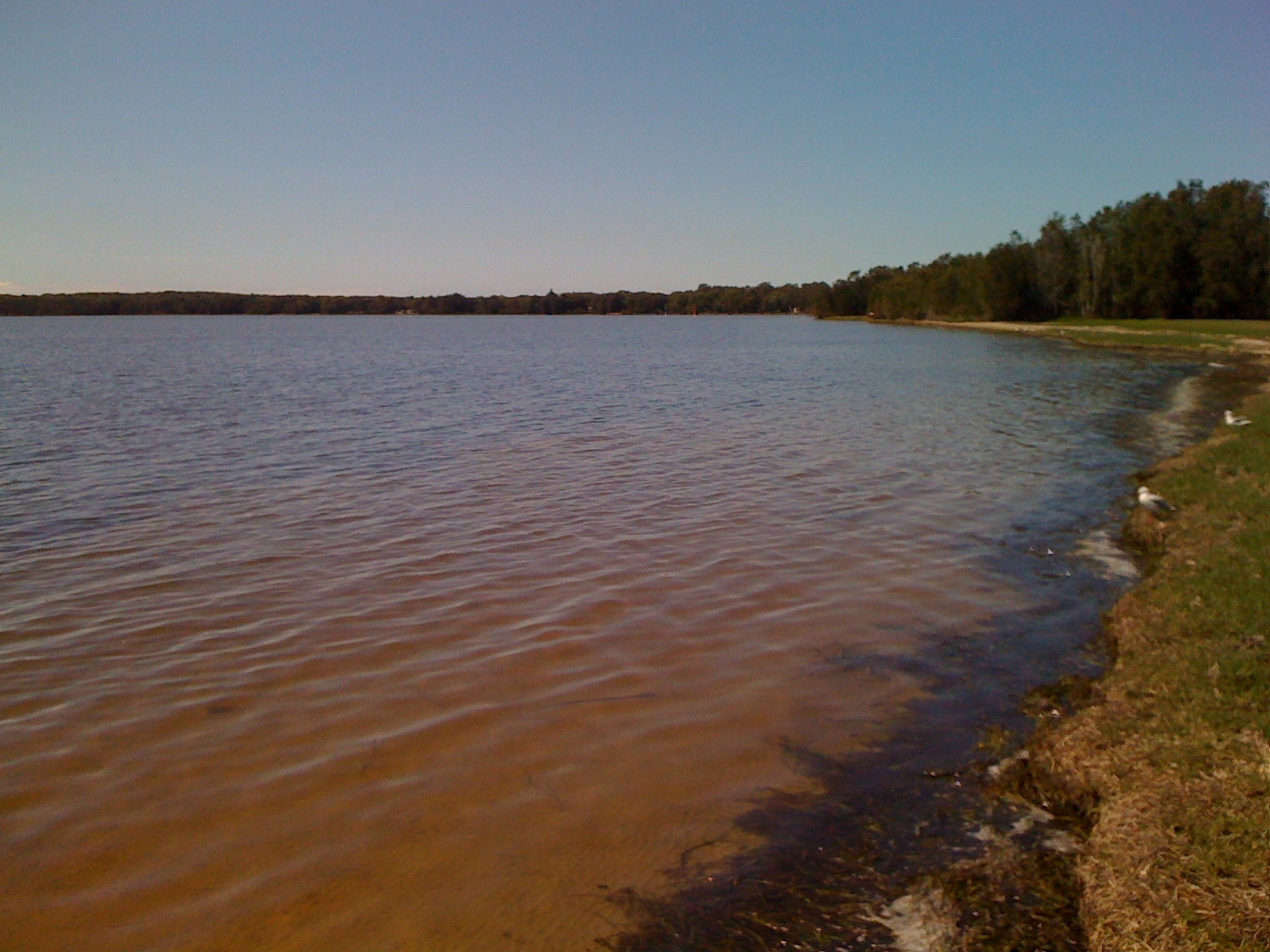

Lake Munmorah, viewed from Budgewoi.
Lake Munmorah, looking north and somewhat east, towards Newcastle (Australia, 2013)
The satellites were right... Lake Munmorah was up here, and I found it easily enough, near the sleepy retail heart of Budgewoi. The lake was smaller than I imagined, and its shores less developed than its companions up here, such as my mistress (Budgewoi Lake). Seaweed padded the bank like a rotting carpet, encasing within in it fallen tree trunks and pieces of driftwood washed up from God only knows where, the occasional strewn bottle of beer or crumpled aluminum can, packed full of mud. The coastal plain from Tuggerah to Newcastle is riddled with lakes like this one, perforated with them, and I have often wondered how they formed. My Mum reckons they all started as bays: the western foreshores of the lakes were once beaches on the open sea, augmented by headlands and river mouths, and all the other usual Australian coastal features. Over time the bays clogged up with run-off from the rivers, and sand bars surfaced offshore, eventually linking up to create shallow lagoons within their perimeter. Having colonized the sea, land was in turn colonized by life, and the sand bars were overlaid with spear grasses, shrubs, trees, possibly even a littoral rainforest or two. Animals moved in to consume the plants or those animals which fed on them: birds, marsupials, fruit bats, frogs. Invasions washed over the region like high tides on a sandy beach, like tsunami. Four waves of human conquest followed, the last of them the Anglo-Saxon wave, settlers lured by the promise of prawns and outdoor sports, cheap housing just a few hours from the suburban sprawl of Sydney. That's the whitefella history of this region, the local Darkinyung Aboriginal people doubtless have their own creation story. Since the whitefellas won, their version became history. And so it will remain, until the whitefella settlement is itself submerged, and thrown back to the bottom of the sea. I'd say it will happen sometime before 2200, courtesy of Global Warming! Thus we have been warned; thus we will be warmed.

From the lake it wasn't that far to Lakes Beach, through an arm of somnolent suburbia. I strode past Halekulani Bowling Club with its attendant courtesy buses, crossed the channel which connects Lake Munmorah and Budgewoi Lake. Budgewoi actually means "meeting of the two waters" in the local Aboriginal language, and I wouldn't be surprised if the name sprang from this very channel, the one I was lucky to cross today. I continued over the Central Coast Highway, its asphalt surface burning hot in the sun. Waves could be heard crashing reassuringly not too distant, and there was a soothing salt smell in the air. I looked forward to being able to walk along the beach, and feel warm, soft sand between my toes. But the ocean also provokes in me a fear which is close to primal, so I was a little apprehensive about getting close to it. When I walk along the coast it feels like I am literally on the edge of the Earth, and I worry about falling off. Kind of irrational, but that is how it feels. Perhaps it is a symptom of agoraphobia. 


Michael's Walk floats across this meadow, on the Budgewoi Beach Circuit (Australia, 2013)
One thing I noticed during a previous trek up here is how dramatically the vegetation changes the closer you get to the sea, plant leaves growing waxy, forests giving way to heaths and meadows where grevilleas flower in their sclerophyllus pods, and tiny blue wrens flit between the grasses, twitching like cicadas. Many people might think that the Australian landscape looks the same wherever you go but once you get to know it, and let go of your preconceptions, you will see that it actually comprises a cacophony of tiny habitats, each with their own inhabitants, noisy miners for the open spaces for example, more mysterious birds for the thicker bush. There are kingdoms built on top of kingdoms on top of kingdoms, realms on top of realms on top of realms. If you know how to read it, there is a story to be learnt here. In a burst of creativity Divinity beget the elemental realm from which emerged, from Sheer Nothing, the stars and planets, the galaxies and black holes, time and space itself. Stars burnt for billions of years, then burst into fiery supernovas, generating the heavy elements in their death throes. On rocky worlds orbiting second generation stars such as our own these elements aggregated, giving birth to the mineral kingdom, sandy beaches and mountains, volcanoes and tectonic plates, wide oceans shimmering beneath their local suns. Amazing enough, but greater glories were to come, on the planets lucky enough to be in the right place, with all the right conditions (the Goldilocks Zone): from the dexterity of carbon molecules began to order themselves, spontaneously, into life. Thus arose the vegetable kingdom, the animal kingdom, the fiefdom of the fungi... and finally the most audacious creation of all, the House of Humanity, Self-Awareness manifested directly into flesh...

As I traversed the sand drifts and scrub which bordered the ocean, I realized that the hot sun was making me thirsty. I looked out wistfully for a vending machine, but I knew I would never find one, not out here. I was on the edge of civilization, the interface of the cultivated world and the primeval nature from which it sprang. Even if there was a vending machine out here, it probably wouldn't work. This was not Japan, where green tea reprieves await you at every bend in the road, even way out in the wilds, near the summit of Mt Fuji. No, this was not Japan at all. I cut through the scrub, where volunteers had toiled to restore natural vegetation to the Pacific shore, and located some kind of path. The path (named Michael's Walk) led me to a boardwalk which floated over a patch of dry swamp. At the end of the boardwalk I found a sign describing the dune restoration project, dedicated lovingly to the memory of Julie Luff, a local resident and dunecarer. 


In memory of Julie Luff, a map of the Budgewoi Beach Circuit Walk (Australia, 2013)
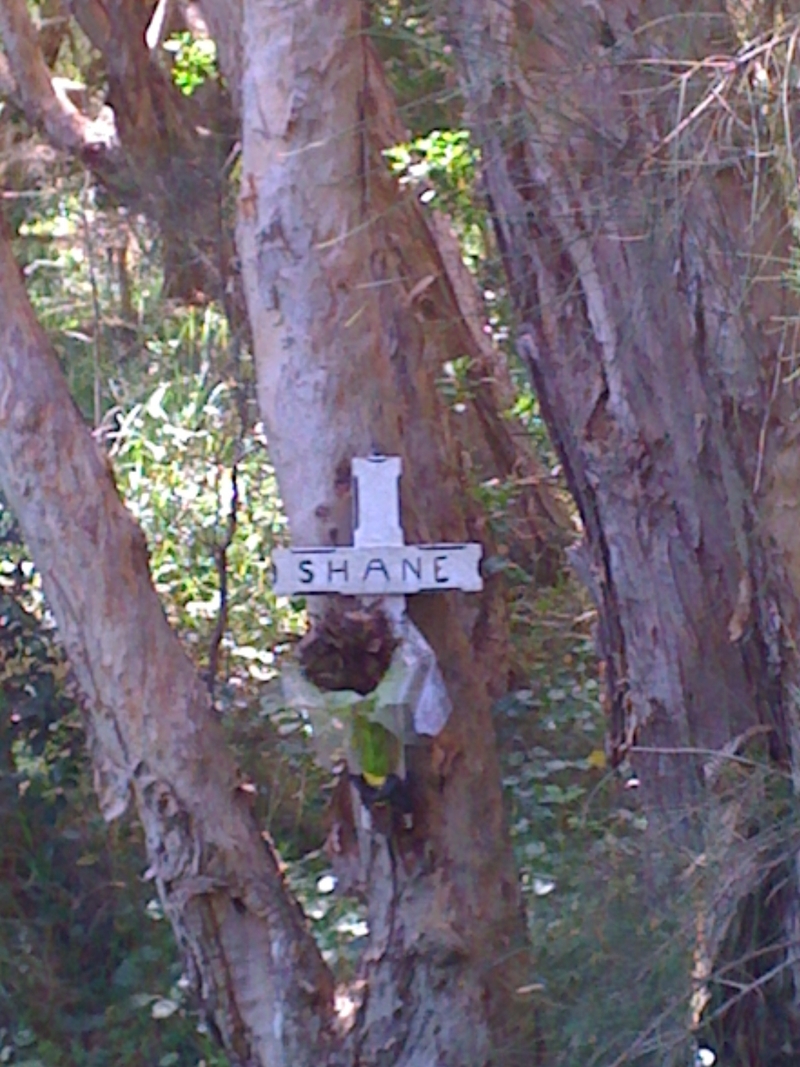
Just a few steps on, the ocean now in sight, I was stopped in my tracks by a crucifix hanging from a paperbark tree. The crucifix was emblazoned with the mysterious name, "Shane", and accompanied by a bouquet of wilted flowers. I stood mesmerized before this makeshift shrine for a moment or two, wondering who Shane was, and what had happened to him here. Was it an accident, suicide, or death by drowning? His spirit might well still be hanging around here, haunting this sun-scorched coast.

Michael's Walk, the dedication to Julie Luff, and now Shane's tree, I thought. It seems like every square inch of land here is named after someone!

Island off Lakes Beach on the NSW Central Coast, south of Newcastle, north of Sydney, on the Australian Coastal Walk!
Memorial to a guy named Shane (Australia, 2013)
Everyone tries to leave their stamp on things, something to signify that they had been here. Dogs piss on trees, and monarchs brand their heads on to their stamps and coins. Patting the bulge in my pocket as I made my way down to the beach, I pondered: Why are the coins so heavy in Australia, so clunky, so chunky? I would like living here more if the coins were more practical. A pedantic thought, perhaps, but I believe there is symbolism in everything, even especially in the currency, in the currency that a country chooses to use. What does the Australian 50 cent coin tell you about this country, anyway: that we are clumsy people, that we're ruled by a foreign Queen? The huge coins are like the huge pills the pharmacists expect you swallow... they are not user-friendly. Not like the pills or the coins in Japan.
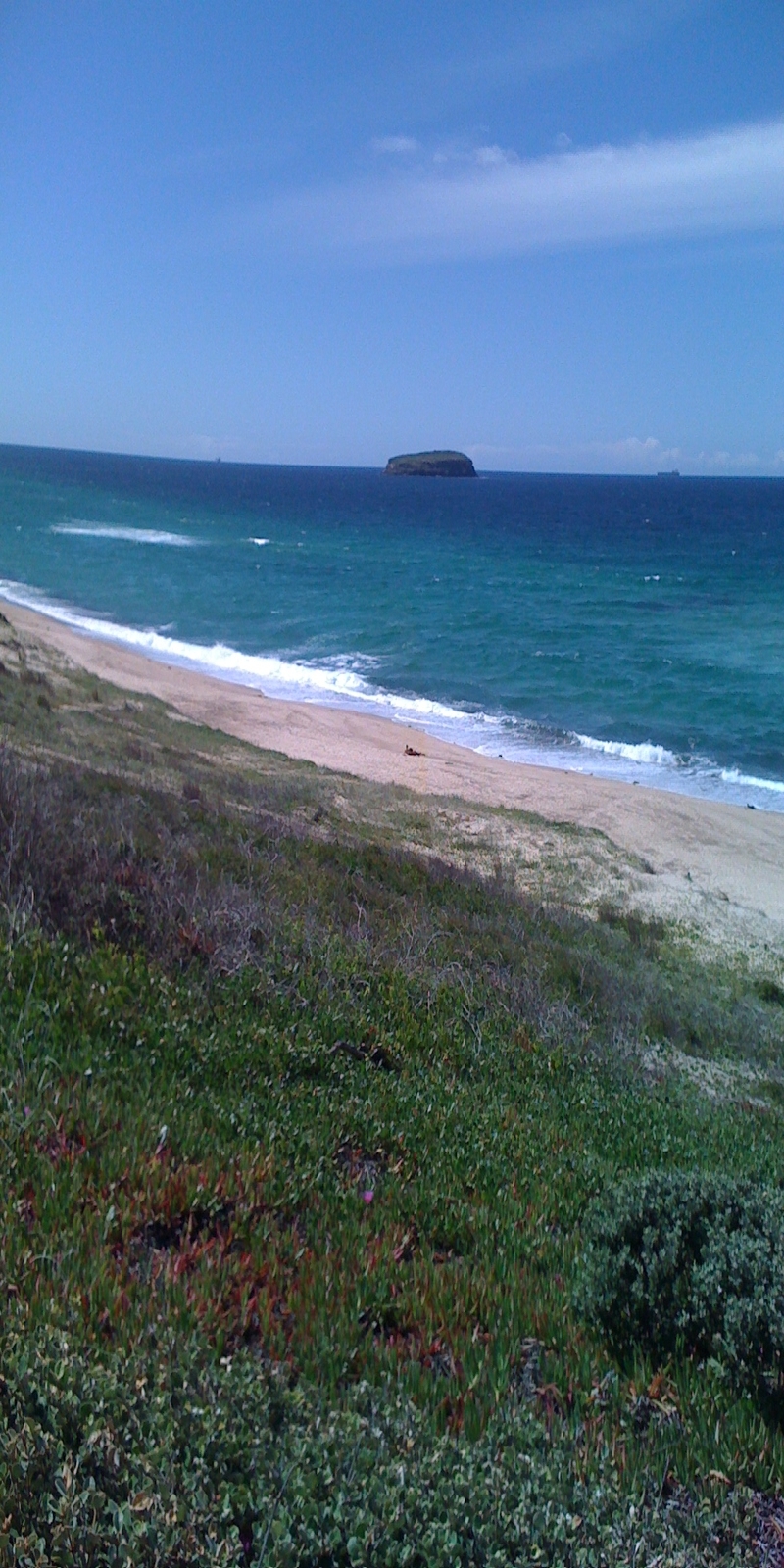

Island off Lakes Beach on the NSW Central Coast, south of Newcastle, north of Sydney, on the Australian Coastal Walk!
Bird Island, off the Lakes Beach, in Wyong Shire, NSW (Australia, 2013)
I took off my thongs and tumbled down to the beach, ready to commence my long walk to Norah Head. My eyes running along the shore, I tried to imagine what it would like flying over this coast in a passenger jet, headlands falling away beneath me, sandstone glinting in the sun, coal ships queued up on the approach to Newcastle, that great port to the near north. A jolt of electricity passed down my frame, adrenaline squirting up my arms, towards my hands. It was too much to think about, even to simulate it. My phobia was too strong. Mild despair gripped me, and a sinking feeling... when was I ever going to get off this rock? I remembered a month or so earlier, during an anxiety attack, I had been afraid to even look at the stars in the night sky, due to the overpowering sense of dread they engendered. To gaze upon the face of that naked immensity, that colossal emptiness, is truly a frightening thing... an entire Universe twinkling in the sky above, all those stars and floating worlds, stretching away remotely, but yet bearing their presence forcefully upon yours. That's the thing living in Australia, you see a lot of stars at night. You are dreadfully exposed. Beneath our feet, things are no less comforting. What really goes on down there, anyway? 
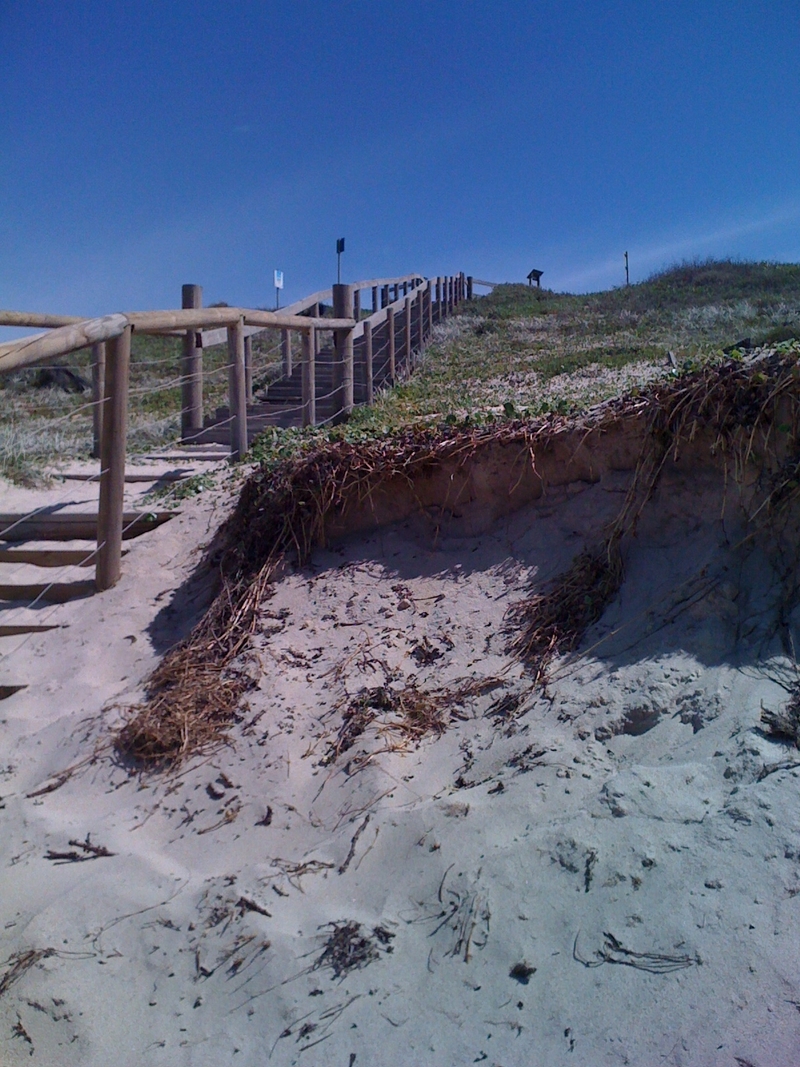


Down on the sand, past all the bidou weed, north of Sydney, on the Australian Coastal Walk!
Tumbling down the stairs on to the warm sands of Lakes Beach, near Budgewoi (Australia, 2013)
Sometimes these days it feels as if I am living in a floating world, cast adrift on a rising tide. The ground beneath my feet seems solid enough, but I know that the whole continent is riding like a raft on a magma sea, creeping north, irrepressibly. Above me the sky, that infernally cheerful blue sky... what could be more steadfast than that sky you might think, what could be more dependable? But like the ground, the blue sky is a deception, a lie... you could even call it a mirage. The sun is not yellow at all, it is white, and the blueness of the sky is merely an effect, caused by the scattering of the solar radiation through the atmosphere. As Einstein boldly proclaimed, we are all trapped in our own little bubbles of relativity only rarely encountering all the other floating bubbles out there, like ships passing in the night. Rare is the man or woman intuitive enough to notice when the bubbles bounce against each other in a momentary collision, soft film walls yielding ever so slightly. Rarer still is the man or woman who can pierce the film which separates our floating worlds in a resounding pop!, and dive through the mirror from one universe into another, merging with it, breathing underwater.

Tuesday, October 4, 2011

Cape York Birding: Day 1 (Gunning for the Golden-Shouldered Parrot)

Two months ago I flew to far-north Queensland with my father (pictured, directly below) to flee the southern winter and also spot some birds, which are his specialty and his big love in life. After hanging out in Cairns for a while we winged it further north up to Cape York, a vast peninsula riven by monsoonal rivers, saturated with tropical savannah, and timbered with millions of termite mounds, all of them artfully erected to avoid the blistering sun. Cape York teems, too, with birds: brolgas, jabirus, Papuan frogmouths are just some of the species to be found, palm cockatoos smart enough to use tools, and flocks of rainbow lorikeets so prodigious they literally blot out the whole sky. Of the 900 or so bird species that inhabit Australia, Dad and I identified more than 100 during the six days we spent up there, dodging the roadtrains, and crunching the corrugations. That was cool and all, but from the outset my father had his heart set on snaring two specimens which are rare, kind of endangered even: I'm speaking here of the red goshawk (Erythrotriorchis radiates), and the golden-shouldered parrot (Psephotus chrysopterygius). To hunt them we enlisted the aid of gregarious guide David (Chook) Crawford, of Close-Up Birding Adventures. Chook actually has a golden-shouldered parrot painted (second photo below) on his vehicle, and commands an encyclopaedic knowledge of the Cape. He knows its trails and creek beds like the lines of his hands, and he has plenty of entertaining yarns to tell (most of them custom-crafted for the campfire!) He is the original Crocodile Dundee, to be frank, and he did not disappoint us... he found us the parrots which were his emblem, and he found them fast enough (on the first day of our adventure to be precise!) That was the highlight of our Cape York birding expedition, day one: my father got his wish, well half of it; I meanwhile had the chance to explore a part of the world which is as exotic as it is isolated, and penetrate right up close to the northernmost tip of Australia. If we had gone just a little bit further, we would have reached New Guinea. Where, quite possibly, another Chook might have awaited us!


Dad watches brolgas fly over the Nifold Plain, on the Cape York peninsula (Australia, 2011)
Chook collected us early at the Bohemia Resort, which had become our base in Cairns. Despite my hangover I was excited to be getting out of town and traversing some fresh territory. Excited I was, but also apprehensive, as I have had enough panic attacks on the freeway in recent months to know that driving can be treacherous for me. We struck off across the verdant farmland north of Cairns, cutting through the canefields and lush country, heading for the nearby hills. I was seated in the back; my Dad, meanwhile, rode shotgun. I might not have known it at the time, but this was to be the first of many missions across the mountains, east to west, west to east, then east to west again, as the peninsula narrowed inexorably towards the tip. Chook confessed to being in something of a hurry, due to reports of bushfires in the vicinity of Musgrave Roadhouse, which was our beeline for the day. He wanted to get up there as fast as possible, in other words, in case the fire closed in. So, there wouldn't be much time for twitching on the way. We were immediately consoled with the promise of a healthy flock of golden-shouldered parrots flapping around in the bush near Musgrave. "He's up there right now," Chook said; "we'll find him." I wondered briefly why Chook had chosen to refer to the parrots as "he". They couldn't all possibly be males, could they? And even if they were, a flock of "he's" still constitutes a "they", surely?


Chook's Pajero, adorned with the endangered golden-shouldered parrot, sitting on a termite mound (Australia, 2011)

Ascending the Atherton Tableland towards Kuranda, Cairn's answer to Katoomba, I felt my anxiety climb... in direct proportion to our altitude. The reality of my plight had sunk in: this was to be a 1300km round trip all the way to the top of Australia and back, and the journey had only just begun. And there was no possible way I could pike out this late in the game! To take my mind off things I chatted to Chook, who turned out to be quite a captivating guy. He disclosed that he used to work as a guide at the nearby Mareeba Wetlands, then decided to start his own business chasing birds. He claimed that while birdwatching had something of a geeky reputation, he wanted to bring a bit of mystery and manliness into the equation, a bit of the Aussie larrikin spirit you might say. Glancing ahead at my Dad in his greygreen shorts and T-shirt and his goofy greygreen hat, I couldn't help but feel that the geeky birder stereotype might be here to stay, though, for a few more years at least. Best not to say so openly, I supposed... I might get shot down for blaspheming like that! So, I reclined in my seat, and tugged the handgrip by my shoulder, which for some reason soothed my spirits somewhat. Chook ploughed on, tearing up the Mulligan Highway through Kuranda to Mareeba (16°59′0″S, 145°25′0″E), where we paused to pick up some supplies and fuel. From the windows of the Pajero, Mareeba appeared to be a classic Outback Australian town, just pimped up with palms. While Chook filled the tank I wandered into the service station to buy a Coke or something like that, and maybe a bottle of water to hydrate myself. I would have loved to stay and have a look around, but that fire up north was moving in... there was no time to linger.


Just a quiet country street, in Mareeba (Australia, 2011)

So we rolled on, mauling Mt Molloy (population 273), Mt Carbine, Desailly, and finally landing on a prick on the map called Lakeland, where we halted for lunch. Somewhere along the way, my iPhone lost connectivity with the rest of the world, and the Internet died. I could no longer check my earnings from Google AdSense, or post updates to Twitter. I took plenty of photos though, of all the scenes that passed my window... most of them were blurred and rubbishy. My camera, nonetheless, was recording a more accurate depiction than my brain, which was clouded with fear, and subpanic: derealization flattened my senses and my perceptions, rendering the world two-dimensional, like a screen. You might call it tunnel vision. I clutched the handgrip besides me, and tried my best to relax. Thankfully, traffic was light: a few grey nomads in their campervans, 4WDs coated with red dust, and the occasional piece of mining kit being hauled up to Weipa. Chook explained that campervans would be useless once we hit the corrugations; from that point on it was 4WD territory, 4WDs and road trains only LOL. Pineapple and peanut farms surged past along with the telegraph poles, and miles and miles of open bush. The sky was a euphoric blue.


Pausing to take in the view, on Route 81 (Australia, 2011)
Beyond the Cooktown turnoff, the road mounted a ridge, and presently we were presented a spectacular view of the surrounding country (16°46′0″S, 144°88′0″E). This was something worth stopping for, so Chook pulled up, and we all got out...


Dad checking his watch, in his goofy greygreen birding hat (Australia, 2011)

... to join a small scrum of sightseers. It was evidently a popular vantagepoint, and every conceivable surface (road, railings, cliff-face) was covered with graffiti. We paused to take in the view, which was righteous, nonetheless.


Across the canyon, looking east (Australia, 2011)
I was surprised how hot it was outside, in contrast to the air-con comfort of Chook's Pajero. It was something like 30°C (86°F), and getting hotter all the time.


Mysterious tree with yellow flowers, possibly a kapok, alongside an aluminium can (Australia, 2011)

Curiosity satiated, we repaired to the car, to resume our ride. The road raced on, across stony, bone-dry territory. Chook pointed out various birds as we sped, quite a few of them raptors. He declared that you could tell how interesting a raptor was by the way it flew... those with upturned wings were the ones worth watching. When we arrived at Lakeland Roadhouse, I noticed some kind of bird of prey was circling the plains below. Its wings, disappointingly, were lowered. "Probably a whistling kite," Chook remarked.


Welcome to Lakeland Roadhouse (Australia, 2011)
We sauntered inside and ordered lunch. Chook recommended the house hamburger. I was about to discover that dining on the Cape revolves around hamburgers, steak and toasted cheese sandwiches (which they serve with cute little pickles here.) My burger was good, though; I gobbled it down, then paced around the roadhouse for a while, trying to keep my anxiety at bay. Something about being trapped in a restaurant ramps my blood pressure up: it might be the acoustics, the loud voices, all the cutlery clanging together? Chairs being dragged over tiled floors don't help one bit.


The sign says $2 for a shower at Lakeland Roadhouse (Australia, 2011)
I took a note how much it cost to use the bathroom. One day when I am traveling across Australia on my own this information might be useful, as raw data in an algorithm (or a comparison chart). The bathroom reminded me of a dream I had sometime, somewhere... was that the dream I was over there in the Congo, fleeing with the refugees down that rust-red jungle highway? Yes, that might have been the one.


There was a small gifts shop inside the roadhouse (Australia, 2011) 
I explored the small giftshop, with its local paraphernalia...


On to the dirt (Australia, 2011)
... and then, gratefully, it was time to bail. Leaving Lakeland, we abandoned the Mulligan Highway, and picked up the gauntlet offered us by the Peninsula Development Highway. More a rut than a road, the highway tailgated what remained of the former telegraph line, built in colonial times to connect Brisbane with its farflung northern domains. Like the colonial telegraph, the highway was decaying, disintegrating, and returning to the bush; before too long bitumen dropped away, to be replaced by rutted corrugations. Right about this moment I realized: this is the real Outback, right here, this is what it is all about! Termite mounds lifted themselves from the earth, the first of them short and scrappylooking, spaced far apart, but as time flew by they grew larger and more confident, some of them fashioned like the smashed chimneys left behind by country housefires, others like miniature Ulurus. Roadtrains, those apex predators of the Australian road, emerged from the woodwork, dragging their own dust storms in their wake. Chook withdrew to the side of the road whenever one passed, allowing it plenty of room. "The road's all yours, big boy," he would said, or words to that effect. And I would ask myself, again: Why does everything up here get called a "he"?


Road etiquette of the North: the small give way to the large (Australia, 2011)
As Chook disclosed, this was the road etiquette of Cape York: the small give way to the large. And there are none larger out here than the roadtrain, 100 tonnes of torment, 22 wheels of whiplash and whiteout. Chook implored us all to wind up our windows as it barrelled towards us. The Pajero rocked, side to side, as the shockwave hit, and then we were splattered with sand and soil. Looking around, I noticed that all the roadside trees and bushes were smeared red with this kind of abuse.


Throwing out the anchor, and battening down the hatches (Australia, 2011)
We were entering a strange world, a Gulliverian domain where everything was larger than life: bugs, men, trucks, even the farms which carved up the land here. The farms, actually cattle stations, were the size of European principalities, and most of them boasted airstrips. One of the principalities was called Artemis Station, and it was on this sprawling property that Chook had last sighted golden-shouldered parrots. We dropped in at the homestead to see if they were still around. The station owners did a lot of work helping the local parrot population, Chook informed us. They monitored their movements, and their numbers, and reported it all to the relevant authorities.


Arriving at Artemis Station (Australia, 2011)
Inside the house, I felt like I had stepped back in time, into the rustic décor of my wheat belt youth. The lady of the house put a cuppa on and we talked to the Boss about various topics, most pressingly the bushfire at Musgrave. It was moving in fast, our host confided... in fact, it seemed to be gunning straight for the roadhouse herself! Alarming stuff, but the Boss had a piece of good news, too, something that lifted our spirits: the birds were here, he divulged, and naturally we could visit them right away. Bullseye! I thought. This is how the west was won! But first there was a coffee or a cup of tea to drink, a coffee or a cold beverage, and a biscuit or two to chew upon. I stood up the whole time, fighting the urge to panic, wishing we could all just get on with it, and stampede out the door. Standing up always renders me restless, for whatever reason... it gives me vertigo, not just the fear of heights kind, but the crazy headspin version too. I suppose I could have just sat down on the nearest chair, but that might not have been polite. And it would not have been the knightly thing to do, in this land of He-Men, and He-Women...


Looking for golden-shouldered parrots, on Artemis Station (Australia, 2011)
Eventually we were back outside roughroading across rugged terrain, the Lady of the House in her vehicle, us bringing up the rear in the Pajero. The spirit of the chase had finally gripped me, and I was fondling a pair of binoculars excitedly, in expectation of an imminent glimpse. The Lady screeched to a halt, so suddenly we nearly rammed her. This was evidently a significant vantagepoint, so we all scurried out... to join about a dozen golden-shouldered parrots frolicking in a clearing. Yatta! I rejoiced, lifting my binoculars for a closer look. We've found the birds. Only problem was, my Dad couldn't see them, not unaided anyway. By the time we pointed them out to him, and his atrophied brain had registered the  headings and coordinates, processed all this information, and relayed appropriate instructions to his eyes and limbs, the birds were gone, a puff of brilliant feathers, a burst of green on green. For a moment it seemed this whole expedition would be in vain, like Burke and Wills' quest for the Gulf of Carpentaria... doomed by a lack of vision. I could sense Chook's frustration: you can lead a horse to water, but how do you make him drink? Some kind of elegant solution was called for. Thankfully, Chook provided one. Retreating to the Pajero momentarily, he returned with a tripod-mounted scope, fitted with a video camera display. Now all he had to do was focus on the parrots, and my Dad could stand behind him, enjoying a close-up view on the screen, without needing to make any fiddly moves. Up close and personal, that's the way Chook rolls. My Dad, suffice to say, was in twitcher heaven.


Remnant of the old telegraph line, at Musgrave Roadhouse (Australia, 2011)
The day was dragging on, and the westering sun had turned the bush a peculiar shade of burnt sienna. I was looking forward to getting a beer, and putting my feet up. Fortunately it wasn't that much further to Musgrave Station (14°46'50"S, 143°30'14"E), our deadline for the day. Located halfway between Cairns and Weipa, 570km south of The Top, Musgrave Station sits atop the aforementioned telegraph line, remnants of which are still visible, as are other interesting relics...


Posting box, beneath the rafters at Musgrave Station (Australia, 2011)
... such as the grave of Samuel Thomas, a pioneer and local identity, lying in a dusty corner of the carpark.


The grave of Samuel Thomas, killed in 1919 (Australia, 2011)
As late as the 1930s there were Aborigines running around in the bush, Chook admitted. Musgrave served as a fort as well as a telegraph relay station in the frontier war. Thomas was apparently a victim in one of the skirmishes. A victim or a perpetrator, it is always hard to tell.


Waiting for a beer, and then maybe a steak or hamburger (Australia, 2011)

Finally, after a long day rushing around, clutching my handgrip, biting my tongue, etc, I could crack open a cold VB, and kick back. Watch some Imparja TV at the downstairs bar, as a harvest moon rose in the clear night sky... who could ask for more than that? A hot shower, and then the chance to fall asleep in a cabin with the air-con on, while wallabies jumped around in the dark outside.


Shine on harvest moon (Australia, 2011)
Only problem was that bushfire closing in just over the airstrip. We could see it after nightfall, an ominous orange glow on the horizon. And if we survived that, another day of gunning around the bush awaited me. Because while Dad could cross the golden-shouldered parrot off his bucket list, there was still one significant critter left to go. Whether he would be able to see it unaided or no, that was the question.

Sunday, August 19, 2007

Islands in the Stream

There was a unique alignment of the planets yesterday presenting me a rare treat, and an entirely free Saturday with no classes to teach at either Ichinoe or Taito Ward. I had known already that Riki-kun and his mother would be on holiday in Okinawa (沖縄), so when I received an early phonecall from Kobayashi-sensei informing me that the lessons at Kidea were also cancelled, I felt pretty pleased. I fell back into my futon, savoring the opportunity to sleep in. An hour or two later, Nonomura-san called too, to say that her students were unable to study. I jumped out of bed, eager to seize the day (What should I do? what should I do?) Hang out with Maniac High, or explore my new 'hood, which I am slowly beginning to appreciate, and accept. I opted to go for a walk, and return to the river which had enchanted me a few weeks' previous, on my last totally all day off. Maniac High could wait, I reasoned. I needed time off, to get in touch with some of my older habits.

Edo River (江戸川) is one of the most storied waterways of the city, and it passes within half a kilometer from my apartment on its voyage to Tokyo Bay. It is the river which gives my ward its name, and its banks are pocked with baseball fields, baseball being of course the most popular sport in Japan. As it was a Saturday many of those fields were in use, young kids swinging their bats or fooling around on their bicycles, or driving remote controlled cars. I tramped past them all, following the floodplain (江戸川病院前野球場) roughly north, before ducking under the tracks of the Chuo-Sobu Line, to cross the Ichikawa Bridge into Chiba Prefecture. 
It was a long walk, and it allowed to me to contemplate all my recent adventures, moving house and my detention with Maniac High, the girl I had kissed in the whirlpool at Yomiuri Land after my release, my porn debut. I estimated that (based on current data) if I continued consorting with Maniac at the present rate, I might spontaneously kiss 20 girls over the next 5 years. How many kisses does it take to advance to the next breakthrough? I wondered, fingering my keitai's calculator. One could liken it to climbing a steep hill, each step becoming progressively more difficult, from mindsex to rapport, and then all the way to penetration. Or perhaps, the journey that spermatzoa take in their battle to fertilize the ova; a million souls might join in the challenge, but only one will hit their target, and achieve incarnation...

Traversing the Edogawa Riverbed Green Space, I noticed the Wayo Womens' University (和洋女子大学) ascending to the north-west. On my previous expedition on the river I had mistaken it for a shopping mall, and I imagined that I might find social stimulation there. Now it looked more like a Tuscan basilica. Whatever the case, there were no bitches to be seen in the vicinity of the school. I guess they were on holiday.


The Womens' University dropping behind me, as I ventured north (Japan, 2007)

Beyond the university the river, which until now had been bearing north-east, bent back to the west. Perhaps it was my imagination, but the landscape seemed to grow more rural too, more idyllic and abandoned. Houses and factories were thinning, with fields beginning to appear, many of them overgrown with weeds. Looking west through the summer haze, I could barely make out the skyscrapers of Shinjuku.


The towers of Shinjuku, visible to the west (Japan, 2007)

While I was getting tired, this contact with nature energized me... it amazed me to realize that such pastoral beauty could be found in walking distance of my apartment. 


Fishing in the Edo... in this island of nature in the city (Japan, 2007)

I came upon fields sprouting spring onions and other vegetables. Chiba is supposed to be the number one prefecture in Japan when it comes to spring onions, and they are a mainstay of Japanese cuisine.


Vegetable lots, in Chiba Prefecture (Japan, 2007)

Entering Matsudo City (松戸市) I encountered 
some kind of waterworks, an immense water treatment plant in fact, appearing to block my way. I swerved right, navigating a narrow path to a quaint village called Kuriyama, a short distance from the bank. I call Kuriyama a village because that is it appeared to me -- a lost village in the middle of the megalopolis. An island in the stream you might consider it, a pocket of Old Harmony that had been spared Virilio's mad urban rush, and his dromological doom.  Near the top of the hill there was a rustic temple, which is named Honkyuji (本久寺).


Honkyuji, in Matsudo (Japan, 2007)

Sometime later, Manic High sent me an MMS, inviting me to go see the fireworks with his family out at Setagaya. Much as I would have liked to chill at Shinozaki, watching The OC and Colombo on TV, I knew I was too young to retire so early. I found a train station at Konodai (国府台), on a line which I never knew existed, and began the laborious trip crosstown. I could sit down at least, and rest my aching legs. On a whim, I decided to rename Maniac "Dennis the Menace". It is what Meth calls him, and it has a nice ring to it. There is another Maniac High out there, and one day I might meet him.


Related Posts Plugin for WordPress, Blogger...