
Memoirs of a Nomadic Soul Clawing His Way, One Mile at a Time, Around the World!
Showing posts with label religion and spirituality. Show all posts
Showing posts with label religion and spirituality. Show all posts
Sunday, January 2, 2022
Rebellious Qi
I have read that in Traditional Chinese Medicine, panic attacks are blamed upon rebellious Qi, an uprising of that fundamental lifeforce also called "Chi" (or 氣) . This theory resonates with me as several occasions before my first attack, I suffered freak spells of dizziness and unsteadiness on my feet. One evening I was walking towards the Monolith in Shinjuku (新宿) when a sudden whoosh! of energy surged from my legs to my crown. A week or so later I had my first (official) attack, at the aforementioned tower. Whenever I moved my arm or turned my head, a powerful force would shudder through my body, with a reverberating din similar to the bionic sound effects in The Six Million Dollar Man. Time had slowed down, it felt, and every event was full of dread significance. As the attack progressed, I was startled to notice luminous sparks spraying up from the bottom of my visual field, like manic laser beams fired in an old arcade game... (For more on Qi rebellions and the herbs that can remedy them, click here.)

Saturday, December 14, 2019
Ded Moroz, and the Defecating Log: Christmas Around the World
SEASON'S GREETINGS!
One of the fascinating things about travelling and visiting new countries is learning about the colourful and unique festivals that exist out there. Now while I don't travel as much as I used to, I am able to explore the world vicariously, through my job on iTalki, and my online wanderings. It has become clear to me that Christmas is a global event, celebrated on every continent. The way it is celebrated differs starkly, however, depending on the locality. Not every country has a Santa Claus, and Santa doesn't always ride in a sleigh. In Spain the Three Wise Men deliver presents to children, which kind of makes sense, since they gifted gold, frankincense and myrrh to baby Jesus in the Bible. In Holland they have a Santa but he lives in Spain and sails to and from the Dutch homeland by boat. Go figure. Russian children send letters to Ded Moroz, a bearded old man who resides in Vologda near the North Pole, and whose name means "Father Frost". He walks with a long magic staff and sometimes rides a troika.
I believe there is a relationship between Christmas and New Year's Day in that they offer a glimmer of hope in the midst of winter. They both arrive just after the winter solstice, the most desperate time of all, but they promise that the light/sun/Son will return. It might be faint and distant, but the light is there and can be seen, twinkling through the hoary boles. The rebirth has begun... (To read my full account of how Christmas is celebrated around the world, click here.)
One of the fascinating things about travelling and visiting new countries is learning about the colourful and unique festivals that exist out there. Now while I don't travel as much as I used to, I am able to explore the world vicariously, through my job on iTalki, and my online wanderings. It has become clear to me that Christmas is a global event, celebrated on every continent. The way it is celebrated differs starkly, however, depending on the locality. Not every country has a Santa Claus, and Santa doesn't always ride in a sleigh. In Spain the Three Wise Men deliver presents to children, which kind of makes sense, since they gifted gold, frankincense and myrrh to baby Jesus in the Bible. In Holland they have a Santa but he lives in Spain and sails to and from the Dutch homeland by boat. Go figure. Russian children send letters to Ded Moroz, a bearded old man who resides in Vologda near the North Pole, and whose name means "Father Frost". He walks with a long magic staff and sometimes rides a troika.
 |
| The Christmas Shitter (El Caganer), and El Tio (Australia, 2019) |
I believe there is a relationship between Christmas and New Year's Day in that they offer a glimmer of hope in the midst of winter. They both arrive just after the winter solstice, the most desperate time of all, but they promise that the light/sun/Son will return. It might be faint and distant, but the light is there and can be seen, twinkling through the hoary boles. The rebirth has begun... (To read my full account of how Christmas is celebrated around the world, click here.)
Wednesday, October 30, 2019
Remember the One Who Left
I like music which reminds me of places that I have been, or places that I want to go. Listening to Drum&Bass I feel like I am back in London in a council flat, bass-bins throbbing, high hats crackling, the air heaving with hashish. Vietnamese love songs transport me to Mũi Né on a languid evening, waves crashing on a nearby beach, a radio crooning in a fisherman's hut. Vietnamese music always sounds so sad, it must be because they had a tragic history...
I love music's ability to rally our emotions, and take us on a journey. When I got out of my 16 days of detention in Japan, the only one who could really understand what I had been through was Jónsi Birgisson, the frontman of Icelandic quartet Sigur Rós. It didn't matter that I had never met him, it was obvious that he understood. It doesn't matter that his songs are mostly wordless, it is the emotion that counts. In fact, his music speaks of the realm beyond language which we inhabited before incarnation, andseparation... (To listen to my curated playlist of music from around the world, click here.)
I love music's ability to rally our emotions, and take us on a journey. When I got out of my 16 days of detention in Japan, the only one who could really understand what I had been through was Jónsi Birgisson, the frontman of Icelandic quartet Sigur Rós. It didn't matter that I had never met him, it was obvious that he understood. It doesn't matter that his songs are mostly wordless, it is the emotion that counts. In fact, his music speaks of the realm beyond language which we inhabited before incarnation, and
Thursday, March 21, 2013
Floating Worlds
Sick of hanging round the house, I rose early and rode Busways #90 (ticket: AUS$4.60) over to Budgewoi, on the opposite side of the lake. The cops were arresting some dude at the interchange at Lake Haven while I was waiting for my bus... typical. There was a big mob of single mums and truant teens congregated round the commotion, rubbernecking, teeheeing, bumming cigarettes... standard. It seemed like it was going to be a warm day, which is usual in this part of the world, at this time of the year. Once the bus pulled up, however, it was all air-con chilled and comfy, if somewhat claustrophobic. Pushing through the scrum, I climbed the step, paid the driver, and took my favorite seat behind the midriff exit, the one fronted with its own perspex shield. Maybe it is because it is shielded that I like it so much, it seems to offer some protection against something, I don't know what. I pulled out my iPhone and was checking the news when I noticed my old Salvation Army mate Simon stepping up on to the transport, so I gestured him over to sit with me. He obliged me cheerfully, the bus took off, and we were on our way through the dewy, sun-sparkled, spider silk-strewn streets. A little bit later, on the approach to Toukley Bridge, my drinking partner Steve boarded, and took a seat in front of me. I am not sure if he recognized me or not, but I certainly recognized him. I am starting to build up a network of Negroes up here in the Wyong Shire, 18 months after moving here, I am getting to know the scene pretty well. People wave to me when I walk the streets, they beep their horns as they drive past me. It makes me think I have been here too long, and that it is probably time to roll the dice again, and jump to a new locale. Do another Quantum Leap, and materialize into a brand new life. I have still got a year to go before the jump, but the coordinates are already being plotted, the warpdrive readied for action! Soon I will be on my merry way, winging myself to a whole different city/country/civilization, and Australia will be just a memory (again.) Anyway, I had a bit of a chat to Simon before he got off, and told him some yarns from my time in Japan in exchange for a bit of his life story. He seems like a drifter to me, a natural nomad: originally from Leichhardt in Sydney, he now works at the supermarket at Lake Haven, and is looking for a decent place to live in the vicinity. He complained about all the hoops you need to jump through to make it with the landlords these days, the character references required by real estate agents, the proof that you have a job, etc. Listening to Simon talk, I felt my resentment rise. Why do they make it so hard for nomads like us? I wondered. What's up with all this Nanny State nonsense? It's discrimination, that's what it is! discrimination against those who don't fit the regular profile! Discrimination, in other words, against people like me. Simon bundled out once we hit Toukley to attend his interview with the real estate agents, and Steve disembarked shortly afterwards. I was all on my own in my fave seat as the bus lumbered on, through the backstreets of Norahville, taking me on a nostalgia trip of my early adulthood (I used to work at the newspaper here in 1994/95). Ahead of me, blonde-haired women were sharing tips on how to rort the Housing Department, while their blonde kids ran amok up and down the aisle. It is a very blond(e) blue-eyed part of the world here, and kind of a fascistic one... a welfare fascist state, if such a thing is possible. A whole lost tribe of Britons grown up feral among the gum trees and rainbow lorikeets, DNA bleached by the relentless sun. Flotsam and jetsam of a vanished Empire, washed up on to the Antipodean shore. Quite a few people up here are on the dole, myself included. Public transport in Australia seems reserved for folks like us. This is not Japan, where CEOs are humble enough to catch the train to work. Here in Oz humility is not a virtue anymore, and the CEOs probably get around town by helicopter. We turned on to Budgewoi Road and motored along past holiday homes, caravan parks, and even the odd golf course. Fibro shacks presently yielded on the right to a long, scrub-lined beach. This was Lakes Beach, in fact, and my mission for the day was to follow it homeward, back to Norah Head, where Wallarah Road would pick me up and carry me through Toukley to the Wallarah Bay Recreation Club. Where hopefully my Dad and a couple of beers were waiting! While in the area I also wanted to have a peek at Lake Munmorah, which the satellite pics claim is up here. I like to get a mental map of the geography, wherever I am living; I like to know my way around on foot, just in case I get lost and can't find my way back home.
The satellites were right... Lake Munmorah was up here, and I found it easily enough, near the sleepy retail heart of Budgewoi. The lake was smaller than I imagined, and its shores less developed than its companions up here, such as my mistress (Budgewoi Lake). Seaweed padded the bank like a rotting carpet, encasing within in it fallen tree trunks and pieces of driftwood washed up from God only knows where, the occasional strewn bottle of beer or crumpled aluminum can, packed full of mud. The coastal plain from Tuggerah to Newcastle is riddled with lakes like this one, perforated with them, and I have often wondered how they formed. My Mum reckons they all started as bays: the western foreshores of the lakes were once beaches on the open sea, augmented by headlands and river mouths, and all the other usual Australian coastal features. Over time the bays clogged up with run-off from the rivers, and sand bars surfaced offshore, eventually linking up to create shallow lagoons within their perimeter. Having colonized the sea, land was in turn colonized by life, and the sand bars were overlaid with spear grasses, shrubs, trees, possibly even a littoral rainforest or two. Animals moved in to consume the plants or those animals which fed on them: birds, marsupials, fruit bats, frogs. Invasions washed over the region like high tides on a sandy beach, like tsunami. Four waves of human conquest followed, the last of them the Anglo-Saxon wave, settlers lured by the promise of prawns and outdoor sports, cheap housing just a few hours from the suburban sprawl of Sydney. That's the whitefella history of this region, the local Darkinyung Aboriginal people doubtless have their own creation story. Since the whitefellas won, their version became history. And so it will remain, until the whitefella settlement is itself submerged, and thrown back to the bottom of the sea. I'd say it will happen sometime before 2200, courtesy of Global Warming! Thus we have been warned; thus we will be warmed.
From the lake it wasn't that far to Lakes Beach, through an arm of somnolent suburbia. I strode past Halekulani Bowling Club with its attendant courtesy buses, crossed the channel which connects Lake Munmorah and Budgewoi Lake. Budgewoi actually means "meeting of the two waters" in the local Aboriginal language, and I wouldn't be surprised if the name sprang from this very channel, the one I was lucky to cross today. I continued over the Central Coast Highway, its asphalt surface burning hot in the sun. Waves could be heard crashing reassuringly not too distant, and there was a soothing salt smell in the air. I looked forward to being able to walk along the beach, and feel warm, soft sand between my toes. But the ocean also provokes in me a fear which is close to primal, so I was a little apprehensive about getting close to it. When I walk along the coast it feels like I am literally on the edge of the Earth, and I worry about falling off. Kind of irrational, but that is how it feels. Perhaps it is a symptom of agoraphobia.
One thing I noticed during a previous trek up here is how dramatically the vegetation changes the closer you get to the sea, plant leaves growing waxy, forests giving way to heaths and meadows where grevilleas flower in their sclerophyllus pods, and tiny blue wrens flit between the grasses, twitching like cicadas. Many people might think that the Australian landscape looks the same wherever you go but once you get to know it, and let go of your preconceptions, you will see that it actually comprises a cacophony of tiny habitats, each with their own inhabitants, noisy miners for the open spaces for example, more mysterious birds for the thicker bush. There are kingdoms built on top of kingdoms on top of kingdoms, realms on top of realms on top of realms. If you know how to read it, there is a story to be learnt here. In a burst of creativity Divinity beget the elemental realm from which emerged, from Sheer Nothing, the stars and planets, the galaxies and black holes, time and space itself. Stars burnt for billions of years, then burst into fiery supernovas, generating the heavy elements in their death throes. On rocky worlds orbiting second generation stars such as our own these elements aggregated, giving birth to the mineral kingdom, sandy beaches and mountains, volcanoes and tectonic plates, wide oceans shimmering beneath their local suns. Amazing enough, but greater glories were to come, on the planets lucky enough to be in the right place, with all the right conditions (the Goldilocks Zone): from the dexterity of carbon molecules began to order themselves, spontaneously, into life. Thus arose the vegetable kingdom, the animal kingdom, the fiefdom of the fungi... and finally the most audacious creation of all, the House of Humanity, Self-Awareness manifested directly into flesh...
As I traversed the sand drifts and scrub which bordered the ocean, I realized that the hot sun was making me thirsty. I looked out wistfully for a vending machine, but I knew I would never find one, not out here. I was on the edge of civilization, the interface of the cultivated world and the primeval nature from which it sprang. Even if there was a vending machine out here, it probably wouldn't work. This was not Japan, where green tea reprieves await you at every bend in the road, even way out in the wilds, near the summit of Mt Fuji. No, this was not Japan at all. I cut through the scrub, where volunteers had toiled to restore natural vegetation to the Pacific shore, and located some kind of path. The path (named Michael's Walk) led me to a boardwalk which floated over a patch of dry swamp. At the end of the boardwalk I found a sign describing the dune restoration project, dedicated lovingly to the memory of Julie Luff, a local resident and dunecarer.
Just a few steps on, the ocean now in sight, I was stopped in my tracks by a crucifix hanging from a paperbark tree. The crucifix was emblazoned with the mysterious name, "Shane", and accompanied by a bouquet of wilted flowers. I stood mesmerized before this makeshift shrine for a moment or two, wondering who Shane was, and what had happened to him here. Was it an accident, suicide, or death by drowning? His spirit might well still be hanging around here, haunting this sun-scorched coast.
Michael's Walk, the dedication to Julie Luff, and now Shane's tree, I thought. It seems like every square inch of land here is named after someone!
Everyone tries to leave their stamp on things, something to signify that they had been here. Dogs piss on trees, and monarchs brand their heads on to their stamps and coins. Patting the bulge in my pocket as I made my way down to the beach, I pondered: Why are the coins so heavy in Australia, so clunky, so chunky? I would like living here more if the coins were more practical. A pedantic thought, perhaps, but I believe there is symbolism in everything, even especially in the currency, in the currency that a country chooses to use. What does the Australian 50 cent coin tell you about this country, anyway: that we are clumsy people, that we're ruled by a foreign Queen? The huge coins are like the huge pills the pharmacists expect you swallow... they are not user-friendly. Not like the pills or the coins in Japan.
I took off my thongs and tumbled down to the beach, ready to commence my long walk to Norah Head. My eyes running along the shore, I tried to imagine what it would like flying over this coast in a passenger jet, headlands falling away beneath me, sandstone glinting in the sun, coal ships queued up on the approach to Newcastle, that great port to the near north. A jolt of electricity passed down my frame, adrenaline squirting up my arms, towards my hands. It was too much to think about, even to simulate it. My phobia was too strong. Mild despair gripped me, and a sinking feeling... when was I ever going to get off this rock? I remembered a month or so earlier, during an anxiety attack, I had been afraid to even look at the stars in the night sky, due to the overpowering sense of dread they engendered. To gaze upon the face of that naked immensity, that colossal emptiness, is truly a frightening thing... an entire Universe twinkling in the sky above, all those stars and floating worlds, stretching away remotely, but yet bearing their presence forcefully upon yours. That's the thing living in Australia, you see a lot of stars at night. You are dreadfully exposed. Beneath our feet, things are no less comforting. What really goes on down there, anyway?
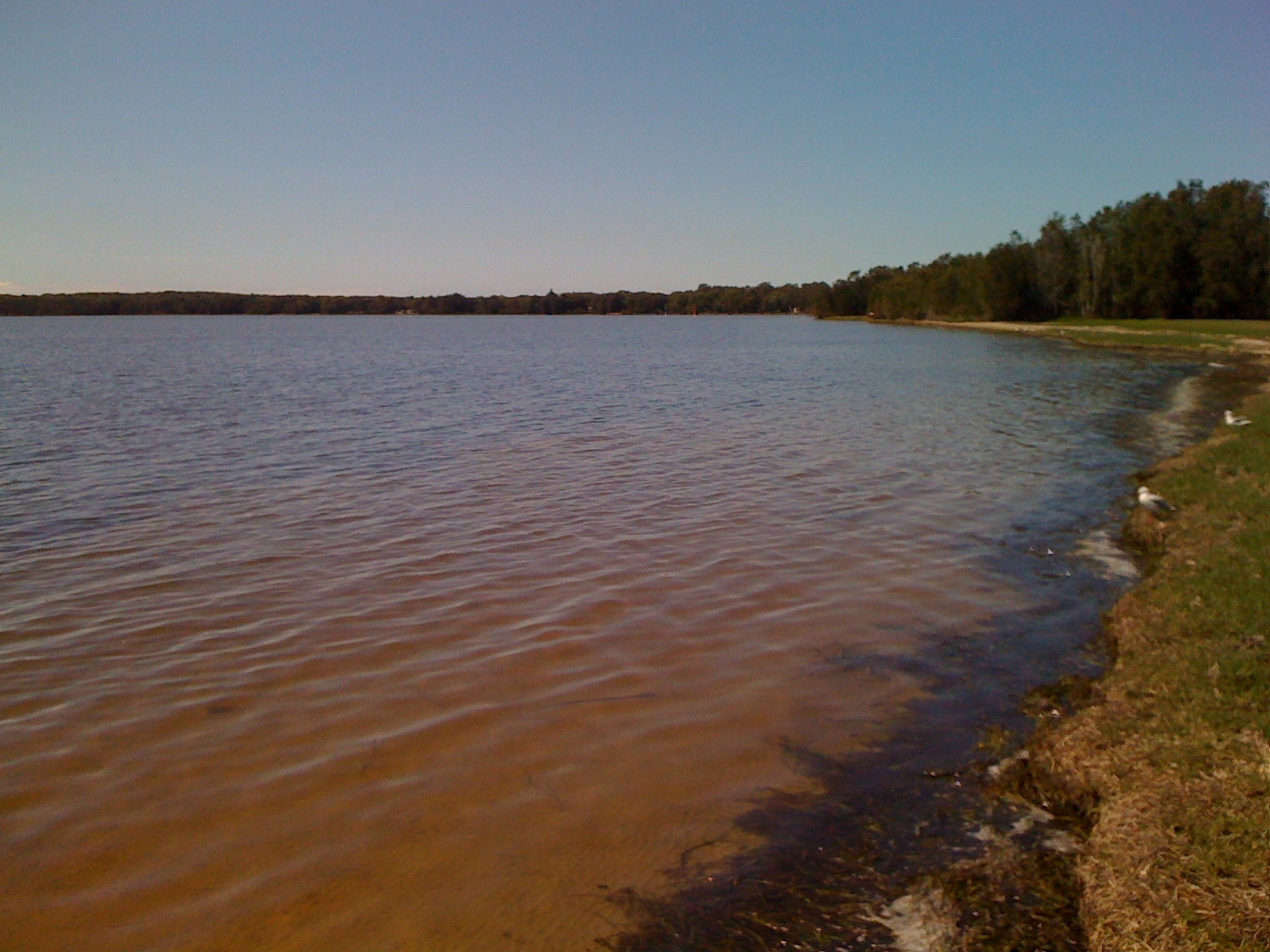 |
| Lake Munmorah, looking north and somewhat east, towards Newcastle (Australia, 2013) |
From the lake it wasn't that far to Lakes Beach, through an arm of somnolent suburbia. I strode past Halekulani Bowling Club with its attendant courtesy buses, crossed the channel which connects Lake Munmorah and Budgewoi Lake. Budgewoi actually means "meeting of the two waters" in the local Aboriginal language, and I wouldn't be surprised if the name sprang from this very channel, the one I was lucky to cross today. I continued over the Central Coast Highway, its asphalt surface burning hot in the sun. Waves could be heard crashing reassuringly not too distant, and there was a soothing salt smell in the air. I looked forward to being able to walk along the beach, and feel warm, soft sand between my toes. But the ocean also provokes in me a fear which is close to primal, so I was a little apprehensive about getting close to it. When I walk along the coast it feels like I am literally on the edge of the Earth, and I worry about falling off. Kind of irrational, but that is how it feels. Perhaps it is a symptom of agoraphobia.
 |
| Michael's Walk floats across this meadow, on the Budgewoi Beach Circuit (Australia, 2013) |
As I traversed the sand drifts and scrub which bordered the ocean, I realized that the hot sun was making me thirsty. I looked out wistfully for a vending machine, but I knew I would never find one, not out here. I was on the edge of civilization, the interface of the cultivated world and the primeval nature from which it sprang. Even if there was a vending machine out here, it probably wouldn't work. This was not Japan, where green tea reprieves await you at every bend in the road, even way out in the wilds, near the summit of Mt Fuji. No, this was not Japan at all. I cut through the scrub, where volunteers had toiled to restore natural vegetation to the Pacific shore, and located some kind of path. The path (named Michael's Walk) led me to a boardwalk which floated over a patch of dry swamp. At the end of the boardwalk I found a sign describing the dune restoration project, dedicated lovingly to the memory of Julie Luff, a local resident and dunecarer.
 |
| In memory of Julie Luff, a map of the Budgewoi Beach Circuit Walk (Australia, 2013) |
Michael's Walk, the dedication to Julie Luff, and now Shane's tree, I thought. It seems like every square inch of land here is named after someone!
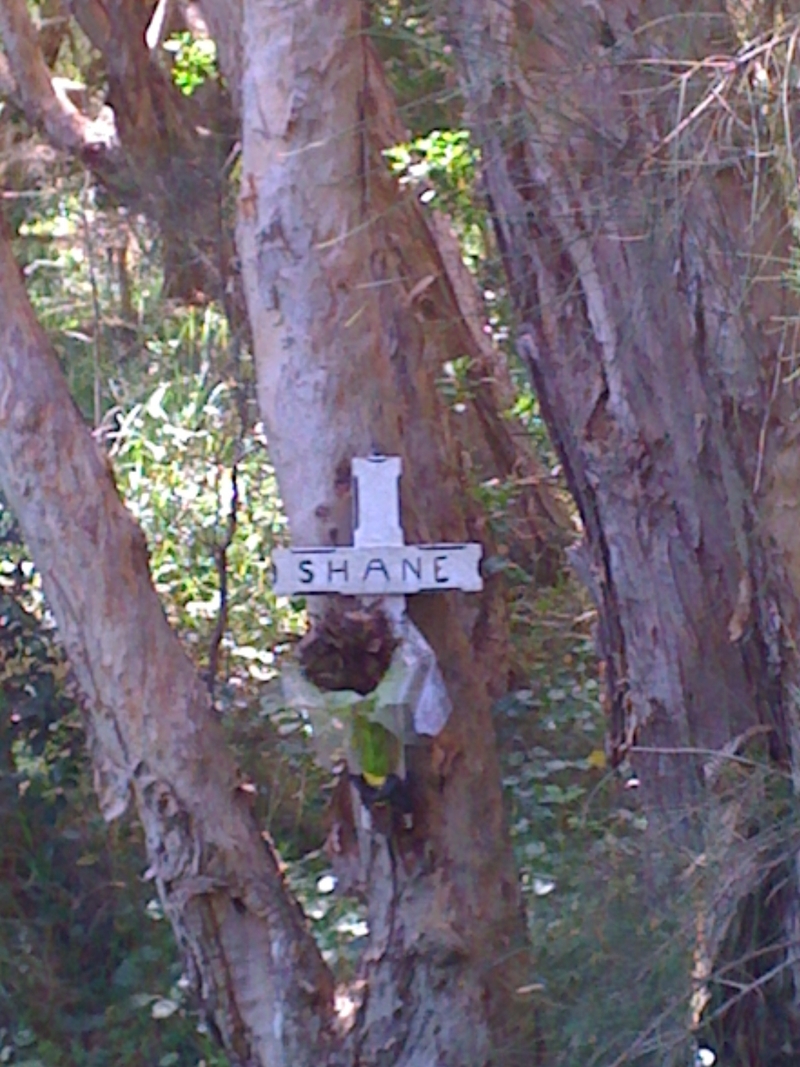 |
| Memorial to a guy named Shane (Australia, 2013) |
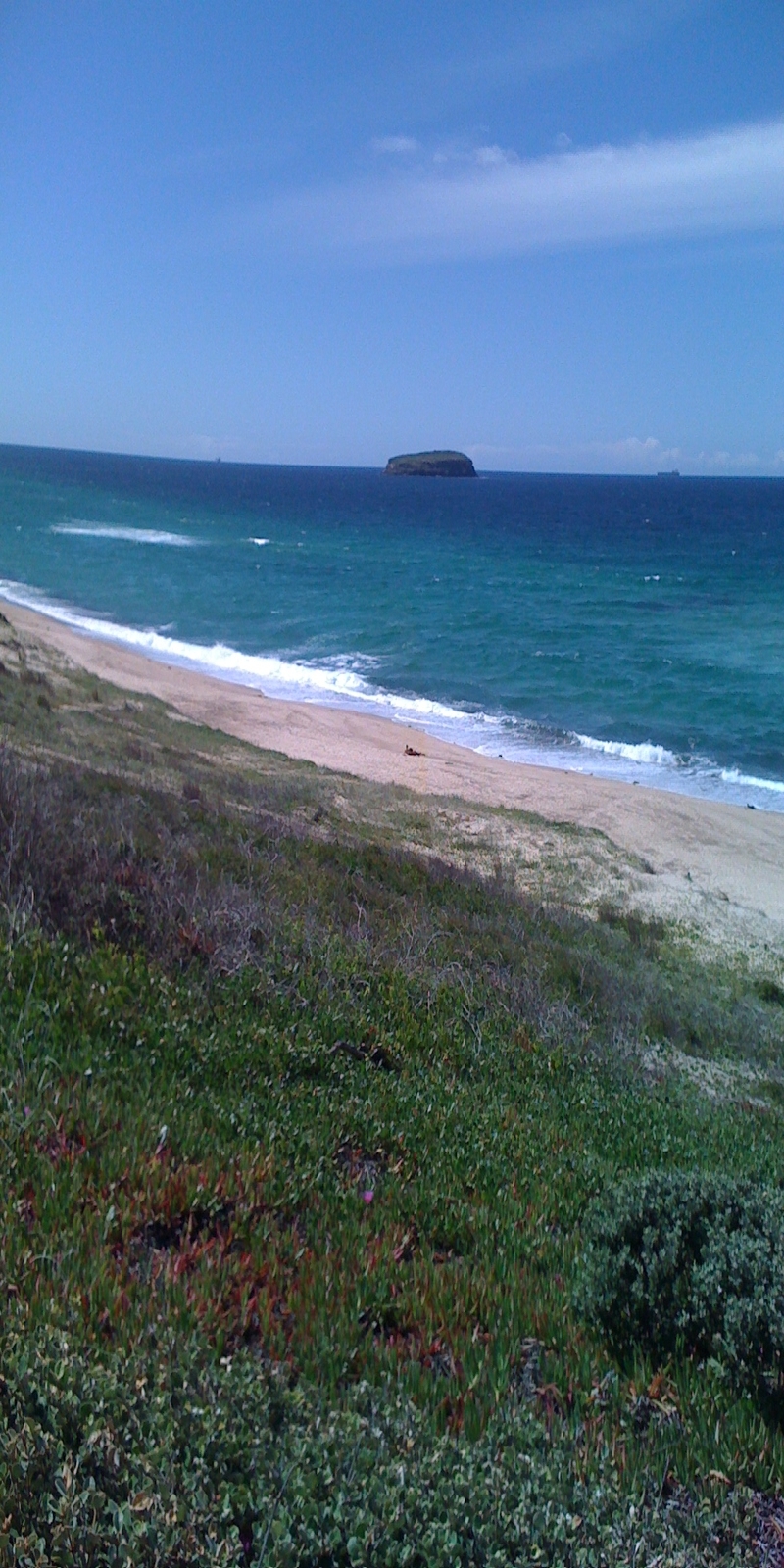 |
| Bird Island, off the Lakes Beach, in Wyong Shire, NSW (Australia, 2013) |
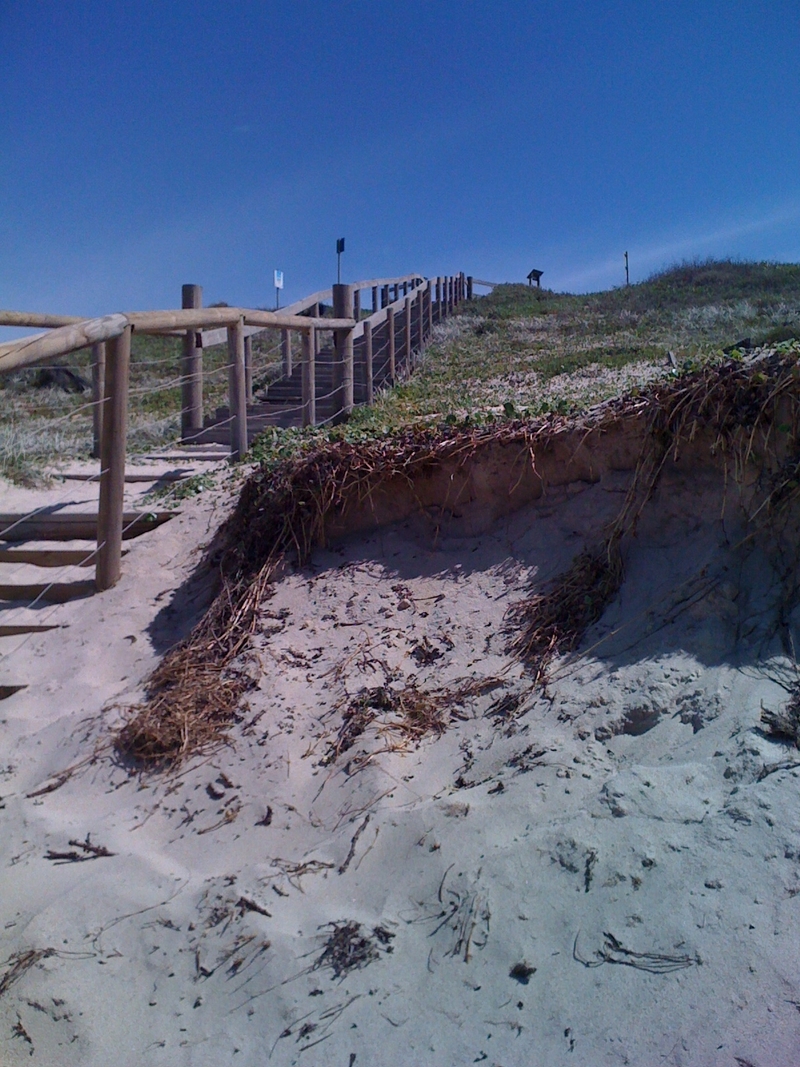 |
| Tumbling down the stairs on to the warm sands of Lakes Beach, near Budgewoi (Australia, 2013) |
Sometimes these days it feels as if I am living in a floating world, cast adrift on a rising tide. The ground beneath my feet seems solid enough, but I know that the whole continent is riding like a raft on a magma sea, creeping north, irrepressibly. Above me the sky, that infernally cheerful blue sky... what could be more steadfast than that sky you might think, what could be more dependable? But like the ground, the blue sky is a deception, a lie... you could even call it a mirage. The sun is not yellow at all, it is white, and the blueness of the sky is merely an effect, caused by the scattering of the solar radiation through the atmosphere. As Einstein boldly proclaimed, we are all trapped in our own little bubbles of relativity only rarely encountering all the other floating bubbles out there, like ships passing in the night. Rare is the man or woman intuitive enough to notice when the bubbles bounce against each other in a momentary collision, soft film walls yielding ever so slightly. Rarer still is the man or woman who can pierce the film which separates our floating worlds in a resounding pop!, and dive through the mirror from one universe into another, merging with it, breathing underwater.
Friday, March 25, 2011
An Accident Waiting to Happen, in Cairns (Part 1)
Isn't it strange how many of the great discoveries were made by accident? Penicillin was first isolated by scientist Alexander Fleming who, returning from holiday, noticed that fungus growing feral on petri dishes in his lab killed any bacteria they came into contact with. Naddoðr, legendary Viking king, was sailing home to the Faroe Islands when he lost his bearings and got barreled on to the eastern coast of Iceland, which was then uninhabited, and unexplored. Christopher Columbus found America on the way to China and in doing so, confounded the prevailing wisdom of his age. It was totally an accident that I discovered Cairns last week, fleeing as I was the triple tragedy in Japan, or more precisely my persistent panic attacks, which have pestered me like a plague for more than two years now, plagued me like a pestilence, and promise me plenty of fresh pain in the foreseeable future. Cairns is not the kind of place I would have chosen to travel to otherwise, but destiny drove me there... destiny and the deadly Tohoku Earthquake and tsunami, which dislodged me from my Japanese home of a decade, shook me from my sloth and my slumber, and sent me packing with nothing save my suitcase and the shoes on my feet. Like all Australians I knew Cairns, I understood it was a resort on the Barrier Reef, realized that it was touristy in nature, and during my many years in Japan I had also learnt that it was popular with Japanese visitors. Not surprisingly, then, the place had never really appealed to me. It didn't feel edgy enough, or so I thought, it didn't seem exotic. It sounded, basically, the kind of place bogans went for their holidays, and I would much rather embark for Bangkok, or Berlin, or even Bali, ffs!) A few days after the great quake of March 11, with relentless aftershocks rattling my apartment in eastern Tokyo, and radiation bleeding from the breached reactors up on the beach at Fukushima (福島), I saluted Japan with a sad sayonara, and then scrambled out the door. Changed the departure date on my Jetstar Airlines ticket, informed my boss it was over, and scurried out the fucking door. Of all three actions, giving notice to my boss was actually the most awkward, which speaks sagas of the sway he had hitherto held over me. For a long time, it seemed that I would be his bitch forever, a servant in the outhouse, the kouhai to his Koresh. It just shows that when the chips are down, when your life is actually at stake, self-preservation will always victor over subservience, and submissiveness (and don't fall for their piety, even the most devout religious types secretly fear their deaths!) Stockholm Syndrome be damned... I wasn't going to die from caesium contamination! Like the earthquake itself, the break with my boss was an inevitability that was long overdue, but something which neither of us had had the heart to hasten. Fittingly, it had to be forced upon us, by fate. According to my new Jetstar booking, I was supposed to stay in Cairns for a few hours on Sunday morning, just long enough to change planes, and possibly crunch on a croissant. But then destiny intervened, once again, this time more benignly. I missed my connecting flight, and was thus free to enjoy a full day strolling the streets and shores of this captivating tropical city, the capital of the cane fields, gateway to Cape York. This is the story of how that happened, and what I discovered there. In the meantime, let's wind the clock back a few days, to that crazy and chaotic aftermath of 3/11, when I honestly feared that my life was about to end, crushed by collapsing masonry, or felled by fallout. This is the story of how I became a nuclear refugee, and how the Moving House project met its indignant demise, dumped out on the pavement with the rest of the trash. Quite a few narratives met their demise on the same day, in fact, all of them indignantly. Let's give thanks to them, now, while we can, all of them one by one! They all deserve to be honored such, after what they have given me.
On Wednesday morning last week (March 16) my boss rang me and told me not to bother reporting to work for the next week or so, as the school would be closed on account of the radiation. When I pressed him further on exactly how long this recess would last, he conceded it could indeed be more than a week... possibly two weeks, a month, who knew? Until the crisis was over, in other words (not there was a crisis of course, and not that he used so many words (typical Japanese doublespeak in action!)) Parents were too scared to send their kids to class (he didn't say that, but that's what I inferred.) Everyone was hunkering down, as if under siege (that was his unspoken gist.) "Don't go outside, ne," he added (meaning: deadly particles might be wafting down from the reactors.) "By all means, chant to the gohonzon on your own. But we don't do gongyou today." Hanging up the phone, I reclined on my futon, imagining a whole free week ahead of me... no, not a week, possibly even a month, a whole month free of work, a month cleared of chanting, and possibly even purged of panic too! I thought to myself: Is this not yet more proof that the Third Free Month has arrived at last, in these dying days of my life in Japan? With every day, my life is becoming more free... freedom is breaking out all over the map! Maybe I could celebrate this change in fortune, I figured, by taking a nap? Because God knows, I needed one! So I sprawled out on the mattress, inserted my earplugs, and attempted to sleep. Try as I might to suppress them, however, thoughts kept arising in my mind, unsettling thoughts: what exactly was going on up there at Fukushima, and why were people so concerned? ... what if there was a powerful aftershock while I was asleep? would I have time to save myself? ... how am I going to survive without a job, especially now that I have retired from Telephone English, and am already living off my credit card? They were, in fact, much the same thoughts which had thwarted my efforts to sleep and eat a decent meal since the great quake struck, five days previously. Unlike my panic phobias, the fears that motivated these thoughts were real, and demanded respect: from time to time an actual aftershock did arrive, a seismic jolt shifting my bookcase on its foundations, and jiggling my windchime judiciously. One of the reactors up at Fukushima had indeed blown up, and I had watched it happen on CNN, and NHK (and all the other networks). I would now be completely unemployed, with no income save Google Adsense, and Chitika. That was reality, not hyperbole. My life seemed to be crumbling around me. On top of that, I couldn't even go out for a walk!
Sleep was out of the question, so I sat up, and dug out the letter I had started writing to N. earlier in the week. Sleep deprivation had rendered me emotional, and I rapidly scribbled out a page or two about how much I missed her, how this entanglement had inspired me to appreciate her love, and how much I was looking forward to living with her in Việt Nam if I ever got out of this mess, blah blah blah. Soppy, sycophantic shit it was, and I had a feeling that it might embarrass her to read it, as she is way less sentimental about these matters than myself. But what was I going to do: this could be my last transmission before the caesium cloud descended, my last will and testament if you might! Since she never replies to my emails these days, or even answers the fucking phone, launching a letter at her was the only way I could get her attention. And this made me ponder: Why does she make herself so hard to reach? It's strange behavior considering that I am giving up my life in Japan to be with her...
The windchime was jiggling before I felt the jolt. My bookcase shifted immediately after that, and began buckling on its legs, jumping like a catfish on a pole. I bolted up from the futon, and made for the back door, and my escape pod. While I was standing there on the back step, preparing to abandon ship, I noticed an announcement flash up on the TV: a magnitude 6.0 aftershock had hit off the coast of Chiba Prefecture, beneath the Pacific floor. While it rated only a 3 (out of 7) on the subjective Shindo scale here in Edogawa Ward, over at Choushi, on the headland I walked on New Years Day, the shaking measured an alarming 6. Across the Edo River, in places like Funabashi (船橋市), vibrations were recorded at Shindo 4. I know a guy who lives over that way (Jim from Telephone English (TE)), and I wondered how he was going. Shindo 4 is pretty serious, I have only suffered it a few times in my life, all of them in Japan of course, and most of them in the past week! According to Wikipedia, at Shindo 4 "hanging objects swing considerably and dishes in a cupboard rattle. Unstable ornaments fall occasionally. Very loud noises." This aftershock, prominent as it was, triggered its own family of afteraftershocks which erupted all around the east coast, each one answering the previous one, as if they were subterranean deities communicating, stocky dwarfs ringing their hammers of iron on the bedrock beneath my feet. I stood in the doorway until the commotion died down, and then some. This game was getting old. I was over it. I had to get out.
Official advice be damned, I decided to go outside for a walk. Just to be on the safe side, I switched over to the weather channel briefly, to see which way the wind was blowing. To my delight, Tokyo seemed to be enjoying a westerly breeze. What a relief, I thought, all that Fukushima fallout is being blown out to sea! I picked up N.'s letter, put on my coat, and bundled out the door. Happy to be outside, rather than cooped up inside, watching my death on TV. It was sunny out, and the wind felt kind of strong. There weren't many people around, giving the streets an eerily apocalyptic feel.
I mailed off N.'s letter at a post office nearby, and then shopped for some groceries at the Yamaichi supermarket on the old salt route (Shinozaki Highway), in Minami-Shinozaki (南篠崎). It was a place I discovered by chance, walking home from work one magic afternoon in the summer of 2007, when life seemed fresh and full of promise. The magic was all gone today, however, and the aisles of the supermarket were deserted. None of their sushi trays, or curated cuttlefish, looked particularly enticing to me. Perhaps all the good stuff had been snapped up already. I picked up some items nonetheless, and shuffled out. Out on the street, the wind blew, menacingly. It was rather a strong breeze, stronger than the weather channel had prepared me for. Possibly it was my imagination, but there seemed to be something caustic riding on that breeze too, something biting, something even luminous. It was only until I returned home, and switched on the TV, that I realized that the wind had changed direction during my walk, and was now blowing down from the north... down from the reactors... down from the fields of death in Tohoku...
I remembered that I had Jim's phone number in my address book, so I gave him a call. I hadn't spoken to him since my abrupt disappearance from Telephone English, and I figured I owed him an explanation. As it turned out, he was flat on his back, literally, across the river in Chiba Prefecture. He told me he was working at TE on Friday afternoon when the great quake struck. The temblor was so terrifying that all the edutainers rushed downstairs to take cover on the street (which, it seems, is a typical gaijin thing to do in this situation!) The phone lines went down, so they couldn't work. But the train lines were down too, so they couldn't get home either. They ended up camping out in the office, and Jim said he did his back in trying to sleep on the hard floor. Surprisingly, he didn't seem as rattled as I was by all the aftershocks. "The earthquake is over, it's finished, we had it on Friday... what you have to worry about is the meltdown," he said. "My folks have been on the phone, telling me to get out, saying you'd have to be crazy to remain here. That is, indeed, what I am planning to do... get out."
"You're going to leave?" I asked him, feeling a little jealous.
"I will only be gone for a week or so," he replied. "Long enough for things to cool down."
"I can imagine there would be a mass exodus, if things got really dire," I said. "You probably wouldn't even be able to leave... the flights would be booked out, the highways gridlocked with traffic."
"Most Japanese would stay, because they have nowhere else to go," Jim said. "We, on the other hand... we have options."
I remembered Ken-san asking me yesterday if I planned to leave Japan. Until that point, I hadn't even considered it. I mean, I was leaving on account of my panic attacks, I had a ticket booked and all, but I hadn't considered hastening my departure due to the disaster. Now, listening to Jim talk, I felt myself brimming with resentment, and envy. How come he could leave, and I had to stay behind? Why was it that I felt so burdened by commitments, and restraints (including financial restraints), that I had to quell my natural instincts to flee? If I was a true Vagabond, I thought to myself, I could leave at any time, I would just pack up my suitcase and leave. Stockholm Syndrome be damned: I never wanted to be a resident! A true Vagabond would just get a train out to the airport, and leave. And in one blinding epiphany, talking to Jim in the radioactive breeze, that is what I decided to do! I decided to pack my suitcase, and leave.
But first, I needed to call my Mum.
 |
| Soil liquefaction brings a pond of water to the surface, on the bank of the Edo River, where the baseball teams play (Japan, 2011) |
Sleep was out of the question, so I sat up, and dug out the letter I had started writing to N. earlier in the week. Sleep deprivation had rendered me emotional, and I rapidly scribbled out a page or two about how much I missed her, how this entanglement had inspired me to appreciate her love, and how much I was looking forward to living with her in Việt Nam if I ever got out of this mess, blah blah blah. Soppy, sycophantic shit it was, and I had a feeling that it might embarrass her to read it, as she is way less sentimental about these matters than myself. But what was I going to do: this could be my last transmission before the caesium cloud descended, my last will and testament if you might! Since she never replies to my emails these days, or even answers the fucking phone, launching a letter at her was the only way I could get her attention. And this made me ponder: Why does she make herself so hard to reach? It's strange behavior considering that I am giving up my life in Japan to be with her...
Official advice be damned, I decided to go outside for a walk. Just to be on the safe side, I switched over to the weather channel briefly, to see which way the wind was blowing. To my delight, Tokyo seemed to be enjoying a westerly breeze. What a relief, I thought, all that Fukushima fallout is being blown out to sea! I picked up N.'s letter, put on my coat, and bundled out the door. Happy to be outside, rather than cooped up inside, watching my death on TV. It was sunny out, and the wind felt kind of strong. There weren't many people around, giving the streets an eerily apocalyptic feel.
I mailed off N.'s letter at a post office nearby, and then shopped for some groceries at the Yamaichi supermarket on the old salt route (Shinozaki Highway), in Minami-Shinozaki (南篠崎). It was a place I discovered by chance, walking home from work one magic afternoon in the summer of 2007, when life seemed fresh and full of promise. The magic was all gone today, however, and the aisles of the supermarket were deserted. None of their sushi trays, or curated cuttlefish, looked particularly enticing to me. Perhaps all the good stuff had been snapped up already. I picked up some items nonetheless, and shuffled out. Out on the street, the wind blew, menacingly. It was rather a strong breeze, stronger than the weather channel had prepared me for. Possibly it was my imagination, but there seemed to be something caustic riding on that breeze too, something biting, something even luminous. It was only until I returned home, and switched on the TV, that I realized that the wind had changed direction during my walk, and was now blowing down from the north... down from the reactors... down from the fields of death in Tohoku...
I remembered that I had Jim's phone number in my address book, so I gave him a call. I hadn't spoken to him since my abrupt disappearance from Telephone English, and I figured I owed him an explanation. As it turned out, he was flat on his back, literally, across the river in Chiba Prefecture. He told me he was working at TE on Friday afternoon when the great quake struck. The temblor was so terrifying that all the edutainers rushed downstairs to take cover on the street (which, it seems, is a typical gaijin thing to do in this situation!) The phone lines went down, so they couldn't work. But the train lines were down too, so they couldn't get home either. They ended up camping out in the office, and Jim said he did his back in trying to sleep on the hard floor. Surprisingly, he didn't seem as rattled as I was by all the aftershocks. "The earthquake is over, it's finished, we had it on Friday... what you have to worry about is the meltdown," he said. "My folks have been on the phone, telling me to get out, saying you'd have to be crazy to remain here. That is, indeed, what I am planning to do... get out."
"You're going to leave?" I asked him, feeling a little jealous.
"I will only be gone for a week or so," he replied. "Long enough for things to cool down."
"I can imagine there would be a mass exodus, if things got really dire," I said. "You probably wouldn't even be able to leave... the flights would be booked out, the highways gridlocked with traffic."
"Most Japanese would stay, because they have nowhere else to go," Jim said. "We, on the other hand... we have options."
I remembered Ken-san asking me yesterday if I planned to leave Japan. Until that point, I hadn't even considered it. I mean, I was leaving on account of my panic attacks, I had a ticket booked and all, but I hadn't considered hastening my departure due to the disaster. Now, listening to Jim talk, I felt myself brimming with resentment, and envy. How come he could leave, and I had to stay behind? Why was it that I felt so burdened by commitments, and restraints (including financial restraints), that I had to quell my natural instincts to flee? If I was a true Vagabond, I thought to myself, I could leave at any time, I would just pack up my suitcase and leave. Stockholm Syndrome be damned: I never wanted to be a resident! A true Vagabond would just get a train out to the airport, and leave. And in one blinding epiphany, talking to Jim in the radioactive breeze, that is what I decided to do! I decided to pack my suitcase, and leave.
But first, I needed to call my Mum.
Thursday, August 19, 2010
Churches of Ho Chi Minh City
Even if you are not Christian or religious, the churches of Ho Chi Minh City offer a fascinating glimpse into the cultural life of the people... and its turbulent recent history.
According to Saigonist, one in 10 Vietnamese are Christian (predominantly Catholic).
They are a legacy of French colonialism, but the way they practice their faith is quite different from how things are done in Europe, or the West.
In this pictorial guide, I want to introduce to some of the churches that I have stumbled upon, in my rambles around Ho Chi Minh City.
I know what you must be thinking: SAIGON DOESN'T SEEM THE KIND OF PLACE YOU SHOULD WALK AROUND. The traffic is chaotic and pedestrians figure rather low on the food chain of vehicles. Red lights don't necessarily mean "stop", and footpaths can suddenly be invaded by those on wheels.
I have seen a couple of accidents already in my brief time here. This is a city where you need to have eyes in the back of your head.
That said, it is by walking the streets that you begin to appreciate the true nature of this place. Saigon is a city in which things that are normally kept well inside, such as furniture showrooms, spill out on to the pavements, literally blocking your path. There are fascinating discoveries around every corner, ranging from the sacred, to the profane. It is a hard slog, but it is worth it... (For my full pictorial guide to the churches of Ho Chi Minh City, click here.)

According to Saigonist, one in 10 Vietnamese are Christian (predominantly Catholic).

Wednesday, November 14, 2007
Cosplaygrounds in Akihabara, and the Animism of Roleplay
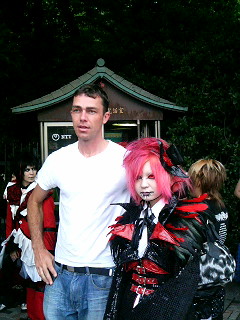 I have got to come right out and admit this: I am no Cosplay fanatic, and find the whole phenomenon just a little bit twisted, a little bit strange. Then again, I am not really one to get into the spirit at fancy dress parties, I am the guy who spoils it by coming clad in regular clothes. I have no interest in roleplaying games, and uniforms rarely feature in my sexual fantasies. That said, I do enjoy peoplewatching and documenting subcultures, and for six years I lived up the road from Akihabara, which is pretty much the Mecca of the Cosplay universe (as well as the Gomorrah and the Babylon, depending on how you look at it). The following post records some discoveries I made in those six years with regards to Cosplay and all the Cosplay venues and shops and institutions in the Akihabara Electric Town. For those who don't know, Cosplay (コスプレ) means "Costume Play", and basically involves dressing up as characters from your favorite anime movie, manga cartoon, video game, or the lead singer of your favorite band, etc. That treasure trove of wisdom, Wikipedia, claims that "in Japan, cosplay as a hobby is usually an end unto itself." I would add that in Japan all hobbies are ends unto themselves, for they are in fact Zen practices designed to initiate satori or selfrealization, but that is another issue! Let's stick to the topic at hand, shall we? Wikipedia continues: "Likeminded people gather to see other costumes, show off their own elaborate handmade creations, take lots of pictures, and possibly participate in best costume contests." I don't go in for it myself, but I do like peoplewatching, and subculturespotting, so I am often at the sidelines of these events, taking notes and snapping photos. When friends come from overseas to visit me, they always want to see some Cosplay. I escort them to Tokyo's Harajuku, which every Sunday is rammed with Cosplay enthusiasts. Some of the get-ups there have to be seen to be believed, they are so detailed, so elaborate, and so deviant!
Along with Harajuku, Akihabara is a popular Cosplay haunt, especially on weekends. The Electric Town is blessed with a large number of dedicated fancy dress cafes, department stores and galleries. The waitresses at such cafes are dressed as video game and anime characters, or maids. In any almost any big Akihabara department store you will find a Cosplay floor which will put your hometown's fancy dress shop to shame. Along with costumes, dolls are perennially popular with shoppers. Last year, at the height of my Akihabara research project, I discovered a creche of almost lifesized dolls inside the Laox Asobit C department store, all of them sporting fully movable limbs, and staring out impassively at the crowds, like deities at a temple. One of them was a maid (of course), another a high school girl with innocent eyes and a raunchily high-cut dress. Some of the others were anime characters or tennis players, or maybe a blend of both. They weren't particularly cheap, the average doll costing around ¥600,000 (US$6000, give or take.) I started thinking: what kind of guy would buy a US$6000 doll? Since that time it dawned on me: the Japanese love affair with dolls/costumes/roleplay is more than just a consumerist fad, or a bit of fun -- there is something mystical in it, something which emanates from the heart of Japanese spirituality. Spend a bit of time in Japan and you will realize that dolls of all kinds (and I'd include robots in this) enjoy an honorable status. In my opinion, this veneration of the doll, and the incredible attention to detail which goes into making them, is in fact a religious expression. It is an animist thing, a Shinto thing. It is no exaggeration to say that many Japanese believe there is a god in everything -- trees, rocks, rivers... why not dolls as well? Dolls are alive, and they have a roughly human form, so it is no wonder that they are given so much respect, and so much devotion. Like dolls, costumes are also alive, imbued with lifeforce, and offer those who put them on an almost magical power... the ability to become another person, to channel fictional characters, to converse with the spirits just like a Mongolian Shaman in a trance. When a Shaman goes into a trance, the ego disappears, and emptiness clears the mind. The devotee finds that his or her essential emptiness is mirrored in the essential emptiness of the Universe, and attains Enlightenment. That is my theory at least!
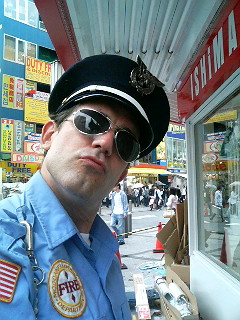 Anyway, enough ranting... I promised myself that I wouldn't rant! Last month I found myself back in Akihabara with my man Dennis the Menace (aka Maniac High), kind of getting carried along in his wake. Dennis (pictured, on the left) was there for a TV job, a program about foreigners enjoying themselves in the Electric Town. Since I happened to be there, the camera crew hauled me in front of the camera and bombarded me with questions. "What are the things you like about Japan and Japanese culture?" they asked me. I burst out automatically: "Cosplay!" It garnered the laugh I anticipated, and I got a few seconds of fame on TV... a few seconds of fun, but nowhere long enough time to discuss my more esoteric ideas on the matter. Anyway, would Japanese viewers really want to listen to some random foreigner espousing his bizarre theory on the Shinto/Buddhist origins of Cosplay, and/or the animist worship of dolls? I doubt it. Gaijin are supposed to be genki and rambunctious, but not too deep. Better to dumb it down, I thought to myself, and not confuse anyone, otherwise I might offend someone! The film crew finished their "interview" with me, then they escorted Dennis to a premise upstairs to have his ears cleaned by a pair of young maids. He was dressed for the part, in a Fire Department shirt, and a police cap, and unlike me he was on his way to being paid. I scurried on through the cold drizzle and rain to Shinjuku, where I pretended to be Mickey Mouse on the telephone for a few hours, to earn my daily bread. Japan is a strange country, that is for sure... everyone is playing a role, and nobody is quite the person you expect to them to be! That's what makes it so fascinating.
Here follows some Cosplay shops, venues, cafes and attractions in Akihabara and other parts of Tokyo like Shibuya, which I have noticed on previous jaunts around town. It's not an exhaustive list by any means, and I may add to it as time goes by:
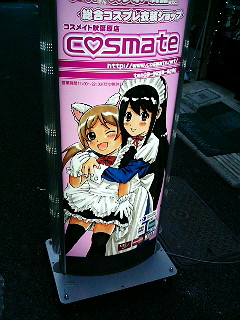 Cosmate: 千代田区外神田1-8-3 野水ビル5.
5th Floor Nomizu Building, 1-8-3 Soto Kanda, Chiyoda Ward, Tokyo.
Phone: (03) 3526 5043. Web: http://www.cosmate.net. Map: http://www.cosmate.net/akihabara.htm.
If high school girls in panties and leotards do it for you, then this is your place! If you are thinking of starting your own maid cafe and need uniforms for your staff, have a look at Cosmate's range. As far as I know, there are three outlets in Tokyo -- the address and phone number listed above belongs to the head store, in Soto Kanda. From the rather gruff reception which awaited me when I tried to enter one of the shops last year, they don't care too much for tourists walking in off the street just to check out the merchandise. This place is for serious fetishists only... whether young females or dirty old men, I am not quite sure!
That said, you don't even have to visit the store to buy that leotard or maid outfit -- you can order straight off their website! Which might be just as well, for schoolgirls (or dirty old men) too embarrassed to lug those stretch enamel sailor leotards up to the counter! I am not sure if they deliver overseas, but you could always try your luck, ne!
 Cospa Shop Akihabara: 千代田区外神田3-15-5ジーストア・アキバ2F.
Off Chou Dori (Akihabara's main street), 2nd Floor Jiisutoa Akiba Building, near Akihabara Station, 3-15-5 Soto Kanda, Chiyoda Ward, Tokyo.
Phone: (03) 3770 3383. Web: http://www.cospa.com/cospaguide/englishguide.html.
This is actually a funky little shop, funky in the way that only Japanese junk and collectible shops can be -- full of quirky and cute little products. This is on the second floor of the Jiisutoa Building, which also hosts the legendary Cure Maid Cafe (see a review of that place further below.) Basically the whole building seems to be given over to models of some kind, maids, or maid costumes. On this floor are the maid costumes. The last time I was there, a couple of Japanese girls were appraising the maid and high school costumes, swooning and exclaiming: "Kawaii!" ("So cute!") There were a range of Samurai style swords at the back of the store, mugs and T-shirts printed with weird anime scenes and slogans -- one of the shirts showed two maids at work, one with distinctive anime blue hair, and the title: "Here are our maids. They are only 13-years-old." Bizarre. Might make a cool sarcastic gift for the folks back home though...
Last April, on a walk through Akihabara, I was handed a document called Cospa Catalog for Girls... if anyone wants to buy it, send me 50 cents by PayPal and its yours! The catalog listed some charming items such as a traditional style Japanese folding fan emblazoned with manga -- a cool fashion item indeed for humid summers in Berlin or New York, and selling for ¥1800. There were also "book covers" and mugs based on the Kyo kara Maoh series (¥1000 and ¥800 Yen respectively), high school uniforms with an anime twist, book markers, neckties, uniforms based on those worn in Gakuen Heaven: Boy's Love Hyper, and plenty of other stuff. Hit the official Cospa website link above to see the latest goods on sale!
As well as Akihabara, there are other Cospa stores around Japan... they even have one inside Narita Airport! Over at Shibuya there is a branch in the Hagihara Building (5-3 Maruyamamachi, Shibuya Ward. Phone: (03) 3770-3383.) Shibuya is of course the coolest part of Tokyo when it comes to extreme fashion. If you come here for a browse and it is a weekend (especially Sunday), make sure you head up to Yoyogi Park at Harajuku to see all the Cosplay chicks, hanging out on the walkway near the dancing Rockabillies.
Cosplay Academy Cave: 台東区池之端1-1-2.
Basement floor Usudamu Kouji building, 1-1-2 Ikenohata, Taito Ward, Tokyo.
Phone: (03) 3834 5018. Web: http://web.archive.org/web/20061106171550/http://www.cosplay-academy.com/.
When I used to go to Akihabara every day last year researching shops and venues for
Cure Maid Cafe: 千代田区外神田3-15-5ジーストア・アキバ6F.
 Off Chou Dori, 6th Floor Jiisutoa Akiba Building, near Akihabara Station, 3-15-5 Soto Kanda, Chiyoda Ward, Tokyo.
Phone: (03) 32583161. Web: http://www.curemaid.jp.
Waitresses at this maid cafe go by the names Pudding or Chocolate. As with other cafes, the establishment runs a website where customers and waitresses can chat. According to the manager: "We get nearly 1,000 page visitors a day, which is unbelievable for a restaurant."
Unlike some other cafes, the maids here are elegant rather than sexy... some would even say dour. Sometimes they get up and perform classical music. Items on the menu include pasta for ¥800, sandwiches for ¥500, and beer at ¥500 per glass. You can also buy sets of cards featuring what else but lots of manga style portraits of maids, and there are some pretty expensive but highly detailed maid dolls on sale for like ¥8000 Yen.

Jupiter Akiba Clothes Shop: 千代田区外神田3-14-6 恵光ビル6階.
6th Floor Ekou Building, 3-16-6 Soto Kanda, Chiyoda Ward, Tokyo.
Phone: (03) 3252 2918. Web: http://jupiter-akiba.jp/.
When you see a place in Akihabara which advertises itself as a "clothes shop" you better sit up and take note -- it probably ain't just an ordinary clothes shop. Nothing in Akihabara is ordinary, mundane, or purely utilitarian. While Jupiter Akihaba, situated on the sixth floor of a tower overlooking Chuo Dori, proclaims itself to be a clothes store, it is really a Cosplay joint. A Cosplay heaven, if you will. There is a weird range of costumes and uniforms here. Mannequins of SS officers in full death regalia stand alongside flight attendants and maids and high school girls. Nice touch that...
 Laox Asobit C: 千代田区外神田1-15-18.
1-15-18 Soto Kanda, Chiyoda Ward, Tokyo.
Phone: (03) 5298 3581. Web: http://asobitcity.laox.co.jp/.
Laox is a Japanese chain with numerous stores in the Akihabara precinct. This particular store is devoted to the universe of Japanese anime and manga. The "C" in the name means "character", and "Asobit" is a play on words combining the Japanese for play (asobi) and the bit from bits and bytes fame. In the basement you will find the adult publications such as comics, novels (literary and adult-themed novels as well as books based on games), magazines and gachapon. This is truly adults' only territory -- people under 18 will not be allowed down the stairs or out of the lift. Things are a bit more familyminded on the first floor, which is dedicated to trading figures, miniatures, collectible sets, fancy characters and character-based publications and DVDs. The second floor is filled with new character figurines, Gundam plastic models, paints, and related publications and DVDs. The third floor is called the "Anime Character Floor" and features the likes of Microman, Pokemon, Transformers, Zoids, and American toys. There are also goodies for the girls. On the fourth floor, meanwhile, you will find special effects and heroes like Masked Rider, Godzilla, Ultraman and their ilk filling the shelves.
The highlight of the building, in my opinion, is the fifth floor. This is where (as I described in lurid detail somewhere above) I stumbled upon a row of lifesized anime dolls and maids with US$6000 price tags. The floor also includes blister figures and smaller dolls, as well as plenty of costumes.
2013 UPDATE: I have heard it said that Laox is trying to penetrate the Cosplay and Akiba scene in China, which I would like to explore at some point in the future, seeing as though I will be moving there next year! Stay tuned for my reports... they will be coming!
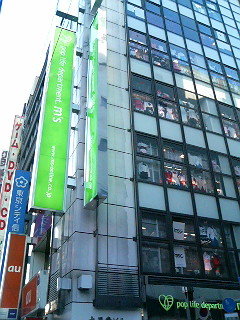
M's Shop: 千代田区外神田1-15-13太平堂ビルB1-6F.
Seven floors of fun inside the Pacific Hall Building, 1-15-13 Soto Kanda, Chiyoda Ward, Tokyo.
Phone: (03) 3252 6166. Web: http://www.ms-online.co.jp.
This prominent building, easily visible from the Yamanote line south of Akihabara Station, is a huge sex goods emporium. I am not game enough to take photos inside but it is pretty interesting, and confirms my suspicions regarding the kinky side of Japan!
Cheap Bastard pointed out on his guide (mostly dedicated to porn): "This is a four-floor store that sells all sorts of pornographic shit. Funny, I didn't see any hentai manga, although they did have hentai anime. Anyhow, this used to be where a video store called Rocket Soft once lived, although that's not why I've included it in this guide. No, I've included it because of the surreal experience I had there. The store opened recently (recently meaning way back in May, damn I've been lazy about updating this section), and being a Curious Bastard I decided to see what was what. It was after working hours, so I found myself in a store full of young and middle-aged businessmen poring over, well, porn. This whole scene of salarymen earnestly scrutinizing various dildos, whips, riding crops, panties, and other accessories quite frankly scared the beejezus out of me. Having visited each floor briefly, I quickly departed this palatial proprietor of pr0n."
It should be noted that it is not only men who get into the costumes and sex aids at M's Shop. The adult convenience store manages to sell a lot of sexy costumes to girls. "When a girl tries one on, often she asks us to take a photo of her," a store PR guy said. "There are too many customers like that, and our walls are plastered with their photos."
Another unique shop in Akihabara is the so-called video box that features gorgeous rooms and a big collection of animation and adult video tapes. "Even diehard fans will never get bored," said a salesperson for one such place, Hanataro.
Do you want to learn more about Cosplay? Angel Cosplay is a good place for girls interested in dressing up. The Good Angel herself, has this to say about Cosplay beginners: "It's really hard to put yourself out there to cosplay for the first time. Find a character that's a lot like yourself and try to get some of your friends to cosplay with you. Cosplaying in groups helps if you're nervous about cosplaying. Just go out and have a good time! There will always be people out there who say mean things but do not ever let them get you down. Be happy and have a great time! ^_^."
Monday, August 7, 2006
We're All Floating
Have you ever read a haiku poem? Not only are they fascinating compositions in themselves, as fragile as a cherry blossom, but they also open a window into the culture and the consciousness of the Japanese people.
For those who don't know, haiku comprise three nonrhyming lines of five, seven and five syllables. To our Occidental mind, they appear too fleeting and incomplete. We feel that there should be something more substantial. If we think Orientally, however, we will realize that they reveal something less... that is, the vacuum which encapsulates the core of the Japanese experience. Just like the empty gestures of the tea ceremony (茶道), they condense the essential nothingness of the Universe. This is the original meaning of the "Floating World", in my opinion at least.
The following haiku, by Matsuo Basho (松尾 芭蕉) is said to be one of the most profound achievements in Japanese literature, but is only seven words long:
"Furuike ya!
Kawazu tobikomu
Mizu no oto."("Oh -- ancient pond!
A frog jumps in,
The sound of water.")
It should be noted that the "ya" is not even a real word, and it is merely deployed as a "state breaker", a crack of Zen revelation. I studied quite a few other haiku today and most of them were deceptively simple, but yet deeply mysterious at the same time. They make me wonder about how the same patterns coil round and round and in upon themselves, conchstyle. In Europe landscaping generally entails elaborate grounds with avenues of grand elms; in Japan the traditional garden is just a raked expanse of gravel rimmed by midget brutally pruned bonsai trees. Haiku are the bonsai of the poetry world, you might say -- severely pruned and bare.
A more contemporary state breaker can be heard in the song We're All Water, written and sang by Yoko Ono, and released on John Lennon's protest album, Some Time in New York City. Ono might be a terrible singer and the whole production is shambolic, but the curious structure of the piece redeems it. Each verse is like a haiku, with three lines of five or seven syllables each, for example this one:
"There may not be much difference
Between Manson and the Pope,
If we press their smile..."
Three is not a particularly rhythmic number at the best of times, at least on a Rock record, but here it lends an exotic, enigmatic quality. Listening to Ono's song, you might find yourself hanging on, waiting for the missing fourth line. Have the courage to let go, however, and you could fall into an abyss, one that you never even noticed there right before your feet... (For more of my discoveries regarding manifestation and the void, click here.)
Wednesday, January 11, 2006
Making Mochi, and Appeasing the Gods (New Year in Shikoku)
One of my goals for the Great Shikoku Sojourn of 2005/06 was to enjoy a traditional Japanese New Year. As reported earlier, I passed New Years Eve last year in a sleazedive Roppongi club and while there is nothing wrong with that, this year I wanted to do things differently. Luckily for me, my adopted family in Shikoku always celebrate New Years the traditional way -- unlike a lot of Japanese these days who opt out for a vacation to Hawaii, or spend New Years Day eating take-out sushi or even Domino's Pizza. Actually, Pizza Hut now deliver their own New Years Day family meal in Tokyo, which costs an astonishing US$120 (as I recently discovered.) But I didn't want to eat anything from Pizza Hut this Japanese New Year, or do anything US military-related socially-wise. I wanted to do things the old school way, Bushi "Way of the Warrior" style. Luckily for me, the gods of Shikoku were on my side. They granted me my wish, and so I will remain forever in their debt, eternally.
My newly adopted grandmother and grandfather are certainly old school in how they live -- they're up every day at 4am to do all the chores that need to be done, like picking vegetables or making presentations to the gods which live all around their country house. I decided to emulate them while I was on their island, for a couple of days at least. Well, I knew I would never be able to get up at 4am, but I wanted to enjoy all the clean-living fun of rural Japan -- working in the fields, taking the dog for a walk in the bamboo thickets, drinking warm sake under the warm warm kotatsu. On my first full day in Shikoku, I was able to participate in another chore, a particularly sacred one -- the making of mochi rice cakes.
Before we go on, I ought to explain... what are mochi rice cakes, exactly, and what do they mean to the Japanese people? Let's go to one of the popular sources of modern times: Wikipedia! Wikipedia says: "Mochi (Japanese 餅) is the Japanese variant of Chinese rice cake, which, like its Chinese origin, is made of glutinous rice, pounded into paste and molded into shape; however, unlike the Chinese variety, it is molded right after it is pounded, whereas the Chinese variety is baked once again after to solidify the mixture as well as sanitize it. Traditionally in Japan, it is made in a ceremony called mochitsuki. It may also be made in an automatic mochi machine, similar to a breadmaker. In Korea, a nearly identical food is called duk (also spelled dduk, duek, d'uk, or tteok)." (Ed's note: those Koreans have a knack of giving the same basic food a million different names -- see my Korean Dog Soup Page for more comfirmation of this!)
On the subject of Mochitsuki, which is the ceremony I was blessed to participate in, Wikipedia continues: "Polished glutinous rice is soaked overnight and cooked (eds note: see first picture in the series below: the rice is being steamed in a traditional mushiki here.) The rice is pounded with wooden mallets (kine) in a traditional mortar (usu). Two people will alternate the work, one pounding and the other turning and wetting the mochi. The mochi must be kept wet to keep it from sticking to the mallet. The sticky mass is then formed into various shapes (usually a sphere or cube)."
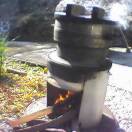
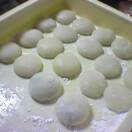
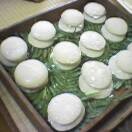
That's making mochi in a nutshell: a lot of steaming, a lot of pounding, and a lot of kneading into the desired usually moon-like shape. What you end up with a lump of soft, sticky, gooey, glutinous goodness. They taste somewhat bland perhaps, although you can spice them up coating them with various substances, or stuffing them with red bean paste or even ice cream (that last item is not particularly old school though!) In the photo block beneath you can see another variant being made -- grass mochi! Kusa mochi (Japanese: 草餅), also known as yomogi mochi, is a Japanese sweet, and despite the name is made not from grass but rather mugwort.


Yes sirree, the Japanese love cooking and eating these rice cakes at New Years Eve, although they are often eaten elsewhere in the year. Japanese also love presenting the mochi to the gods, to thank and honor them and to ensure good fortune in the following year. It is interesting that throughout human history, all over the world people have felt compelled to offer sacrifices to the Higher Beings, in order to win their appeasement and their approval. I was reading Homer's The Odyssey last year, and what impressed me the most, apart from the brutality of the climax, was how on almost every second page one of the heroes burnt up a pile of bovine thigh bones, or a rack of juicy steaks, to satisfy Zeus and his ilk. Now they don't practice animal sacrifice in Japan, but they do have plenty of reverence for the gods -- and there are literally millions of gods in this country. They don't sacrifice animals, but they do sacrifice food, which must have meant a big loss of resources back in the old days when there were a lot of hungry mouths to feed.
One thing I ought to point out right here is that New Years Day is celebrated in a completely different way in the East than it is in the West. In Japan/Korea/China/Vietnam New Years Eve/Day is kind of similar to the western idea of Christmas in that it is a day for family get-togethers, quiet reflection and acts of religious devotion, the consumption of vast quantities of food, dozing off in armchairs, getting up late and basically taking it easily. Ironically, Christmas Eve is the time to party in Japan, and many couples ask each other out on dates on this day; going to Kentucky Fried Chicken is especially popular. Go figure! So in other words, the Japanese New Year is our Christmas, and our New Year is their Christmas, in a manner of speaking! One of the things Japanese people do on New Years Day, apart from eating and drinking a lot of substances themselves, is that they make offering to the gods. At the home of my adopted family in Shikoku, they honor and partake in a particular tradition, which I call making mochi trees. Actually, it is only one tree they make, a small typically Japanese bonsai style fake tree, basically a stick skeleton hung with colorful shiny baubles and -- get this -- little pieces of mochi, rolled up to make what are called mochibana (rice cake flowers). The little stick tree is then propped up in front of the household altar, in the belief that the gods will come and eat the flour flowers, while the humans are off enjoying themselves devouring osechi ryori and sinking sake elsewhere in the house.

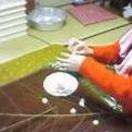
In the photo bar above, you can see mochibana being applied to the branches of the fake tree, by my girl C. In the photo bar beneath, you can see the mochi tree in all its colorful glory, before the household altar. The final photos display more substantial fare for the gods -- a full tray of shrinkwrapped rice cakes ready for Divine Degustation. There are also some dried kaki (persimmon) and a whole salted fish, if any spiritual beings take a fancy to that.
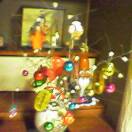
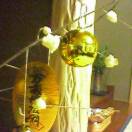
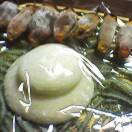
The idea of leaving fish and dried foods on an altar in your house for invisible beings to eat might seem strange to us westerners, but we do have some similar practices of our own. In a lot of countries people leave out glasses of warm milk (or cold beer, in Australia) for Santa Claus to drink on his annual visit, and there is a carrot in every house for the Easter Bunny. In some countries, children who have lost teeth put them in a glass of water beside their bed, and in the morning they are transformed into money! Perhaps Santa and the Easter Bunny and the Tooth Fairy are all we left of our pagan animist past. In Japan in the animist past lives on. In Japan animism never died.
Like many other things in Japan, mochi plays a spiritual role in life. Every village or town has its own special ways of using it in its religious rites and customs. In the small town of Aratano (Tokushima Prefecture) in Shikoku, for example, a festival is celebrated in the early New Year called Mochi Nage, or "Thrown Mochi". The idea behind Mochi Nage is disarmingly simple: people turn up at the local Shinto shrine, some shrine workers come out with bags of cooked (and I assume blessed) rice cakes, wrapped in plastic for hygiene, and proceed to hurl them at the assembled crowds. Little kids dash about, catching or picking up as many of the rice cakes as they can bundle into their arms. Old ladies push younger countrymen/women aside in the mad melee. Perhaps some fire works are discharged. At the Mochi Nage festival I attended at Aratano, I got pelted by a couple of the thrown cakes, which are actually quite hard and could easily "take an eye out", if you were hit the right way. I also managed to collect a big bag full of mochi, and this bag was eyed enviously by some of the local kids in attendance there. The gods were on my side; I managed to do a good job.
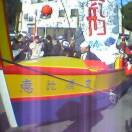
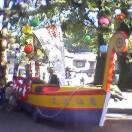
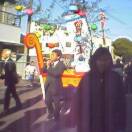
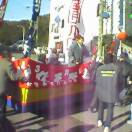
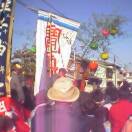
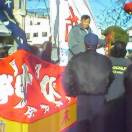
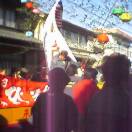

In the photo bar above, you can see photos from the Mochi Nage festivities at Aratano. In this town's version of Mochi Nage, a colorful boat-like vehicle (actually a converted car) is first rolled through the streets, attracting a crowd of eager scavengers. Like a Pied Piper, the car led us on to the local shrine where the proper rice cake chucking and catching sessions began -- and as I already mentioned, I ended up scooping up much of the venerable little goodies (attribute that to luck, or perhaps to favor of the mochi gods!)
Mochi Nage celebrations are also held to bless the construction of a new house, according to some reports I have read on the Internet. As Amy Chavez has reported: "Japan must be the only country where throwing food is not only acceptable but encouraged. Whole neighborhoods gather to throw food at each other in a tradition called Mochi Nage or, throwing rice cakes. No ceremony in Japan is complete without mochi, a symbol of happiness. In the old days, they probably threw only rice cakes, but these days they throw anything from packaged store-bought bread to bags of chips and instant ramen -- modern symbols of happiness..."
Whether we be human or animal or vegetable or god, all we want is the same thing in life: recognition for our existence and our efforts, and perhaps a bit of love and respect served on the top. That is what mochi encapsulates, and celebrates: the awareness that life is a ritual in which everyone must play their part, and in which every part is glorious. Witness the life cycle of this critter: pounded out of generous grains nurtured by the Four Elements, molded into moon shapes, then offered to the local deities, or tossed to little kids and grandmothers at the shrine... isn't this all just a celebration of the earth, a celebration of what the Earth can offer? We take from the earth and give back to it, and then it gives back to us, etc. The cycle keeps on repeating, endlessly. Creating abundance out of scarcity, rebirth out of decay, a New Year from the Old. The cycle never ends. The gods of Shikoku taught me all this, and more. In time, I might teach them a thing or two! In a couple of lifetimes or so.
My newly adopted grandmother and grandfather are certainly old school in how they live -- they're up every day at 4am to do all the chores that need to be done, like picking vegetables or making presentations to the gods which live all around their country house. I decided to emulate them while I was on their island, for a couple of days at least. Well, I knew I would never be able to get up at 4am, but I wanted to enjoy all the clean-living fun of rural Japan -- working in the fields, taking the dog for a walk in the bamboo thickets, drinking warm sake under the warm warm kotatsu. On my first full day in Shikoku, I was able to participate in another chore, a particularly sacred one -- the making of mochi rice cakes.
Before we go on, I ought to explain... what are mochi rice cakes, exactly, and what do they mean to the Japanese people? Let's go to one of the popular sources of modern times: Wikipedia! Wikipedia says: "Mochi (Japanese 餅) is the Japanese variant of Chinese rice cake, which, like its Chinese origin, is made of glutinous rice, pounded into paste and molded into shape; however, unlike the Chinese variety, it is molded right after it is pounded, whereas the Chinese variety is baked once again after to solidify the mixture as well as sanitize it. Traditionally in Japan, it is made in a ceremony called mochitsuki. It may also be made in an automatic mochi machine, similar to a breadmaker. In Korea, a nearly identical food is called duk (also spelled dduk, duek, d'uk, or tteok)." (Ed's note: those Koreans have a knack of giving the same basic food a million different names -- see my Korean Dog Soup Page for more comfirmation of this!)
On the subject of Mochitsuki, which is the ceremony I was blessed to participate in, Wikipedia continues: "Polished glutinous rice is soaked overnight and cooked (eds note: see first picture in the series below: the rice is being steamed in a traditional mushiki here.) The rice is pounded with wooden mallets (kine) in a traditional mortar (usu). Two people will alternate the work, one pounding and the other turning and wetting the mochi. The mochi must be kept wet to keep it from sticking to the mallet. The sticky mass is then formed into various shapes (usually a sphere or cube)."
That's making mochi in a nutshell: a lot of steaming, a lot of pounding, and a lot of kneading into the desired usually moon-like shape. What you end up with a lump of soft, sticky, gooey, glutinous goodness. They taste somewhat bland perhaps, although you can spice them up coating them with various substances, or stuffing them with red bean paste or even ice cream (that last item is not particularly old school though!) In the photo block beneath you can see another variant being made -- grass mochi! Kusa mochi (Japanese: 草餅), also known as yomogi mochi, is a Japanese sweet, and despite the name is made not from grass but rather mugwort.
Yes sirree, the Japanese love cooking and eating these rice cakes at New Years Eve, although they are often eaten elsewhere in the year. Japanese also love presenting the mochi to the gods, to thank and honor them and to ensure good fortune in the following year. It is interesting that throughout human history, all over the world people have felt compelled to offer sacrifices to the Higher Beings, in order to win their appeasement and their approval. I was reading Homer's The Odyssey last year, and what impressed me the most, apart from the brutality of the climax, was how on almost every second page one of the heroes burnt up a pile of bovine thigh bones, or a rack of juicy steaks, to satisfy Zeus and his ilk. Now they don't practice animal sacrifice in Japan, but they do have plenty of reverence for the gods -- and there are literally millions of gods in this country. They don't sacrifice animals, but they do sacrifice food, which must have meant a big loss of resources back in the old days when there were a lot of hungry mouths to feed.
One thing I ought to point out right here is that New Years Day is celebrated in a completely different way in the East than it is in the West. In Japan/Korea/China/Vietnam New Years Eve/Day is kind of similar to the western idea of Christmas in that it is a day for family get-togethers, quiet reflection and acts of religious devotion, the consumption of vast quantities of food, dozing off in armchairs, getting up late and basically taking it easily. Ironically, Christmas Eve is the time to party in Japan, and many couples ask each other out on dates on this day; going to Kentucky Fried Chicken is especially popular. Go figure! So in other words, the Japanese New Year is our Christmas, and our New Year is their Christmas, in a manner of speaking! One of the things Japanese people do on New Years Day, apart from eating and drinking a lot of substances themselves, is that they make offering to the gods. At the home of my adopted family in Shikoku, they honor and partake in a particular tradition, which I call making mochi trees. Actually, it is only one tree they make, a small typically Japanese bonsai style fake tree, basically a stick skeleton hung with colorful shiny baubles and -- get this -- little pieces of mochi, rolled up to make what are called mochibana (rice cake flowers). The little stick tree is then propped up in front of the household altar, in the belief that the gods will come and eat the flour flowers, while the humans are off enjoying themselves devouring osechi ryori and sinking sake elsewhere in the house.
In the photo bar above, you can see mochibana being applied to the branches of the fake tree, by my girl C. In the photo bar beneath, you can see the mochi tree in all its colorful glory, before the household altar. The final photos display more substantial fare for the gods -- a full tray of shrinkwrapped rice cakes ready for Divine Degustation. There are also some dried kaki (persimmon) and a whole salted fish, if any spiritual beings take a fancy to that.
The idea of leaving fish and dried foods on an altar in your house for invisible beings to eat might seem strange to us westerners, but we do have some similar practices of our own. In a lot of countries people leave out glasses of warm milk (or cold beer, in Australia) for Santa Claus to drink on his annual visit, and there is a carrot in every house for the Easter Bunny. In some countries, children who have lost teeth put them in a glass of water beside their bed, and in the morning they are transformed into money! Perhaps Santa and the Easter Bunny and the Tooth Fairy are all we left of our pagan animist past. In Japan in the animist past lives on. In Japan animism never died.
Like many other things in Japan, mochi plays a spiritual role in life. Every village or town has its own special ways of using it in its religious rites and customs. In the small town of Aratano (Tokushima Prefecture) in Shikoku, for example, a festival is celebrated in the early New Year called Mochi Nage, or "Thrown Mochi". The idea behind Mochi Nage is disarmingly simple: people turn up at the local Shinto shrine, some shrine workers come out with bags of cooked (and I assume blessed) rice cakes, wrapped in plastic for hygiene, and proceed to hurl them at the assembled crowds. Little kids dash about, catching or picking up as many of the rice cakes as they can bundle into their arms. Old ladies push younger countrymen/women aside in the mad melee. Perhaps some fire works are discharged. At the Mochi Nage festival I attended at Aratano, I got pelted by a couple of the thrown cakes, which are actually quite hard and could easily "take an eye out", if you were hit the right way. I also managed to collect a big bag full of mochi, and this bag was eyed enviously by some of the local kids in attendance there. The gods were on my side; I managed to do a good job.
In the photo bar above, you can see photos from the Mochi Nage festivities at Aratano. In this town's version of Mochi Nage, a colorful boat-like vehicle (actually a converted car) is first rolled through the streets, attracting a crowd of eager scavengers. Like a Pied Piper, the car led us on to the local shrine where the proper rice cake chucking and catching sessions began -- and as I already mentioned, I ended up scooping up much of the venerable little goodies (attribute that to luck, or perhaps to favor of the mochi gods!)
Whether we be human or animal or vegetable or god, all we want is the same thing in life: recognition for our existence and our efforts, and perhaps a bit of love and respect served on the top. That is what mochi encapsulates, and celebrates: the awareness that life is a ritual in which everyone must play their part, and in which every part is glorious. Witness the life cycle of this critter: pounded out of generous grains nurtured by the Four Elements, molded into moon shapes, then offered to the local deities, or tossed to little kids and grandmothers at the shrine... isn't this all just a celebration of the earth, a celebration of what the Earth can offer? We take from the earth and give back to it, and then it gives back to us, etc. The cycle keeps on repeating, endlessly. Creating abundance out of scarcity, rebirth out of decay, a New Year from the Old. The cycle never ends. The gods of Shikoku taught me all this, and more. In time, I might teach them a thing or two! In a couple of lifetimes or so.
Tuesday, September 27, 2005
Regaining My Hope in Sigur Rós
I must confess that I had lost hope in Sigur Rós after () came out. In comparison to Ágætis Byrjun, Sigur Rós' first major release, the () album was harder to get into: austere, funereal, blank as a pair of empty parentheses. While Ágætis Byrjun grabbed you from the get-go, and took you on a glorious adventure, () was downbeat, and deliberately intimidating. Not only did none of the tracks have names, but they all kind of sounded the same. It was disappointing, because I fancied that I had finally met my kindred spirits in this Reykjavík quartet. I feared that the Victorious Rose had withered, and died, just as I was starting to dig them. That was two years ago, and a lot of water has flowed under the bridge since then, to abuse an old cliche... I have been to Iceland, and discovered plenty of fresh talent in that creative powerhouse. Sigur Rós had played their part in my life, or so I thought, but now I required them no more. How wrong was I: all of a sudden, Sigur Rós are back, happier and more accessible than ever! Frontman Jónsi Birgisson is actually singing, in Icelandic at least! And in gratitude, I have to bow deeply, and say: Thank you. Or, more succinctly: Takk..., which is the title of their new album.
Last Sunday I bought the latest Sigur Rós installment Takk... and consumed it, captivated, at the old school desk in my sharehouse. It was such an exhilarating experience, I literally couldn't get out of my chair until it finished. From the opening moments of mesmerizing feedback, which suggest a sun rising over a field of lush lupines, you sense that this is going to be an upbeat record. The sun slowly morphs into the sweep of a North Atlantic lighthouse, slicing through the fog. A beam from that lighthouse swivels your way, sending out fluctuating waves that just melt you, instantaneously. All at once, I felt the melancholy of () blown away, and the curtain rise on a whole new act in the Sigur Rós saga. It was an introduction that, for me at least, called for an instant rewind. So let's rewind it, and do it properly, in this review... one track at a time! With the occasional YouTube video or other media file thrown in, once they become available.
Track 1: Takk... ("Thanks...")
Like a ray of scintillating sunshine, Takk... penetrates deep into your soul, to grant you a Higher Grace. I believe there are saints in India who can enlighten you just by uttering a couple of words in your earshot, or staring you in the eye. Sigur Rós also seem to possess this ability, this Shamanic power, and all you have to do is hear their music, and be transformed! As the introduction begins, it feels like a baby is being born, descending into Being (in the fringes, meanwhile, the sonic equivalent of angelic heraldry hangs.) Why do the introductions to Sigur Rós albums always sound like childbirth? I marveled, hearing this tune play out, the second time I rewound it. Not the birth of an ordinary baby, of course, that would be too mundane. Here we are talking of angel birth!
Track 2: Glósóli ("Glowing Sole")
Glosoli carries forward the euphoria of the intro, but the Fafner-frustrated bass, and restless percussion, suggests some discord... it appears our angel child has taken form, but finds her/himself forsaken in this cold world. Inexplicably, the sun has disappeared (then again, it might just be midwinter in the Land of Fire and Ice!) The bass frets round and around, locked in a holding pattern. The strings do manage to lift off though and before too long we have Jónsi ululating too, yodeling almost, his voice higher than I have ever heard before, almost operatic you might say. He sings, sweepingly:
At 3:47 the bass guitar grinds into a countdown, lead guitar joining in, cascading into a crescendo which can only be called Heavy Metal, Iron Maiden in slow-mo. Jónsi rides atop the sonic blast, rejoicing:
On cue, the kids charge up a steep grassy slope, overtaking gulls which bob on the breeze, to the high cliff which towers over the sunlit beach. As Jónsi hollers they leap off the edge, one by one -- not to fall to their grisly deaths but rather to soar, angelic, into the citrine sky. There is an angel inside everyone of us, that is one of Sigur Rós' recurring motifs... and these kids have lights in their soles. We are Homeric heroes all, living in our own personal saga. Therefore, everything we do is worthy of epic treatment.
Track 3: Hoppípolla ("Jumping in Puddles")
In an interview recently aired on MTV Japan, band members declared Takk... to be their "happy album". Critics have been predictably quick to label the record as too optimistic and orgasmic, and to question the band's sincerity. I think they are missing the point: the thing about Sigur Rós is that they do emotional music -- their range encompasses everything from ecstasy to sorrow and existential dread. That said, Hoppipolla manages to push it to 11 on the ecstasy scale, which is no mean feat. It is, allegedly, the story of some kids splashing around in a puddle and having fun (once again, a simple theme turned into an opera of epic proportions.) The result is the most beautiful song on the album, or at least one of the most accessible.
In the video posted above, homage is paid to such juvenile pursuits as tagging buildings, throwing water-bombs, and playing knock-and-run. Typical of Sigur Rós, normal roles get reversed, and the perpetrators of said acts are senior citizens, while the victims are young dudes played by the members of the band (at 1:19, for example, you can see Jónsi working behind the counter in a shop.)
Track 4: Með Blóðnasir ("With a Nosebleed")
The continuation of the previous song by other means, this is also a very inspirational piece in its own right. According to an interpretation I have read online, one of the kids splashing around in Hoppipolla has injured himself/herself and gotten a nosebleed, but nobody cares because everyone is having so much fun. Loops of guitar, keyboards and glockenspiel are tossed around, with Jónsi surfing over the top. Casper on the Sigur Rós message board said: "Með Blóðnasir is just wild! if it were an actual song it'd be the best thing they've ever done!" I just wonder whether by separating this and Hoppípolla into two units, Sigur Rós have deliberately tried to make it harder for both to get commercial radio playtime. Instead of selling out, the band seem to be trying to goad commercial radio into breaking a few of its own rules, and become a bit more experimental.
Track 5: Sé Lest ("Train")
Building straight off of Með Blóðnasir, the glockenspiel is isolated, playing a repeated melody that moves up in fifths all while bouncing in 16th notes. A whimsical vocal line comes over and is followed by bass, percussion and feathery strings (apparently provided by fellow Icelanders amiina). At this stage it is all starting to sound very mid-1990s Björk, as soothing as a lullaby. Near the five-minute mark, multiple tonal instruments balance against each other, with on odd bowed instrument over the back. At 6:30, curiously, we are full-fledged into a night-time polka. That's right, a freaking polka! This is cool -- only Sigur Rós could pull off a transition like that. It leaves me wondering: Is there anything this band can't do?
Track 6: Sæglópur ("Sea Nitwit")
After the whimsical folly of Sé Lest, Sæglópur erupts with a surprising force... you could describe it a power ballad with its piano intro, geyser blasts of bowed guitar, multiple climaxes, and the endless cries of "þú" ("you"). The trademark Sigur Rós strategy of old was to build up songs over a long time to a devastating climax, like an Mid Atlantic cataclysm. Usually they would start off sluggish and serene and at the 6th minute mark or so, the breakout would take place. That was well and good, but with this new album they have taken things to the next level. Instead of sprawling songs which turn hyper at the end, Sigur Rós have amped up the intensity... they can now pull off multiple climaxes. 11 out of 10, in the Spinal Tap tradition. And as any pornographer will tell, nothing beats milking that money shot multiple times...
Track 7: Milano ("Milan")
Listening to Sigur Rós, you might find yourself wondering: What planet does this music come from? I met an American in Mumbai this year who joked that Jónsi's voice was "out of this world." I agree with him -- Jónsi is indeed an alien, an emissary from another galaxy... but that ain't surprising considering his pedigree. The truth is that Iceland itself is an alien and otherworldly place. Going to Iceland is in fact the next best thing to visiting another planet. It is built atop a dimensional fault line, a gateway between the 'branes. What happens then when Sigur Rós leave their homeland, and vacation in, say, Milan? Well, this song could be the result! It starts off slowly, as you might expect after the dramatic heights of the previous track. There is tender strings action, and a bit of piano too, revolving like a music box. As in Með Blóðnasir there is a circular structure to this song, each bar measured by a Fafner bass, which ever so slowly accelerates. Tension accumulates, as tension is wont to do. At 3:45 we finally reach bursting point, guitars thrashing, but this is a minor eruption. I guess there wasn't that much energy to release after Sæglópur. All that climaxing will exhaust you, sometimes.
Track 10: Svo Hljótt ("So Quietly")
When we are lost at sea and the sun refuses to shine, we embodied beings need a guiding star. Suddenly I realize that () was our communal long night of the soul, the wilderness we had to traverse in order to arrive at Takk..., this oasis of plenty. With Jónsi as our mad Pied Piper (or the drummer who can shatter glass with his voice.) As the magnitude of this revelation sinks in, my only rational response is to bow low and proclaim, "Thank you Sigur Rós, for the hope you gave me. Thank you for the joy." I leaned on you, and you leaned on me. What goes around comes around, and every tribute is returned.
Track 11: Heysátan ("Hay Stack")
Heysátan unfolds like a hymn, each note constructing a church stone by stone, wall by wall, pew by pew. Inside this sacred place, the atmosphere is that of a wake (albeit a rather jubilant one). Jónsi is either playing the role of a priest, or a demonic choirboy. Grapevine has the last word on this fitting finale: "A refrain of key notes of one chord, we hear horns, plucked guitar and keyboards all combining for airy but understated effect. Jónsi is most clear in the vocals here, sounding, dare we say it, like an Icelandic Billy Corgan..."
Takk... is one serious mindtrip, more of a drug than an album, and it is reminiscent of the Múm works that I have reviewed on this site. The cover of the CD (pictured above), designed to resemble a yellowed Victorian novel, also recalls Múm's album covers. Difficult to say though whether Sigur Rós directly imitated Múm in this respect, or whether both bands are merely reflecting the current trends in Nordic graphic design. Whatever, this is a very Icelandic album, and for lovers of Iceland such as myself, it is great to notice all the indigenous touches on this production.
 |
| Takk, the third album released by Sigur Rós. |
Last Sunday I bought the latest Sigur Rós installment Takk... and consumed it, captivated, at the old school desk in my sharehouse. It was such an exhilarating experience, I literally couldn't get out of my chair until it finished. From the opening moments of mesmerizing feedback, which suggest a sun rising over a field of lush lupines, you sense that this is going to be an upbeat record. The sun slowly morphs into the sweep of a North Atlantic lighthouse, slicing through the fog. A beam from that lighthouse swivels your way, sending out fluctuating waves that just melt you, instantaneously. All at once, I felt the melancholy of () blown away, and the curtain rise on a whole new act in the Sigur Rós saga. It was an introduction that, for me at least, called for an instant rewind. So let's rewind it, and do it properly, in this review... one track at a time! With the occasional YouTube video or other media file thrown in, once they become available.
Track 1: Takk... ("Thanks...")
Like a ray of scintillating sunshine, Takk... penetrates deep into your soul, to grant you a Higher Grace. I believe there are saints in India who can enlighten you just by uttering a couple of words in your earshot, or staring you in the eye. Sigur Rós also seem to possess this ability, this Shamanic power, and all you have to do is hear their music, and be transformed! As the introduction begins, it feels like a baby is being born, descending into Being (in the fringes, meanwhile, the sonic equivalent of angelic heraldry hangs.) Why do the introductions to Sigur Rós albums always sound like childbirth? I marveled, hearing this tune play out, the second time I rewound it. Not the birth of an ordinary baby, of course, that would be too mundane. Here we are talking of angel birth!
Track 2: Glósóli ("Glowing Sole")
Glosoli carries forward the euphoria of the intro, but the Fafner-frustrated bass, and restless percussion, suggests some discord... it appears our angel child has taken form, but finds her/himself forsaken in this cold world. Inexplicably, the sun has disappeared (then again, it might just be midwinter in the Land of Fire and Ice!) The bass frets round and around, locked in a holding pattern. The strings do manage to lift off though and before too long we have Jónsi ululating too, yodeling almost, his voice higher than I have ever heard before, almost operatic you might say. He sings, sweepingly:
"Nú vaknar þúAllt virðist vera breyttÉg gægist útEn er svo ekki neitt..."
Now you wake up, to find all is different. I look out, but see nothing. Tie my shoes so, and head for the door. Outside on the lava plain, a boy stands waiting. He is decked out in period costume, and carrying a drum. Part Pied Piper, part pirate dwarf, he seems like he's on a mission. He is on a Crusade, no less, and he is calling for volunteers. The drummer boy assembles a posse of kids as the song advances, constructing cairns, sleeping on moss beds, traversing the dark and steaming landscape, before the sun is finally located hiding over what must be the black beach of Vík in southern Iceland. The sound wells, bowed guitar building, and surging through it all is an epic feel, an incredibly epic feel, the kind you might encounter in a Homeric poem, or an Old Norse saga.
At 3:47 the bass guitar grinds into a countdown, lead guitar joining in, cascading into a crescendo which can only be called Heavy Metal, Iron Maiden in slow-mo. Jónsi rides atop the sonic blast, rejoicing:
"Og hér ert þú, fannst mér!Og hér ert þú, Glósóli!"
On cue, the kids charge up a steep grassy slope, overtaking gulls which bob on the breeze, to the high cliff which towers over the sunlit beach. As Jónsi hollers they leap off the edge, one by one -- not to fall to their grisly deaths but rather to soar, angelic, into the citrine sky. There is an angel inside everyone of us, that is one of Sigur Rós' recurring motifs... and these kids have lights in their soles. We are Homeric heroes all, living in our own personal saga. Therefore, everything we do is worthy of epic treatment.
Track 3: Hoppípolla ("Jumping in Puddles")
In an interview recently aired on MTV Japan, band members declared Takk... to be their "happy album". Critics have been predictably quick to label the record as too optimistic and orgasmic, and to question the band's sincerity. I think they are missing the point: the thing about Sigur Rós is that they do emotional music -- their range encompasses everything from ecstasy to sorrow and existential dread. That said, Hoppipolla manages to push it to 11 on the ecstasy scale, which is no mean feat. It is, allegedly, the story of some kids splashing around in a puddle and having fun (once again, a simple theme turned into an opera of epic proportions.) The result is the most beautiful song on the album, or at least one of the most accessible.
In the video posted above, homage is paid to such juvenile pursuits as tagging buildings, throwing water-bombs, and playing knock-and-run. Typical of Sigur Rós, normal roles get reversed, and the perpetrators of said acts are senior citizens, while the victims are young dudes played by the members of the band (at 1:19, for example, you can see Jónsi working behind the counter in a shop.)
Track 4: Með Blóðnasir ("With a Nosebleed")
The continuation of the previous song by other means, this is also a very inspirational piece in its own right. According to an interpretation I have read online, one of the kids splashing around in Hoppipolla has injured himself/herself and gotten a nosebleed, but nobody cares because everyone is having so much fun. Loops of guitar, keyboards and glockenspiel are tossed around, with Jónsi surfing over the top. Casper on the Sigur Rós message board said: "Með Blóðnasir is just wild! if it were an actual song it'd be the best thing they've ever done!" I just wonder whether by separating this and Hoppípolla into two units, Sigur Rós have deliberately tried to make it harder for both to get commercial radio playtime. Instead of selling out, the band seem to be trying to goad commercial radio into breaking a few of its own rules, and become a bit more experimental.
Track 5: Sé Lest ("Train")
Building straight off of Með Blóðnasir, the glockenspiel is isolated, playing a repeated melody that moves up in fifths all while bouncing in 16th notes. A whimsical vocal line comes over and is followed by bass, percussion and feathery strings (apparently provided by fellow Icelanders amiina). At this stage it is all starting to sound very mid-1990s Björk, as soothing as a lullaby. Near the five-minute mark, multiple tonal instruments balance against each other, with on odd bowed instrument over the back. At 6:30, curiously, we are full-fledged into a night-time polka. That's right, a freaking polka! This is cool -- only Sigur Rós could pull off a transition like that. It leaves me wondering: Is there anything this band can't do?
Track 6: Sæglópur ("Sea Nitwit")
After the whimsical folly of Sé Lest, Sæglópur erupts with a surprising force... you could describe it a power ballad with its piano intro, geyser blasts of bowed guitar, multiple climaxes, and the endless cries of "þú" ("you"). The trademark Sigur Rós strategy of old was to build up songs over a long time to a devastating climax, like an Mid Atlantic cataclysm. Usually they would start off sluggish and serene and at the 6th minute mark or so, the breakout would take place. That was well and good, but with this new album they have taken things to the next level. Instead of sprawling songs which turn hyper at the end, Sigur Rós have amped up the intensity... they can now pull off multiple climaxes. 11 out of 10, in the Spinal Tap tradition. And as any pornographer will tell, nothing beats milking that money shot multiple times...
Track 7: Milano ("Milan")
Listening to Sigur Rós, you might find yourself wondering: What planet does this music come from? I met an American in Mumbai this year who joked that Jónsi's voice was "out of this world." I agree with him -- Jónsi is indeed an alien, an emissary from another galaxy... but that ain't surprising considering his pedigree. The truth is that Iceland itself is an alien and otherworldly place. Going to Iceland is in fact the next best thing to visiting another planet. It is built atop a dimensional fault line, a gateway between the 'branes. What happens then when Sigur Rós leave their homeland, and vacation in, say, Milan? Well, this song could be the result! It starts off slowly, as you might expect after the dramatic heights of the previous track. There is tender strings action, and a bit of piano too, revolving like a music box. As in Með Blóðnasir there is a circular structure to this song, each bar measured by a Fafner bass, which ever so slowly accelerates. Tension accumulates, as tension is wont to do. At 3:45 we finally reach bursting point, guitars thrashing, but this is a minor eruption. I guess there wasn't that much energy to release after Sæglópur. All that climaxing will exhaust you, sometimes.
 |
| Sigur Rós, somewhere in Iceland. |
Track 8: Gong ("Gong")
Mournful strings commence this journey, which are presently joined by guitars, drums, bass and finally a frantic piano. Jónsi is like a wolf howling at the sky, supported by a ghostly choir (quite probably, a choir of one.) Grapevine considers that this is "close to a melodic rock song, until it breaks into the big drama after the four-minute mark." In my own opinion, Gong is one kick-ass track -- a new direction for the band, a climax upon a climax, and another highlight of an album so crammed full of highlights.
Track 9: Andvari ("Zephyr")
Reviewers haven't cottoned on to it, but I swear this is another version of the same dirge which dragged on eight times on the () album. This is the 9th rendition of the song if I am correct, and I in my opinion it is the best. It is also the most moving moment of an already powerful album. As Gong retreats, guitars, music box and glocks pick up a sentimental melody, joined by the bass. At length Jónsi enters the fray, droning in what, suspiciously, sounds like Hopelandic, Uh-oh! you might think, remembering the bleak days of ()... Are we back on that kick? To be honest though, you don't need to understand Sigur Rós' lyrics to feel the meaning, and there sure seems to be a lot of emotion crammed into his wailing. At 1:50, Jónsi surprises me by singing (in English!) the short phrase, "I love you." Hackneyed perhaps, but it brought tears to my eyes on the first and second hearings, for there is a gratitude in his admission -- I could imagine that he was addressing me personally, or at the very least the loyal fans of the band. Giving thanks, in the true spirit of this record. I might be wrong... others claim this is a love song dedicated to his new boyfriend. I didn't even know he was gay!
Mournful strings commence this journey, which are presently joined by guitars, drums, bass and finally a frantic piano. Jónsi is like a wolf howling at the sky, supported by a ghostly choir (quite probably, a choir of one.) Grapevine considers that this is "close to a melodic rock song, until it breaks into the big drama after the four-minute mark." In my own opinion, Gong is one kick-ass track -- a new direction for the band, a climax upon a climax, and another highlight of an album so crammed full of highlights.
Track 9: Andvari ("Zephyr")
Reviewers haven't cottoned on to it, but I swear this is another version of the same dirge which dragged on eight times on the () album. This is the 9th rendition of the song if I am correct, and I in my opinion it is the best. It is also the most moving moment of an already powerful album. As Gong retreats, guitars, music box and glocks pick up a sentimental melody, joined by the bass. At length Jónsi enters the fray, droning in what, suspiciously, sounds like Hopelandic, Uh-oh! you might think, remembering the bleak days of ()... Are we back on that kick? To be honest though, you don't need to understand Sigur Rós' lyrics to feel the meaning, and there sure seems to be a lot of emotion crammed into his wailing. At 1:50, Jónsi surprises me by singing (in English!) the short phrase, "I love you." Hackneyed perhaps, but it brought tears to my eyes on the first and second hearings, for there is a gratitude in his admission -- I could imagine that he was addressing me personally, or at the very least the loyal fans of the band. Giving thanks, in the true spirit of this record. I might be wrong... others claim this is a love song dedicated to his new boyfriend. I didn't even know he was gay!
Track 10: Svo Hljótt ("So Quietly")
As its name might imply, Takk...'s penultimate track starts off restrained, with somber aspirations. but soon builds into one final banger -- a tornado, geyser, or the tractor beam from a UFO in a cornfield somewhere (draw your own allusions here.) The rock bible NME claimed: "Choice cut Svo Hljótt sounds like the bit in Lord Of The Rings when Gandalf dies reinterpreted by operatic mythical winged beasts." Translated into English, the lyrics are more prosaic, but also quite revealing:
"I thank you for the hope you gave me
I thank you for the hope..."
Track 11: Heysátan ("Hay Stack")
Heysátan unfolds like a hymn, each note constructing a church stone by stone, wall by wall, pew by pew. Inside this sacred place, the atmosphere is that of a wake (albeit a rather jubilant one). Jónsi is either playing the role of a priest, or a demonic choirboy. Grapevine has the last word on this fitting finale: "A refrain of key notes of one chord, we hear horns, plucked guitar and keyboards all combining for airy but understated effect. Jónsi is most clear in the vocals here, sounding, dare we say it, like an Icelandic Billy Corgan..."
Takk... is one serious mindtrip, more of a drug than an album, and it is reminiscent of the Múm works that I have reviewed on this site. The cover of the CD (pictured above), designed to resemble a yellowed Victorian novel, also recalls Múm's album covers. Difficult to say though whether Sigur Rós directly imitated Múm in this respect, or whether both bands are merely reflecting the current trends in Nordic graphic design. Whatever, this is a very Icelandic album, and for lovers of Iceland such as myself, it is great to notice all the indigenous touches on this production.
Subscribe to:
Posts (Atom)
