Adsense Top Bar

Showing posts with label food. Show all posts

Saturday, August 8, 2026

The Flippening: The City and the Bush

The northern expanse of Sydney is noted for its steep, hilly terrain, and extensive wilderness. As on the Central Coast and indeed the Illawarra to the south, the rugged topography impeded the region's development, but thankfully preserved its natural environment. Consequently, protected, interlocking conservation zones abound, among them the Ku-ring-gai Chase, Berowra Valley, Garigal and Marramurra National Parks as well as Muogamarra Nature Reserve. They are sliced by freshwater streams, and studded with Aboriginal carvings (if you know where to find them). Black cockatoos screech across the canyons with their mournful, wailing cries, while bush turkeys scratch around the undergrowth. In winter, fog crawls out of deep gullies and cloaks the genteel settlements on the ranges.

Occupying much of that is known as the upper North Shore, the Hornsby Plateau is part of a larger geographical feature, the Sydney Basin, and it includes any number of gorges (for example, the nearby Galston Gorge). The deeply incised landscape creates microclimates, with exposed ridges being more subject to extremes than the sheltered valley sides.


Berowra Creek, on a hot summer day (Australia, 2025)

In pre-colonial times, Berowra Creek is believed to have marked the boundary between the Dharuk and Kuring-gai tribes, and, as such, the surrounding Berowra Valley probably played an important role in ceremonies in which both groups participated. In fact, as the Guide to Elouera Bushland Natural Park reported: "‘Berowra’ is a word in the Dharuk Aboriginal language meaning ‘windy place’, ‘south-west wind’, and ‘place of many winds’. There is speculation as to what the word ‘Berowra’ really meant. Aboriginal languages did not have the sound ‘ow’ as pronounced today..."

With its leafy streets and manicured lawns, Berowra (33 ° 37' S 151 ° 09' E) today has an "old money" feel. You could imagine that many of the kids around here attend private schools, such as Riverview or Pymble Ladies' College, or Asquith Boys High. When they finish high school, they enroll at Macquarie University.

It's obvious that this district is more affluent than the adjoining Central Coast by the price of specials at the local RSL. They actually do offer a "tradies' special" here, but it costs AUS$18, and the patrons who eat it are often not real tradies. They are generally well-spoken, educated and chat about middle-class issues (certainly not the appeal of Pauline Hanson!)


Jet lining up to land at Mascot, as seen outside Club Berowra (Australia, 2025)

Berowra Waters Road leads from the Old Pacific Highway to the creek, which is even more prestigious. Degustation menus are frequently served down there, some of them prepared by Michelin-starred chefs. On the way, you transit through Berowra Heights with a shopping center, pizzeria, and a tavern. Jack Smith established a boatshed at Berowra Waters in 1898. The road was completed in 1900 and extended to Arcadia in 1902.

BEROWRA ATTRACTIONS
Berowra Waters Holidays: Various Locations. Phone: (0405) 565 256. Website: website here.
A suite of exclusive accommodation options is available along Berowra Creek, including studios, cottages, houses and apartments. Many of them have a motorized tinny, kayaks or fishing rods included in the price. You probably need a boat to get around some of these remote stretches of the river. A seaplane might come in handy too!

Club Berowra: 997 Pacific Hwy, Berowra. Phone: (02) 9456 1844. Website: website here.
I was hoping that my Mounties Group card from Wyong RSL might allow me entrance to this venue, opposite the railway station, but unfortunately it wasn't accepted at the door. I had to do a manual sign-in instead, before eventually becoming an official member later in the week. Inside the club is not at all flashy, ambient lighting is dim, and the appointments dated. One evening when I was there, the VB tank went dry, so I had to switch to their house beer. That said, the staff are friendly if a little slow. 


Entering the greater Sydney sprawl, in Nanna's Tesla (Australia, 2024)

Berowra acts as the terminus of the North Shore line, which runs via Hornsby and Chatswood to Central Station. The freeway (M1), meanwhile, blasts through dynamited Hawkesbury sandstone past Mount Colah and Asquith to a fork at Wahroonga. From there, the Pacific Highway proceeds to Sydney via Pymble and Artarmon and the airport. If you keep on the road, which now takes the name of the Cumberland Highway (A28) you will soon reach Normanhurst, 22km northwest of the central business district.


Approaching the Pacific Highway turnoff, on the M1 (Australia, 2024)

Entering Mount Colah, we are now part of the greater suburban Sydney sprawl. Blocks of flats become more frequent, obviously not as gargantuan as those in the outskirts of Tokyo or Beijing, but you can tell the population density is increasing. Living in apartments is not a typical trait of Australian culture, although it might appeal to Koreans or Chinese.


Mount Ku-ring-gai Track, marching to Berowra (Australia, 2026)

If you prefer more indigenous, oldschool forms of transportation, the Great North Road is your highway. Constructed by convicts between 1825 and 1836, it traverses over 260 kilometers on an absurdly roundabout route through thick bushland from Sydney to Newcastle. Mount Ku-ring-gai (sic) Track is but one tiny fragment of this epic route, linking Mount Kuring-gai Station (note the small difference in spelling) with Apple Tree Creek, and then Waratah Bay. The journey to Berowra Station takes 4 hours, passing by Cowan Station.


On the edge of the national park, at Mount Kuring-gai Station (Australia, 2026)

Leaving Mount Kuring-gai Station from the western exit, meanwhile, a hotspot for Aboriginal art is said to be in very close vicinity, although I didn't manage to reach it myself. Despite being just a few hundred meters north of the station, the trip seemingly entails walking treacherously along the highway into the face of oncoming traffic, and I chickened out after the first bend. Hiking the World, however, made it to this site and this is what he recorded:

"We clambered up onto the rocks and saw a mundoe – which is a spirit footprint. Then we saw a male and female figure with a boomerang. I think this represents Baiame and his wife. We explored the area trying not to step on anything and found lots of mundoes. In a drawing in Nathan Tilbury’s book 'Man made the city but god made the bush' I saw there was another wife on the other side of Baiame but was almost impossible to see in the light that I had. The mundoes seemed to lead to Baiame so they were likely his prints as the book suggested."
STAYING IN MOUNT KURING-GAI
Mount Kuring-gai Motel: 705 Pacific Highway, Mount Kuring-gai. Phone: (02) 9457 9393. Booking: book here.
The cactus logo at the entrance suggests that this facility was once a Mexican-themed roadhouse motel which is now turning Oriental. This suspicion is intensified by the Asian stone lanterns placed next to random cacti in the garden. Indeed, the owners appear to be Chinese and although they speak with Australian accents, they proudly display Chinese watercolors and pottery in the foyer.

Like Brookyln Motel where I sojourned last year, the decor in the rooms is on the dark side (possibly it is an 1980s touch, as Jimmy Ray proposed when he viewed their website). Ruby-red and dark timber, that seems to be the vibe. Unlike Brooklyn Motel, some of the paint on the walls is peeling. The view from my door of a transmission tower was hardly inspiring, too.


Hardly a stellar view, but it is what it is (Australia, 2026)

On the plus (light) side, there is a work desk right next to the window which I initially found quite convenient, before realizing that it exposed me to cars with bright beams pulling up outside in the middle of the night. That was too much intimacy, too fast. It was raining on the first evening of my planned two-week outstay and the air-con felt warm and cozy. Paradoxically, the dark and earthy tones created a warm and cozy atmosphere. On subsequent, non-rainy nights, the din from the highway overpowered the white noise of the air-con, and triggered my anxiety. In fact, there was a lot of noise, not just from the highway (B83), but the freeway (M1) too, as well as the railway tracks.


Dark and earthy tones, inside the Mount Kuring-gai Motel (Australia, 2026)

As always, it takes time to adapt to a new home away from home, and I did adapt to the decor, somewhat. Unfortunately, the chronic, incessant traffic noise defeated me. I could deal with it in the daylight hours, but not at midnight, when I was trying to sleep... and those Flare ear plugs only filter out so much. It is also possible that the dark walls were making the room feel more claustrophobic. I never considered claustrophobia as a potential panic trigger before, but there you go. The walls were closing on me. And so it was, with great reluctance, that five days before I was due to check out, I pulled the plug.


Feeling a bit haggard and ragged, on my final night at Mount Kuring-gai Motel (Australia, 2026)

For those undeterred by my obviously "anxious" review and are willing to give the motel a shot, the owners operate a garden restaurant kitchen cooking generic but supposedly excellent Chinese meals, to be delivered to rooms (between 6pm and 7.30pm). Apart from this kitchen, there are evidently no other dining options in the entire suburb. Mount Colah down the highway at least has a McDonald's and a Liquorland barn, and there is another Liquorland and KFC further on, in Asquith. Asquith is home to my psychiatrist Suresh Goripati, and also a prestigious golf course, on Lord Street.

ASQUITH ATTRACTIONS
Asquith Golf Course: 2-46 Lord Street, Mount Colah. Phone: (02) 9477 1266. Website: website here.
One of the best-known golf courses on the North Shore, with a buffet bistro and live bands. Belmont Parade swings by close to the fairways on its way to Bobbin Head, passing the Kalkari Discovery Centre with its kangaroos and wildlife. Bobbin Head also boasts a marina and picnic ground.

South of Asquith Station, there is no doubt that we are in a major city. Almost every piece of land is developed or being developed, and there is no shortage of cafes or somewhere to eat. Peats Ferry Road branches off to the west while the highway continues straight. If you stick to the Pacific Highway (now called Jersey Street North), you will quickly come upon the Hornsby Maintenance Area, a huge railyard housing numerous Sydney trains under repair.


A development with a troubled history: Asquith Rise, near Asquith Station (Australia, 2026)

One train stop south of Asquith is Hornsby Station, accommodating 20,000 passengers per day. Disembarking from the Peats Ferry Road exit, it appears that every second shop or restaurant is Chinese. Meanwhile, every third business is Korean or Vietnamese. There are also a few Nepali restaurants on this road, and an erotic massage parlor or two. Supermarkets sell exotic products like prunella vulgaris and star anise.


Tonyon Chinese supermarket, on Peats Ferry Road, in Hornsby (Australia, 2026)

HORNSBY RESTAURANTS
Cafe Talk: 282 Peats Ferry Road, Hornsby. Phone: (02) 8924 1545. Website: website here.
This is just one of several Nepali restaurants in Hornsby, and can be found on Peats Ferry Road near the station. During my stay at the aforementioned Mount Kuring-gai Motel, I planned to try their Buff Momo, delectable Tibetan style dumplings stuffed with buffalo meat, but unfortunately the venue was closed when I arrived there. I should have checked their website to learn that it opens daily at noon. Nonetheless, next time I am in town I will definitely dine here and along with the dumplings I might explore their other delights, such as a goat kebab style dish known as sekuwa, deep-fried potatoes, thukpa (noodle soup), keema noodles, savory lentil fritters, and even exotic looking beaten rice and tripe meals from Bhutan.

Oh My Pho!: 183 Peats Ferry Road, Hornsby. Phone: (02) 8407 9260. Home Deliveries: deliveries here.
As I was too early for Cafe Talk during my previous visit, I opted to lunch at this large, classic Vietnamese joint on the opposite side of the road. The menu on the table was book-length, which is often a bad sign when it comes to food quality, but my bowl of udon noodles with pork and blood sausage was banging enough, if just a little bland. I was so thrilled to be eating authentic Asian food again, in an authentic Asian environment. Who knows, I might make this place my regular haunt in the future!


Back in Asia, at Oh My Pho! in Hornsby (Australia, 2026)

It is remarkable how in just 11 kilometers, from Berowra to Hornsby, you progress from primeval wilderness to buzzing urbanity. There is involved in this process a dramatic "flippening" of the classic Australian polarity of "the city and the bush". As Hiking the World claimed earlier in this piece, man built the city while nature designed the bush, and for the past 14 years I have been confined to the peripheral backwaters of society, longing for some diversity. It took 14 years, but now I have finally escaped the Central Coast, and Sydney is within reach... in fact it is already conquered!

The real flippening, to be sure, is not the geographical passage from the bush to the city, but rather the cultural transition from scarcity to abundance, the provincial to the metropolitan, the monoculture to multiculturalism. The colonial to the post-colonial: meat pies to phở, McDonald's to O'Bombay. The quarter-acre block to luxury units in the sky. I can spend an afternoon in Bangkok at Doodee King near the Buddhist water pendulum clock in the mall, or follow a virtual Silk Road of cold and spicy noodles at Xi Bay. I could explore the world in miniature, an even more complete miniature world than that encapsulated by Singapore. After the sun goes down, I can resume my Asian dating odyssey at the likes of Hornsby 142. 

It's been altogether too long!

Monday, June 12, 2017

Asakusa Food: 11 of the Most Fabulous Restaurants and Cafes!

When I first arrived in Asakusa, money was too tight to mention. I had overextended myself in Sumatra and Singapore on the way to Japan, and I was also having trouble accessing my credit. Finding work in Tokyo hadn't proved too difficult, but getting paid was. Fortunately, I was staying in one of the cheapest places in Asakusa, with a master of austerity. The proprietor pointed out plenty of local bargains, for example the infamous beef bowl round the corner (¥280 for the regular size). There was an Ethiopian guy at the ryokan who was hardbudgeting, eating every meal at Yoshinoya, or occasionally picking up a cutpriced bento box. I might have been short of cash, but I wasn't quite that desperate yet... I supplemented my diet with Mos Burger and sushi... (For the full review of the Asakusa dining scene, click here.)


Tuesday, December 25, 2012

Chilled Seafood (on an Unseasonably Chilly Christmas Day)

It was a wet and windy Christmas 2012, the rain often driving, and the general gloom more reminiscent of last year's La Niña than the wannabe El Niño we are experiencing now. Of course, Christmas in Australia is not meant to be cold, and in anticipation of a summer scorcher my Mum had scheduled a spread of seafood for lunch, to serve as an alternative to roast turkey and ham. The plan was to sit out in the shade by the lake, drinking cold beers and pigging out on oysters, cold prawns, Balmain bugs (a relative of the lobster), and barramundi. My Mum probably assumed all this chilled fare would chill us out, both physically and figuratively. What she didn't realize, however, was that some of these foods (such as the lobster) are actually considered warming foods in Traditional Chinese Medicine (TCM), and heat up the body even more than the oldschool Christmas turkey and baked potatoes and ham! 


Cold prawns, oysters, lemon, and wakame (Australia, 2012)
In other words, you won't necessarily get a cooling effect from eating prawns and oysters on a hot day, no matter how long they've been kept in a fridge (according to TCM, at least!) That said, my Mum had got something right by dishing up a bowl of Japanese wakame seaweed salad, to complement the seafood. A type of seaweed, wakame is classed as a cold yin food, and is thus perfect for summer. Like many Japanese foods, wakame has some awesome health benefits, and is packed with valuable nutrients, making it a superfood. Even more astoundingly, wakame is purported to cleanse the body from toxins including radiation poisoning! Just before I left Tokyo last year, in the alarming aftermath of the nuclear meltdowns at Fukushima, there was a huge rush on seaweed products, everyone was stocking up on them in the belief that it would protect their thyroid glands from contamination. The ancient east Asians knew of seaweed's detoxifying powers, and made use of it in their medicine. As it turned out, Christmas Day was rainy and cold, so we didn't need any extra yin in our lunch this year. In fact, we could have done with a bit more yang! (For more on the yin/yang properties of food in TCM and how they can improve your health, click here.)

Friday, December 3, 2010

Mutton at Mumtaz

Mumtaz is one of the most respected Indian restaurants in Ho Chi Minh City. It is also popular -- so popular, in fact, that Trip Advisor ranks Mumtaz number five out of its 267 rated restaurants in the city. At meal times the place is jammed with Indians doing business deals over the table, foreign tourists taking a clue from their Lonely Planet guidebooks, and curious locals. The restaurant is located on Saigon's "golden mile", Đưòng Bùi Viện (Bui Vien Street), in the heart of the backpacker district. It is in fact at the "Indian end" of Bui Vien Street, and there is another classic subcontinental restaurant Akbar Ali right across the road. Whereas Akbar Ali is cozy and carefree, Mumtaz seems more like a serious business and possibly even a chain in the making (there is another establishment on the Hàn River at Đà Nẵng). Whereas Ali Akbar is obviously a family affair, Mumtaz bustles with corporate efficiency. Staff wear shirts adorned with the Mumtaz name. They are happy to make recommendations from the menu, which is as authentic and extensive as an Indian restaurant menu should be... (For the complete guide to Mumtaz and other Indian restaurants in Ho Chi Minh City, click here!)


Wednesday, September 17, 2008

Vietnamese Supermarkets

Ho Chi Minh City might be cheap as chips when it comes to eating out, but prices are rising (food is up about 40 per cent this year according to one report I read recently), and a lot of folk are doing it tough. Consequently, self catering has developed a certain appeal, and it makes sense for those staying a long time, or thinking of staying a long time. Lonely Planet recommends grabbing a loaf of bread and stuffing it with white Vietnamese cheese and whatever else you can pick up at the market; Crowded World Vagabondic tells you there are plenty more self-catering options than that. If you want cost effectiveness and quality, take a stroll through one of the many supermarkets opening up in the city. We might consider them soulless and barren bastions of corporate greed in the west, but supermarkets pack a novelty punch in Vietnam (to the Vietnamese at least), and enjoy a department store style snob status. I think my girlfriend N. likes to go to the local supermarket just to check out what is on special, have a look around, and soak up the vibe. It is a place to hang out, to see and be seen, kind of like the classic American mall of the 1980s, circa Weird Science. Personally, while I loathe shopping at home, I have always been interested in checking out the supermarkets in foreign countries, just to see how they represent the culture. You can judge the taste and temperament of a people by the way they stock their supermarkets. In Spain, there are whole rows devoted to olives, and they take them seriously indeed. In Japan where I live at the moment, you can sometimes pick up a slab of whale, perfect for a steaming winter nabe, or at the end of the day find discount trays of sushi and sashimi, or crumbed chicken or octopus or squid, which sometime work as a filler between thick slices of bread (that combo does give you indigestion though.) Apart from that, there are always plenty of mushrooms and fish, soy sauce and sake... and grumpy old ladies pushing you out of the way. Icelandic supermarkets are sparse, warm and tasteful and sparse, big on bread, cheese and lamb, and numerous specimens from the deep. Go into a supermarket in London, and it is like all the culinary heritage of the world has been assembled under one roof. Moroccan sandwiches and Indian tandoori takeout and so on. I love all that shit!


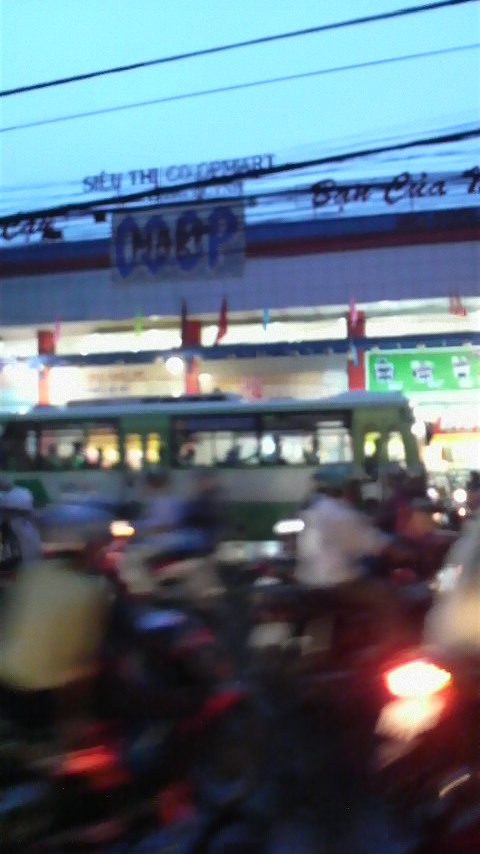
Coop supermarket on Cong Quynh Street in District 1, Ho Chi Minh City
Frantic traffic at the intersection of  Bui Thi Xuan Street and Cong Quynh Street, Ho Chi Minh City, District 1 (Vietnam, 2008) 
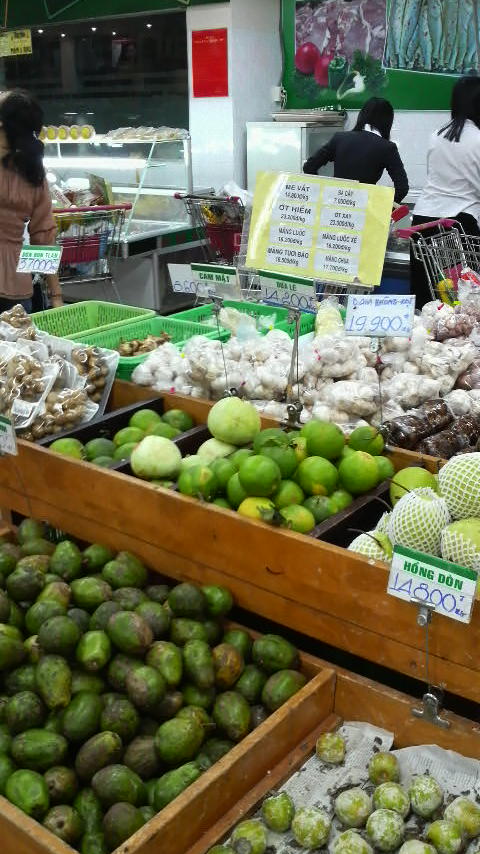
So, how do the supermarkets in Vietnam stack up to those of Barcelona, Tokyo, Reykjavík and London? Well, like Vietnam in general, I find them noisy, crowded, and often chaotic. Wheels on trolleys buckle, causing you to lurch. Last time I went shopping in the state owned Co-op Mart at the end of my adopted street, Bùi Thị Xuân Street, on Cống Quỳnh Street in Saigon, I got followed round the aisles by a pervert. He stood in front of my girlfriend N. and gestured obscenely, squeezing the air with two hands to demonstrate what he would like to do with her breasts. Maybe he was a security guard for the supermarket... I heard they don't like foreigners in that place. And a foreign guy with a local girl, that must be their worst nightmare! Guys giving me the envious eye ought to understand that my life is nothing to be envied... I ought to be envying them. Sometimes relationships aren't they're all cracked up to be... sometimes I wish I was free to fly the coop, get out and do what I want to do, drink rice wine with the old dudes in the slums, or hang out with some girls.  But whatever... the odd pervert aside, I like hanging out at the Co-op Mart on Cống Quỳnh (which they call the Co-op Mart CQ for short), and I am always happy to see what they stock. Unlike the steamy markets outside, Vietnamese supermarkets are air conditioned, and you can take your time checking out the exhibits. Racks of durians looking like medieval torture implements. A vast array of odd fruits and vegetables, with an earthiness you can sense. No genetically modified, shrink wrapped produce here (apart from the mushrooms you see below!) No style over substance, no extravagant carbon mileage. But at the same time, no persistent touts or beggars either... just the odd weirdo or pervert. Furthermore, there is no need to bargain like you do out in the wet markets for a decent price. As this photo demonstrates, all the prices are fixed.


Fruit and veg stands
Fruit and veg, Saigon Style, inside the Co-op Mart on Cong Quynh Street (Vietnam, 2008)

In the bottom right corner of this photo you can see some Hồng Dòn, which I believe are a type of Vietnamese persimmon, going for 14,800 Dong (US$0.89) per kilo (if I can read the sign correctly). They don't look nothing like the persimmons I see every late autumn and early winter in Japan, so they must be the bitter persimmons (the ones you're supposed to eat green.) However, hồng supposedly means "red" or "pink" in Vietnamese, so go figure. In any case, Vietnam is a paradise for fruit and veg lovers, and you could make a decent meal, back in your hotel or apartment, out of some of specimens at the market. Many fruits are eaten with a salt and chilli dipping sauce which might seem like a strange accompaniment at first, but is "quite possibly addictive", as Lonely Planet concedes.


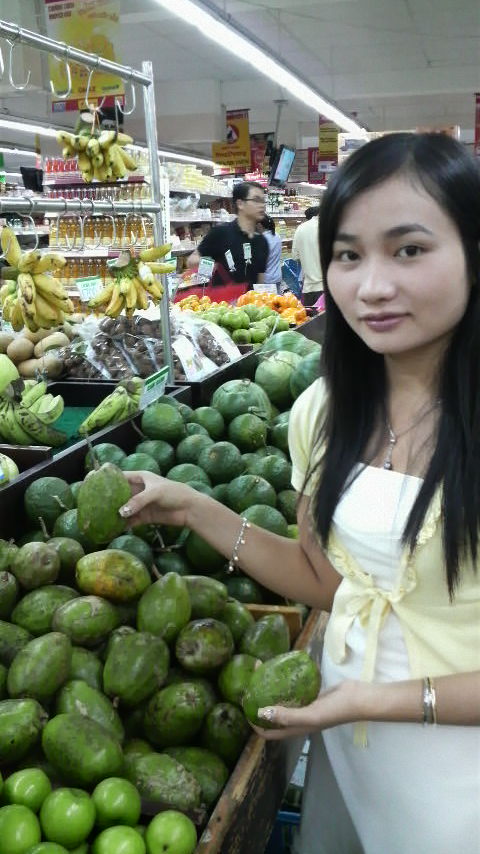
N. ascertains the freshness of this mystery fruit, at the CQ branch of the Co-op Supermarket (Vietnam, 2008)

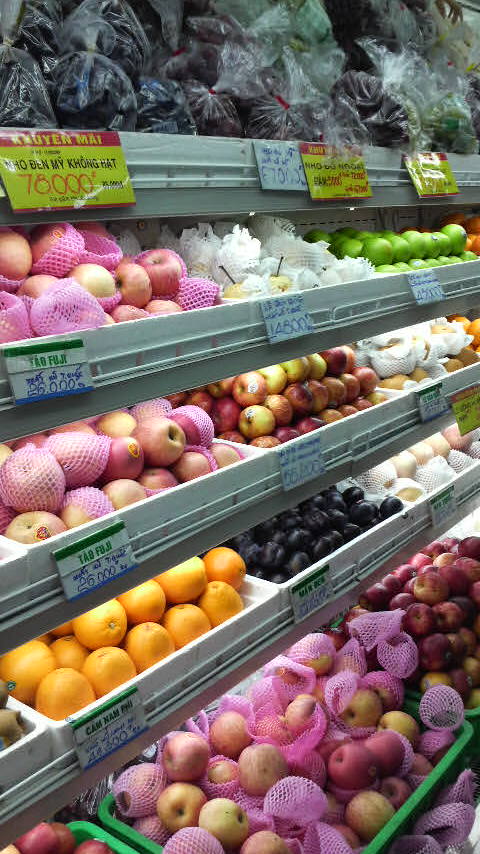
This is another fruit or vegetable I find difficult to identify. Whatever it is, it is probably grown locally -- 95% of the merchandise on sale at Co-op is locally-made or locally-grown products, according to some report I read online. They are quite unlike the type of fruit and vegetables you would see in the West. No boring apples and oranges here! Well, actually there are apples and oranges, but they're in the minority, and they are probably as exotic to locals as the Hồng Dòn are to us


Fuji apples from Japan, wrapped up like gourmet melons in Tokyo, and what seem to be oranges (Vietnam, 2008)

For some reason, milk and dairy products are huge in Vietnam. Probably too huge, in my opinion. You can get free plates and knives and forks attached with cartons of powdered baby milk, which seems a little bit suspicious to me. It seems like aggressive marketing to me, like third world exploitation, the sort that Nestlé might indulge in. Green tea is also rising in popularity in the Land of the South Viets, and you will find gallons of it in the supermarket. Ditto for the local Vietnamese coffee... well, not quite gallons, maybe tons would be a better metric. It's all instant. Back to the tea: I don't know why, but the green tea here seems more yellow than green. For some reason it doesn't work well with me, but then maybe that is my fault. The instant coffee looks like instant coffee anywhere else in the world.


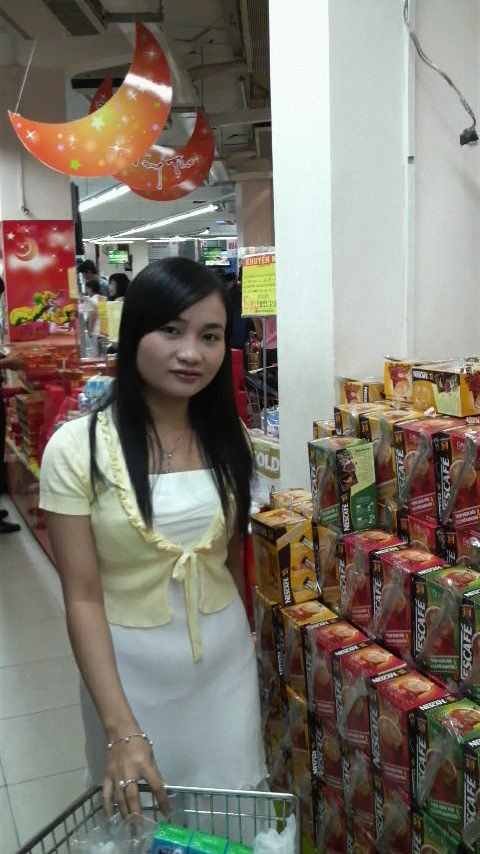
Nga in the coffee and milk goods section of local Coop Mart, a bundle of green tea flavored milk cartons in her trolley
N. with the Nescafe range, in our comfy Co-op (Vietnam, 2008)

On the topic of green tea, the venerable Thanh Nien Daily reports:

Green tea has been drunk in copious amounts by Vietnamese families at home and in restaurants for centuries.
But a recent boom in bottled green tea, made both locally and abroad, means that the traditional beverage is now competing with big names like Pepsi Cola and even bottled water.
Nga (eds. note: no relation to my girlfriend N. featured in this story), a convenience shop owner in a District 5 alley off An Duong Vuong Street, says she started selling bottled green tea – which is often sweetened with honey or sugar – when she noticed the beverages were selling like hotcakes at other local shops...


Thursday, April 5, 2007

Hue Noodle Soup

A couple of days ago I found myself with a lot of hours to kill inside Hồ Chí Minh City Airport, and to pass the time I bought a little book on sale there called The Cuisine Of Viet Nam (Nourishing a Culture). A nourishing little book it turned out to be, indeed -- it got me through the layover at Tân Sơn Nhất, and provided me ample food for thought, regarding the rich world of Vietnamese cuisine. One essay in the collection, written by Nguyệt Biều, concerned the spicy relative of phở -- Bún bò Huế (otherwise known as Huế noodle soup.) I did not know this until I read this book, but Huế is the food capital of Vietnam, and represents the culinary perfection of the nation. It is to Vietnam, perhaps, what Kyoto is to Japan, or Yogyakarta is to Indonesia. It is the soul of the nation. Nguyệt writes:
If one had to pick a single food which is reminiscent of Huế, it would be rice noodle soup with beef and pork. Huế residents prefer to buy their bún bò from street vendors, rather than in restaurants. Street vendors carry soft, thin white noodles (bún) and slices of beef (bò) and pork with them in two bamboo baskets hanging from a pole balanced across their shoulders. 
Consumers eat this noodle dish on the sidewalk, squatting on small stools right next to a pot of boiling broth. The intense fragrance rising from the pot is the greatest advertisement for this dish.
Most street vendors in Huế come from villages outside the city such as Thủy An, Phát Lát, and Vạn Vạn. In these villages, each household has one or two street vendors. Selling rice noodles is both a way of earning a living and of carrying on a family or village culinary tradition. In the morning vendors sell to regular customers, usually in small side streets or alleys. When lunchtime is almost over, they stop selling and shop for the ingredients for the next day. 
Street vendors carry one pot of broth that they can put on a portable charcoal stove, to be heated immediately. Another pot contains additional ingredients such as stewed pig trotters, grilled ground pork, beef and pork tendon, grilled crab, pig and duck blood, and thin slices of beef. On the other side of the bamboo pole is a container of fresh rice noodles and seasonings like onions, scallions, chili peppers, fish sauce, bean sprouts, banana flowers and diced lettuce. Finally, the baskets contain bowls, spoons, chopsticks, a basin for washing, napkins, toothpicks, a tank of green ginger tea, and a few stools: truly a moveable feast. 
Bún bò Huế is completely unpretentious. Its charm lies solely in its fragrance. According to the women who sell rice noodles at Bến Ngự Market, the broth must be delicious above all else: clear in colour with a balance between the salty and sweet flavours of stewed beef bones, pork bones, and chicken.
Vendors tailor each bowl to the customers' desires. In the winter, customers sit next to the red-hot stove and the boiling broth, covering their bowls with their hands, slurping the broth, skewering the noodles with their chopsticks, and biting into pieces of meat. Even food connoisseurs in Hà Nội and Hồ Chí Minh City admit to a love of bún bò Huế, especially when it is served in Huế.

Sunday, December 3, 2006

Sunshine and the Gloom: Reprise

After my successful date with Tomomi last night, I awoke to a sunny and generally pleasant Sunday, this being one of the mildest winters on record. I had an appointment with my old salaryman friend Tanaka-san at 4pm; he wanted me to transcribe the lyrics of a Country&Western song his partner was planning to sing in Osaka (大阪). I met him at Breaks Cafe at Ueno Station, and transcribed his lyrics. After that we marched briskly through the settling cold and madding crowds, down the bleak concrete lanes, to the Himonoya Restaurant in Okachimachi (御徒町). Tanaka-san had spotted the place from the train on the Yamanote Line as he passed on his daily business, and he was keen to check it out. Naturally, the shout was on him.


Himonoya, specializing in sundried cuisine, at Okachimachi (Japan, 2006)

The servings started with a complementary cabbage -- you better believe it a whole cabbage, which we ate with a smearing of slightly spiced mayonnaise. I am not a green veg buff by any means but this cabbage tasted amazing -- "it is fresh," Tanaka-san succinctly remarked. There followed a series of sundried seafood dishes, in the himono tradition -- Tanaka-san sent one of them back to the kitchen for having too much akaimono (red stuff) inside. Apart from the fish, the menu boasted grilled nasu (eggplant) and fried duck (鴨つくね) served with what looked suspiciously like a duck's egg. Who said the Japanese weren't adventurous eaters! There were also plenty of onigiri rice balls, some of them of tremendous proportions. Scary! Naturally, a full spread of Japanese rice wine and beers accompanied the feast. I took a few photos, and sent one or two of them to Tomomi. I returned home feeling elated, basking in the afterglow. The gloom in my heart was lifting. It's funny how your life can turn around, so quickly.


With a new job and a new girlfriend, I have achieved the aims of July 2006. So, let's bask for a while! Breaking free from Kidea is a longterm goal, and I have already come quite far, with 2.5 free days! Since money is the key to power I should focus on repaying my credit debt. There are too many  interesting things happening in Japan to worry about the implementation of Intermediate International Vagabondancy just yet. However, I have laid the foundations of this coming phase of my life.


Himonoya: 5-19-6 Ueno, Taito Ward, Tokyo, Japan. Phone: (03) 3831 8804.

Wednesday, January 11, 2006

Making Mochi, and Appeasing the Gods (New Year in Shikoku)

One of my goals for the Great Shikoku Sojourn of 2005/06 was to enjoy a traditional Japanese New Year. As reported earlier, I passed New Years Eve last year in a sleazedive Roppongi club and while there is nothing wrong with that, this year I wanted to do things differently. Luckily for me, my adopted family in Shikoku always celebrate New Years the traditional way -- unlike a lot of Japanese these days who opt out for a vacation to Hawaii, or spend New Years Day eating take-out sushi or even Domino's Pizza. Actually, Pizza Hut now deliver their own New Years Day family meal in Tokyo, which costs an astonishing US$120 (as I recently discovered.) But I didn't want to eat anything from Pizza Hut this Japanese New Year, or do anything US military-related socially-wise. I wanted to do things the old school way, Bushi "Way of the Warrior" style. Luckily for me, the gods of Shikoku were on my side. They granted me my wish, and so I will remain forever in their debt, eternally.

My newly adopted grandmother and grandfather are certainly old school in how they live -- they're up every day at 4am to do all the chores that need to be done, like picking vegetables or making presentations to the gods which live all around their country house. I decided to emulate them while I was on their island, for a couple of days at least. Well, I knew I would never be able to get up at 4am, but I wanted to enjoy all the clean-living fun of rural Japan -- working in the fields, taking the dog for a walk in the bamboo thickets, drinking warm sake under the warm warm kotatsu. On my first full day in Shikoku, I was able to participate in another chore, a particularly sacred one -- the making of mochi rice cakes.

Before we go on, I ought to explain... what are mochi rice cakes, exactly, and what do they mean to the Japanese people? Let's go to one of the popular sources of modern times: Wikipedia! Wikipedia says: "Mochi (Japanese 餅) is the Japanese variant of Chinese rice cake, which, like its Chinese origin, is made of glutinous rice, pounded into paste and molded into shape; however, unlike the Chinese variety, it is molded right after it is pounded, whereas the Chinese variety is baked once again after to solidify the mixture as well as sanitize it. Traditionally in Japan, it is made in a ceremony called mochitsuki. It may also be made in an automatic mochi machine, similar to a breadmaker. In Korea, a nearly identical food is called duk (also spelled dduk, duek, d'uk, or tteok)." (Ed's note: those Koreans have a knack of giving the same basic food a million different names -- see my Korean Dog Soup Page for more comfirmation of this!)

On the subject of Mochitsuki, which is the ceremony I was blessed to participate in, Wikipedia continues: "Polished glutinous rice is soaked overnight and cooked (eds note: see first picture in the series below: the rice is being steamed in a traditional mushiki here.) The rice is pounded with wooden mallets (kine) in a traditional mortar (usu). Two people will alternate the work, one pounding and the other turning and wetting the mochi. The mochi must be kept wet to keep it from sticking to the mallet. The sticky mass is then formed into various shapes (usually a sphere or cube)."


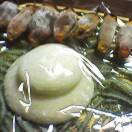
Rice being steamed in a traditional Japanese mushiki steamer to make mochi rice cakesMochi rice cakes soft and tender as moons

That's making mochi in a nutshell: a lot of steaming, a lot of pounding, and a lot of kneading into the desired usually moon-like shape. What you end up with a lump of soft, sticky, gooey, glutinous goodness. They taste somewhat bland perhaps, although you can spice them up coating them with various substances, or stuffing them with red bean paste or even ice cream (that last item is not particularly old school though!) In the photo block beneath you can see another variant being made -- grass mochi! Kusa mochi (Japanese: 草餅), also known as yomogi mochi, is a Japanese sweet, and despite the name is made not from grass but rather mugwort.


Grass mochi being made from burdockGreen grass mochi being made

Yes sirree, the Japanese love cooking and eating these rice cakes at New Years Eve, although they are often eaten elsewhere in the year. Japanese also love presenting the mochi to the gods, to thank and honor them and to ensure good fortune in the following year. It is interesting that throughout human history, all over the world people have felt compelled to offer sacrifices to the Higher Beings, in order to win their appeasement and their approval. I was reading Homer's The Odyssey last year, and what impressed me the most, apart from the brutality of the climax, was how on almost every second page one of the heroes burnt up a pile of bovine thigh bones, or a rack of juicy steaks, to satisfy Zeus and his ilk. Now they don't practice animal sacrifice in Japan, but they do have plenty of reverence for the gods -- and there are literally millions of gods in this country. They don't sacrifice animals, but they do sacrifice food, which must have meant a big loss of resources back in the old days when there were a lot of hungry mouths to feed.

One thing I ought to point out right here is that New Years Day is celebrated in a completely different way in the East than it is in the West. In Japan/Korea/China/Vietnam New Years Eve/Day is kind of similar to the western idea of Christmas in that it is a day for family get-togethers, quiet reflection and acts of religious devotion, the consumption of vast quantities of food, dozing off in armchairs, getting up late and basically taking it easily. Ironically, Christmas Eve is the time to party in Japan, and many couples ask each other out on dates on this day; going to Kentucky Fried Chicken is especially popular. Go figure! So in other words, the Japanese New Year is our Christmas, and our New Year is their Christmas, in a manner of speaking! One of the things Japanese people do on New Years Day, apart from eating and drinking a lot of substances themselves, is that they make offering to the gods. At the home of my adopted family in Shikoku, they honor and partake in a particular tradition, which I call making mochi trees. Actually, it is only one tree they make, a small typically Japanese bonsai style fake tree, basically a stick skeleton hung with colorful shiny baubles and -- get this -- little pieces of mochi, rolled up to make what are called mochibana (rice cake flowers). The little stick tree is then propped up in front of the household altar, in the belief that the gods will come and eat the flour flowers, while the humans are off enjoying themselves devouring osechi ryori and sinking sake elsewhere in the house.


Small pieces of mochi rice cakes are applied to branches of a Japanese New Year TreeWhen fully decorated, the tree will be presented as an offering to the household godsMochi is a food loved by Japanese people, so Japanese people figure that the gods love it as well!

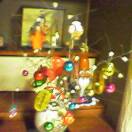
In the photo bar above, you can see mochibana being applied to the branches of the fake tree, by my girl C. In the photo bar beneath, you can see the mochi tree in all its colorful glory, before the household altar. The final photos display more substantial fare for the gods -- a full tray of shrinkwrapped rice cakes ready for Divine Degustation. There are also some dried kaki (persimmon) and a whole salted fish, if any spiritual beings take a fancy to that.

The mochi tree decorated with colored lights and deemed presentable to the godsA fully prepared mochi tree
The finished product wrapped and ready for presentation to the GodsMochi presented to the gods


The idea of leaving fish and dried foods on an altar in your house for invisible beings to eat might seem strange to us westerners, but we do have some similar practices of our own. In a lot of countries people leave out glasses of warm milk (or cold beer, in Australia) for Santa Claus to drink on his annual visit, and there is a carrot in every house for the Easter Bunny. In some countries, children who have lost teeth put them in a glass of water beside their bed, and in the morning they are transformed into money! Perhaps Santa and the Easter Bunny and the Tooth Fairy are all we left of our pagan animist past. In Japan in the animist past lives on. In Japan animism never died.

Like many other things in Japan, mochi plays a spiritual role in life. Every village or town has its own special ways of using it in its religious rites and customs. In the small town of Aratano (Tokushima Prefecture) in Shikoku, for example, a festival is celebrated in the early New Year called Mochi Nage, or "Thrown Mochi". The idea behind Mochi Nage is disarmingly simple: people turn up at the local Shinto shrine, some shrine workers come out with bags of cooked (and I assume blessed) rice cakes, wrapped in plastic for hygiene, and proceed to hurl them at the assembled crowds. Little kids dash about, catching or picking up as many of the rice cakes as they can bundle into their arms. Old ladies push younger countrymen/women aside in the mad melee. Perhaps some fire works are discharged. At the Mochi Nage festival I attended at Aratano, I got pelted by a couple of the thrown cakes, which are actually quite hard and could easily "take an eye out", if you were hit the right way. I also managed to collect a big bag full of mochi, and this bag was eyed enviously by some of the local kids in attendance there. The gods were on my side; I managed to do a good job.

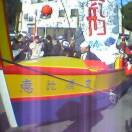
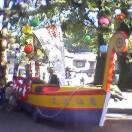
The mochi boat is rolled through the streets of Aratano, dispensing mochi rice cakes all the wayThis is just one of the many mochi-nage festivals held throughout Japan at New Years timeResidents of Aratano follow the mochi boat in hope of scoring some rice cakes
Mochi is a food loved by Japanese people, and is used in many religious festivalsThe closest thing to a state sponsored riot in Japan, the regular mochi nage festivalPart food fight and part holy rite, the mochi nage festival in Japan
Shinto mochi nage festival in JapanMochi nage festival in Shikoku, JapanThe small Shinto shrine in Tokushima Prefecture, Shikoku, home to an annual mochi nage festival


In the photo bar above, you can see photos from the Mochi Nage festivities at Aratano. In this town's version of Mochi Nage, a colorful boat-like vehicle (actually a converted car) is first rolled through the streets, attracting a crowd of eager scavengers. Like a Pied Piper, the car led us on to the local shrine where the proper rice cake chucking and catching sessions began -- and as I already mentioned, I ended up scooping up much of the venerable little goodies (attribute that to luck, or perhaps to favor of the mochi gods!)

Mochi Nage celebrations are also held to bless the construction of a new house, according to some reports I have read on the Internet. As Amy Chavez has reported: "Japan must be the only country where throwing food is not only acceptable but encouraged. Whole neighborhoods gather to throw food at each other in a tradition called Mochi Nage or, throwing rice cakes. No ceremony in Japan is complete without mochi, a symbol of happiness. In the old days, they probably threw only rice cakes, but these days they throw anything from packaged store-bought bread to bags of chips and instant ramen -- modern symbols of happiness..."

Whether we be human or animal or vegetable or god, all we want is the same thing in life: recognition for our existence and our efforts, and perhaps a bit of love and respect served on the top. That is what mochi encapsulates, and celebrates: the awareness that life is a ritual in which everyone must play their part, and in which every part is glorious. Witness the life cycle of this critter: pounded out of generous grains nurtured by the Four Elements, molded into moon shapes, then offered to the local deities, or tossed to little kids and grandmothers at the shrine... isn't this all just a celebration of the earth, a celebration of what the Earth can offer? We take from the earth and give back to it, and then it gives back to us, etc. The cycle keeps on repeating, endlessly. Creating abundance out of scarcity, rebirth out of decay, a New Year from the Old. The cycle never ends. The gods of Shikoku taught me all this, and more. In time, I might teach them a thing or two! In a couple of lifetimes or so.

Wednesday, November 3, 2004

Techscapes and Macrobiotic Highs: An Afternoon in Aoyama

Tokyo is the ultimate urban jungle and life here presents you with endless vistas of cunningly contrived concoctions of glass, concrete and steel, everywhere you look, and seemingly everywhere you go. Whether downtown or in the 'burbs, at home or on the streets, futuristic scenes surround you, seduce you, and astound you to the extent you start to feel like you're the star of your very own Blade Runner fantasy, playing in a cinema in another dimension. Futurism is the name of the game here, the dominant architectural theme, and it has been entrenched for so long it has written itself into the fossil record of the city, as well as the DNA of its inhabitants. It's a shrine to speed, a temple to technology; frenetic as a Drum&Bass track, and just as relentless. Sometimes it is just all too noisy, and all too totalitarian, and you long for a bit of old fashioned peace, a bit of the original 和 ("harmony", the former name for Japan). Interestingly enough, not all of the futurism in Tokyo is new, and some of it looks decidedly dated... that might seem paradoxical until you realize that futurism is a movement not an era, and tomorrow is a day that never dawns. Follow the tracks of the Yamanote Line between Kanda and Akihabara, for example, and you will find older incarnations of the genre, pylons, noodle shops dug under the train lines, slabs of concrete corroded by rust, untidy bundles of wires strung up wherever they will hang, and archaic air-conditioning vents spinning in the morning humidity... pretty it ain't but back in its time this was probably the most high-tech place on Earth, and the very vision of a glorious future. Who were the dreamers who imagined this city into being? I ask myself sometimes, when I am wandering around, what inspired their stupendous leap of imagination? If futurism is just a style, in other words, who invented it, and why? I believe that the official Futurism, the one that gets a capital F, was an Italian artistic movement, an anarchist movement of sorts with Fascist complications, which flared into life in the early 20th Century. Leading proponents of the movement, notably Filippo Tommaso Marinetti, Giacomo Balla, and Umberto Boccioni, glorified fast cars and rogue locomotives and good factory mud, scorned women, proclaimed that war was "the world's only hygiene", and proposed a Khmer Rouge style solution to the "problem" of tradition. According to the Futurist manifesto and the manifestos which followed, museums and libraries should be burnt to the ground or drowned, and the city torn down and built again, from scratch, by every new generation. "Time and Space died yesterday," Marinetti wrote in the first manifesto, published in 1909. "We are already living in the absolute, since we have already created eternal, omnipresent speed." I don't know if there was any direct link between the European Futurists and Japan, although the Axis would later lead them into an ideological marriage, for a short time at least. Perhaps it doesn't matter whether there was a connection or not, this might rather be an example of synchronicity, of the Jungian kind. The way I figure it, in modern societies we all have a vision of how the future should look, each according to our own hopes and fears: it could be hyper-consumerist, neo-communalist, conformist, the brainwashed masses of 1984, or the individualist paradise symbolized by the jetpack and the Martian colonies in the works of Robert A. Heinlein. Others might imagine a world which is pacifist, Deep Ecologist, or perhaps populated by Mad Max warriors roaming the deserts fighting Google and its cyborg spawn. Disparate visions these are indeed, but where they intersect collective dreams emerge, lowest common denominator blueprints: in our case rockets and the atomic bomb, freeways and the motorcar, more recently celebrity culture, TV, and the Internet. Everything shiny and sci-fi, mind you, everyone air-brushed and glittery (and on that matter, note that you never see rust on The Enterprise. Nor do they have any astrologers or Feng Shui geomancers on the bridge! Why is that? What kind of technocentrism is being pushed?) In Asia, things turned out shiny and sci-fi, too, but much of the detail is different. Why so? I speculate that there was in fact a homegrown futurism in Japan, a Zen/Shinto futurism, which culminated not just in the Mitsubishi Zero, but also DoraemonGundamanime, and all these self-flushing toilets you find here today. Futurism may have dreamed of demolishing the ancient cities of Europe but it never succeeded there, the sway of the past was too strong. Tokyo, on the other hand, has always been a city in constant flux -- a chaotic frenzy of construction and destruction -- and Marinetti's Year Zero fantasies finally found their realization beneath a Pacific sky. Accordingly, I consider Tokyo to be one of the world's foremost "techscapes" -- an environment in which the landscape has been totally subsumed by the laws and logic of the megalopolis, and the technology which enables it. It is also a city so detailed, but yet so vast, you could spend years here and keep making amazing discoveries. I discovered something amazing today, actually, with my old girlfriend Akiko: the new Prada showroom in Aoyama. The latter half of this post concerns that discovery. A little earlier in the day, Akiko and I dined at one of Tokyo's quality vegetarian restaurants, Hanada Rosso, which the first half of this post will describe. All in all it was a very cool afternoon indeed, and the coolest aspect of the whole thing is, I believe that Paper Burning made it happen. It is a bold claim, but I stand by it!


High-tech beehive: Prada Showroom in Aoyama (Japan, 2004)
Branded as Tokyo's version of Milan's Via Montenapoleone and one of the top three shopping and entertainment hubs in the city, Aoyama (青山) and the neighboring Omotesandou (表参道) precinct is jammed with quirky boutiques, cute cafes, beauty salons, and even a United Nations University campus. There are plenty of restaurants as well, ranging from sushi joints to expensive French and Turkish eateries. Today with Akiko, a vehement vegetarian, I ventured to a classy macrobiotic restaurant called Hanada Rosso. Hanada Rosso has a policy which states, uncompromisingly: "Non-meat, non-milk, non-egg, non-chemical". When the menu appeared, Akiko and I both ordered the same dish: the Tempe-Burger, a tofu contrivance costing ¥1050. Possibly I followed her lead in ordering here, I am not sure why. But it was a good choice: not only was it delicious, but it left me with a peculiar feeling of satisfaction after eating it -- a kind of purity you might say, a sense of clarity, a macrobiotic high! I felt satisfied but not full at all. Perhaps it was because this food was spiritual food, free of harmful chemicals, lovingly prepared, with no bad dead animal karma to go along with it. Or perhaps it was because of the Korean Shizandra berry smart drug I had ingested just before the date, or even just because I was so glad to see Akiko again, after all our time apart!

Vegetarians visiting Japan often complain about their problems finding suitable food in the country. John Howley maintains a list of Japanese vegetarian restaurants on his website, mentioning only 20 establishments for the Greater Tokyo area -- a conurbation of 20 million people. So, that it is roughly one vegetarian restaurant for every million people (of course, there must be many which have flown under Howley's radar, but still, you get the drift!) Japan is not a vegetarian Utopia by any means, and this fact might seem surprising given its Buddhist past and all, the veneration shown to non-animate entities such as rivers and stones. People don't go heavy on the beef like they do in Australia or the States, but there is usually a certain amount of meat mixed into every meal in Japan -- even tofu gets doused in shaved fish! For vegetarians like my Akiko, trying to educate the masses, all this meat can make life a misery. However, there are vegetarian restaurants around, and if you are in Tokyo, I would recommend a visit to the Hanada Rosso. As well as a delicious range of main courses, the menu features organic beer and wine, soy shakes and organic coffee. The restaurant is located on the second floor of the Sleeve Building, 6-11-1 South Aoyama. The telephone number is (03) 3406 1264.


Having enjoyed a memorable hour or two at Hanada Rosso, playing some personality quiz games I have lately employed for nampa, it was time to hit the streets, and look at the surrounding attractions. We walked into the nearby Idee interior design shop to admire its ample Scandinavian and European displays. It was there, looking out the window, I caught sight of a particularly weird building in the distance, a building audacious even by Tokyo standards -- a crystalline pentagonal green pyramid which Akiko identified as the new Prada showroom. Although neither of us are brand label junkies (nothing could be further from the truth), we decided to make a beeline to the hive-like Prada showroom, to see what the fuss is all about.

Designed by Jacques Herzog and Pierre de Meuron, the building rises from the street like a kaleidoscope, covered with bulbous, diamond-shaped windows. Once inside, those bulbous windows start to distort your senses, making the showroom seem both very big and very small, both at the same time! In fact, "kaleidoscopic" is the best way to describe this building, which is more a piece of art than just a mere showroom. Things always seem to shapeshift when you are inside it. While the outside is green crystal, the interior is a kind of stark white/pearl color which is both soft (in the carpet sense) and futuristic, reminiscent of a UFO. TV sets dangle on stalks from the ceiling, like anemone hunting for prey. Stairs lead to deep-set lounge recesses, where windows afford views of local landmarks, such as Roppongi Hills. It is all very cool, and I couldn't resist snapping off some photos on my keitai phone, even though I was reprimanded for it. 


We ended the afternoon at a cafe where Akiko showed me her iPod, a device I had never seen up close before. Scrolling through her Beatles collection over a Cafe Mocha, I had to confess her contraption made my own Sony MP3 player look a little bit silly, a little redundant. Such a shiny toy her iPod was, high-tech, but also organic... in many ways it was just like the organic high-tech Prada Showroom we had just explored, or a polished stone in a shrine that had miraculously come to life, and revealed its spirit to the world! Like the Tempe-Burger I had consumed earlier in the day, just like that Shizandra smart drug, this gadget seemed designed to lift your consciousness into a higher state of being. It wasn't Japanese, but it was still Shinto, and it was still Zen. It was not only Zen, but it was also a vision, and a visitor from the future. A future which, even now, is slowly dragging itself into manifestation, into being. The iPods are merely the vanguards of what is to come. Much as I hate to admit it, the vegetarians are probably much the same. Thus we have been warned. Watch this space for more!
Related Posts Plugin for WordPress, Blogger...