Adsense Top Bar

Showing posts with label Japan. Show all posts

Sunday, May 28, 2023

Stumble on Baby Step #2

For every six hotels I stay at going forward, one will be like Hotel Gosford, and one will be comparable to the Bayview Hotel at Woy Woy, which I have just checked out of. Yet another will be like the Ocean Beach Hotel (Nightcap at Umina), my next step on the road, where I will still be staying in a pub, but at least I will have my own toilet. The Nightcap will be grade 3, while the Metro Mirage in Newport will be one step above, at level four. Hotel Gosford has been the grungiest of my hotels thus far, partly due to its location, as well as facilities and clientele. Bayview Hotel is just as cheap as Hotel Gosford, but has a friendlier vibe, and a sunnier outlook. That might be due to its location, and the demographics of the city. 

In Woy Woy the population is more gentrified, genteel, and geriatric. Local motorists stop for you when you are crossing the road, rather than beep their horn as in Gosford. There are a lot of zebra crossings... too many, in fact! I feel guilty holding up the traffic. My room was facing north, and directly opposite the Central Coast Ferries wharf on Brisbane Water, which is critical for my attempts to knock off the first two six baby steps out of the Central Coast. All things considered, it was quite cozy, though a little dated.


Afternoon sun in the standard Queen room at the Bayview Hotel (Australia, 2023)

The only problem was that there was no table nor chair, so I was forced to sit on the floor with my laptop resting on the side of the bed for my lessons for iTalki. And while sitting on the floor might be comfortable in Japan, where homes and hotels are often built around this discipline, Australian accommodation is not as accommodating. Carpets can be dusty and unhygienic, with none of the spring of your typical tatami mat. After a couple of hours of sitting crosslegged I would get sore legs, numb extremities, even muscular spasms. I assumed that I would get used to it eventually.

That said, I ticked off the first of the my baby steps easily enough. To be fair, I was suffering mild derealization upon arriving at Davistown, after talking to the boy with the toy brontosaurus on the boat, and the Elvis impersonator at the bus stop on Paringa Avenue, near the shops. In retrospect, my anxiety level seemed to be about 1.7 Distress Units (DU). After that early success, I was confident and complacent (which is always a dangerous combination). Unfortunately, the second baby step to Empire Bay on the other side of Cockle Channel didn't go so smoothly. It was a stormy day, and I had foolishly left my raincoat in the hotel, thinking that it wouldnt rain until evening. As soon as I arrived at the wharf, it started pelting down... (For the full report of my setback on the catamaran to Empire Bay, click here.)

Saturday, December 14, 2019

Ded Moroz, and the Defecating Log: Christmas Around the World

SEASON'S GREETINGS!

One of the fascinating things about travelling and visiting new countries is learning about the colourful and unique festivals that exist out there. Now while I don't travel as much as I used to, I am able to explore the world vicariously, through my job on iTalki, and my online wanderings. It has become clear to me that Christmas is a global event, celebrated on every continent. The way it is celebrated differs starkly, however, depending on the locality. Not every country has a Santa Claus, and Santa doesn't always ride in a sleigh. In Spain the Three Wise Men deliver presents to children, which kind of makes sense, since they gifted gold, frankincense and myrrh to baby Jesus in the Bible. In Holland they have a Santa but he lives in Spain and sails to and from the Dutch homeland by boat. Go figure. Russian children send letters to Ded Moroz, a bearded old man who resides in Vologda near the North Pole, and whose name means "Father Frost". He walks with a long magic staff and sometimes rides a troika.


The Christmas Shitter (El Caganer), and El Tio (Australia, 2019)

I believe there is a relationship between Christmas and New Year's Day in that they offer a glimmer of hope in the midst of winter. They both arrive just after the winter solstice, the most desperate time of all, but they promise that the light/sun/Son will return. It might be faint and distant, but the light is there and can be seen, twinkling through the hoary boles. The rebirth has begun... (To read my full account of how Christmas is celebrated around the world, click here.)
Monday, June 12, 2017

Asakusa Food: 11 of the Most Fabulous Restaurants and Cafes!

When I first arrived in Asakusa, money was too tight to mention. I had overextended myself in Sumatra and Singapore on the way to Japan, and I was also having trouble accessing my credit. Finding work in Tokyo hadn't proved too difficult, but getting paid was. Fortunately, I was staying in one of the cheapest places in Asakusa, with a master of austerity. The proprietor pointed out plenty of local bargains, for example the infamous beef bowl round the corner (¥280 for the regular size). There was an Ethiopian guy at the ryokan who was hardbudgeting, eating every meal at Yoshinoya, or occasionally picking up a cutpriced bento box. I might have been short of cash, but I wasn't quite that desperate yet... I supplemented my diet with Mos Burger and sushi... (For the full review of the Asakusa dining scene, click here.)


Thursday, August 8, 2013

The 7 Hindrances, and the 20% Accomplishment Rule

I might dream of conquering the world, but Reality reminds me that we rarely achieve more than just a fraction of our goals. How much of a fraction is a troubling question -- from my experience it could be a quarter, it might be just a fifth. In the summer of 2006 I was enthralled by a Utopian hope: despite my deepening debt I sincerely believed that medical trials could save me, and manifest for me the jetsetter life I was craving for. Not only would I be able to kick back in Kagoshima (鹿児島) with the cool kids, living it large, but I could use the payments from each trial to party around the planet. Of course, it never worked out that way, and Telephone English (TE) became my actual saviour. Here was evidence of the 25% Accomplishment Rule in action... I didn't qualify as a lab rat, but I was delivered from poverty just in the nick of time, and pumped full of cash. Some of my goal was realized, to be sure, but not all of it, and that was the thing. There were a few Hindrances standing in the way: love was one of them; health, another...

When I started teaching at TE I had big plans to take two months off every year and fly off to Thailand, Iceland, Australia and destinations even further afield, such as Jamaica. In the end I got stuck at my first port of call in Ho Chi Minh City, Vietnam, and most of my funds were squandered there, entranced as I was by tropical romance. I did score a short stopover in Bangkok and two trips to Australia, but much as I would have liked it, I never reached Iceland. Jamaica was completely out of the question. So, my original plan was only partly achieved (25% achieved, perhaps, or only 20%, I haven't figured out the exact percentage!) I had a lot of fun nonetheless and Nga became a cause in herself, a Baudrillardian seduction... she derailed my plans, blew my budget, and in the end I accomplished only a quarter of my aim, or even less than that (how much? how much?) In 2011 I quit TE and abandoned Japan and returned back to Australia, where I the One World Orbit was conceived. Imagining that Google Adsense could free me from employment entirely, I researched the cost of living in Indochina, which various guidebooks suggested was the cheapest region on Earth. I intended to spend three years jaunting around Cambodia, Laos, Vietnam, northern Thailand, and southern China, mucking about on the Mighty Mekong (the Great River, the River of Nine Dragons, ແມ່ນ້ຳຂອງ, 湄公河, etc, etc.) I called it the Indochinese Triennium. It would have been perfect, but my Adsense collapsed, and then I lost Indochina. All I have left is China, which is one-half of Indochina, semantically speaking, but pragmatically much less than that. It is just one-fifth of my original plan, or even a sixth. Furthermore, when I go to China I will have to work to survive, at some school like Wall Street. It sucks but it is better than nothing, and at least I will be back on the road. I can always visit Cambodia in my holidays, and plenty of other nearby nations! That is, if the Seven Hindrances give their assent.

Wednesday, May 29, 2013

Indians in Japan

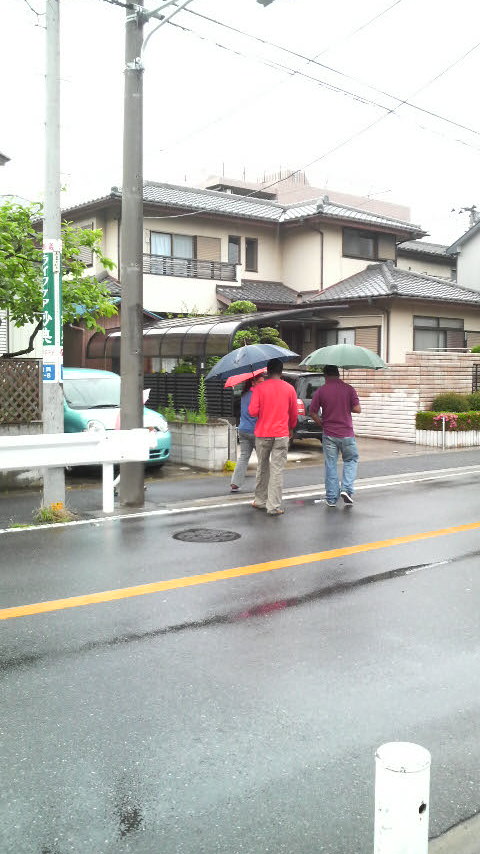
When I lived in Japan I used to see Indians almost every day, just about every day. They were practically everywhere, at least in Tokyo and its surrounds, where I spent most of my time: teaching English, running supermarkets, working in IT; you'd see couples or whole families strolling under parasols through wet Myoden (妙典) on the way to the recycled clothes store at Gyotoku (行徳), or jogging on the concrete banks of the Arakawa River (荒川) in Hirai (平井), or jostling along with the rest of human tide in Shinjuku (新宿) where Indian and Pakistani and Bangladeshi restaurants always did a good trade, and Indian food was popular, perennially. I probably noticed them more because I happened to live in Shinozaki in the Edogawa Ward of Tokyo, which was (and still is) renowned for being one of the centers of the Indian diaspora in Japan. There was an Indian kindergarten/preschool/elementary school/high school just down the road from my old place, near Mizue Station in South Shinozaki. There were plenty of Indians on the train, the Toei Shinjuku Line train. For some reason the Indians tended to congregate in the first carriage, it had become a local tradition. According to statistics there were 22,000 Indians living in Japan in 2010, but there actually seemed to be a lot more. That might because as a foreigner I tended to notice other foreigners easily, and Indians stuck out from the crowd just as much as I did.

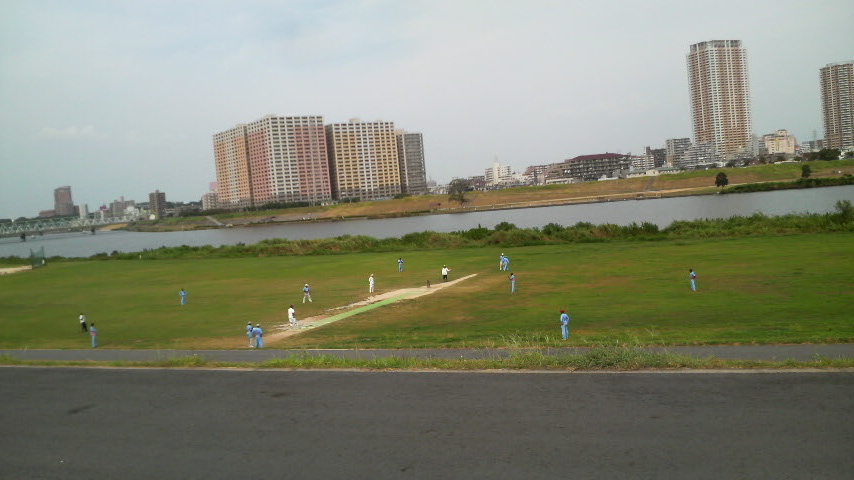
Baseball is the choice of sport in Japan, but the growing Indian community is bringing a bit of cricket action to the floodplains of the country!
Indian cricket game on the bank of the Edogawa River, facing Ichikawa City, surrounded by baseball fields.
Being a nomad myself, I am always interested to meet fellow wayfarers in strange parts of the world, and understand what motivated them to leave the safety and security of home. I also have an interest in ethnic enclaves in general, like the eccentric Ethiopian congregation on the roof of the Church of the Holy Sepulchre in Jerusalem, or the Icelandic/Scandinavian towns on the North American plains. About five years ago (late 2007) I was invited to dinner by Umesh my old Nepali friend in Koenji in west Tokyo, and in the process, I got a glimpse of just how the subcontinental community in Japan lives. Like my own neighborhood in Shinozaki, Koenji has become a magnet in recent years to guest workers and opportunists from the subcontinent: Umesh said his ageing apartment building was owned by a Pakistani. His next-door neighbor was an Indian, and the cold concrete passageway outside the house was more than tinged with the scent of curry. What proved interesting to me, as I dined with Umesh and his wife, was the education into how modern Diasporics use new technology to connect with each other and entertain themselves in their adopted countries. In short: I never used to be much of an Indian movie fan, but if I spend more time at Umesh's house in the concrete heights of Koenji, I will become one.

Indian family or group seen near Myoden in Urayasu City, Chiba Prefecture
Myoden, a quiet suburban region near Urayasu in Chiba Prefecture, boasts a large Indian community, as well as an Indian kindergarten.
Roughly two months after, in February 2008, I returned to Koenji to see Umesh -- it was a truly brutal Sunday afternoon, wind blowing a gale and cold as hell. Things looked warmer in Koenji's PAL Arcade however, with curry shops all over the place, and the atmosphere positively screaming Little India, as the Japanese "king of subculture" Jyun Miura once observed. Umesh made some steaming food and we cracked open a few bottles of beer, ice cold of course. It was cricket season down Under, and Umesh was following the action in the India vs Australia One Day game at the SCG -- not on TV or radio or online TV, but rather watching a text feed updated delivery by delivery, over by over, over the computer. It was like watching a scoreboard -- changes in the numbers denoted action, a leg-bye here, a boundary there. About as far from high fidelity as you can imagine, but at least it was live (real time), and it was in its own way, absolutely riveting (admittedly, it was an unusually exciting match.) Umesh was barracking for the Indians, and I was barracking for the Aussies, and we were drinking big bottles of Asahi beer, and downing a range of Nepali treats. There was no picture and there was no sound, but we had the power of imagination (the world's first Virtual Reality.) In my mind's eye I see it all: the Indians rallying valiantly, in the closing overs, to reach Australia's 7/317 (they were eventually dismissed for 299.)

PAL Arcade in Koenji, the heart of Tokyo's "Little India".
We had no audio, but you didn't need ears to hear the taunts which must have belched from the stands at the Sydney Cricket Ground every time an Indian tail-enders put bat on ball, and darted up to the other end of the wicket. You could feel the tension in the air, as the old cliche goes, even this far away, in wintry Japan... the atmosphere was boiling over. At home in Australia, I could well imagine my Dad cursing at the TV and perhaps even launching the remote-con at the screen, once it dawned on him that India might have a chance of winning. But then Sharma was bowled out by Lee, and everything was golden again, Down Under. Rapturous cheers, and grinning commentators delivering their post-mortems. It was a vivid moment which proved to me that sometimes imagination outclasses technology; and the nearest memory it evoked, was listening to the action at Lords on shortwave radio, when I was about eight-years-old and living on the NSW Central Coast. Those were the days when books had better special effects, than the Hollywood recreations of them (I am thinking in particular of JRR Tolkien's The Lord of the Rings, or Baz Lurhmann's The Great Gatsby). The following night, at my singing job in Shinjuku, I related the story to my Kiwi coworker D. "It is a pity there is nowhere on the Internet you can watch the cricket live," I remarked. "But there is," D. said. "Why don't you try Sopcast? There is some Indian guy running it, feeding cable TV live on to the Net."

Saturday, May 18, 2013

Vintage Shibuya

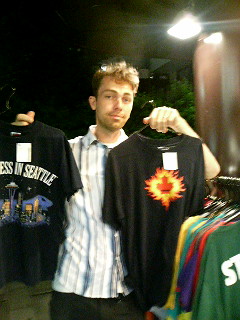
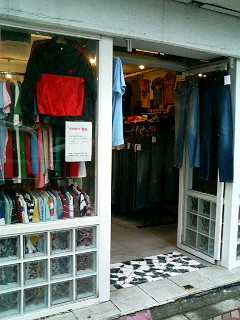
On the streets of ShibuyaOne of the first places I visited in Japan was Shibuya (渋谷), the jubilant youth fashion quarter south of Shinjuku, on the prosperous west side of Tokyo. The date was November 11 2000, my first ever morning in Japan! The sun was shining, the crows were cawing: it was textbook Tokyo to a treat. Unfortunately, my baggage had been lost in transit, and was sitting on a carousel at the airport in Singapore. I was dressed only in my Australian jeans and a T-shirt, and the cold Japanese winter was coming on. I needed to buy a winter coat -- and cheaply! Fortunately, Shibuya saved me. That's the great thing about it, it is a Mecca for recycled clothing. I never expected it would be like this, until I took my first stroll through the narrow winding streets here, looking for a place to stay. I thought Japanese hated old stuff, and were obsessed with the shiny and new. Certainly, the architecture accumulated around Shibuya's sprawling railway station seemed futuristic to a fault, that morning in November 2000: towering department stores, some adorned with colossal TV screens or posters of J-Pop stars, and ads for the latest Beatles anthology. That was the kind of Japan I was expecting and it was all there, in overload. Brand name department stores and bling, check. Fast, brightly colorful passenger trains whizzing by overhead, you bet. Hypermanic salespeople spruiking the crowds with their megaphones and cupped hands, sure. But second hand clothes stores? Who would have thought that? There were tonnes of them, especially on the road which links Shibuya to Yoyogi Park, which I trudged up looking for lodgings. I couldn't find anywhere to stay, but I shortly discovered a preloved jacket, in a bitching industrial style!


Garnet Mae shopping in ShibuyaAccording to the must see website: "Shibuya leads Japan in popularity, constantly creating new culture in the worlds of fashion, food, and music. Fashion trends that start here always draw the attention of young people and they quickly spread throughout Tokyo and then the rest of the country. Sometime between the late 80's and early 90's, Shibuya started to attract public attention as a fashion town. Shibuya, subsequently became more entrenched as the definitive spot for Tokyo's youth. With the boom in brand awareness and the economic boost of the Bubble Economy, PARCO and Marui enjoyed several prosperous years in that era. After Shibuya reached its peak as a trend-setting neighborhood, the town quickly fell back during the economic strife of the late 90's. Though the unusual fashion and makeup among teenage girls captured public attention again during the late 90's, it was in vogue for a very short time."


However, while the economy has slumped, recycled fashions have risen to a new prominence. When funds run low, you turn to budget alternatives. And I believe this is one reason why Japan today is caught in a recycled clothing epidemic. Japan is turning to cheaper alternatives -- this is a good thing, a vagabondist thing. To me, nothing seems so vagabondist as the recycling of clothes and other essential items. It is the ultimate in vagabondism, and Japan is now patently a vagabondist country -- I realised that as soon as I stepped off the plane. I was expecting it to be a Bubble economy, but thankfully it turned out to be postBubble. It was (and still is) a glimpse of life after the Baudrillardian implosion, for those Westerners saddled with their fantasies of endless growth. Young people in Japan understand that while the conveyor belts of production are now dragging to a halt, there are nonetheless vast mountains of goods lying around all over the world, some of them in their original wrappers, waiting to be (un/dis)covered. Just don't call these gems "second hand", or even recycled... they're vintage! Japanese might be budget conscious, but they still have class. Even when they're grungy, Japanese are styling!
More of Garnet Mae unleashed on the streets of Shibuya
For the next 10 years, I used to go shopping in Shibuya a lot. Eventually I got sick of it, and started looking for fresh pastures, out in the suburbs where tourists rarely tread. When foreign friends and relatives came to visit, however, they always insisted on meeting in Shibuya, and seeing that globally renowned Tokyo street style. I made sure to show them some of the recycled clothes stores in the neighborhood too, and my guests were always impressed.

There are flea markets in the Shibuya as well, especially around Yoyogi Park (opposite the NHK headquarters) on weekends, and they are usually popular. The International Herald Tribune reports: 
There are two choices when it comes to buying used clothes in Tokyo: flea markets or clothing shops. Make that three choices if you count the street stalls that crop up on sunny days.
A visit to the Sunday flea market on the roof of the Tokyu Store, across from the East Exit of Shibuya Station, gives a glimpse into the future of clothes recycling in Japan. Most of the buyers and sellers are school kids in their early teens, who pour out of the rooftop elevator at 10 A.M. lugging big sacks of clothes to sell to each other. The limited roof space fills up quickly with shoppers sifting through clothes, shoes, a few electronic goods and the occasional box of used CDs or tapes.
By 11 A.M. the place is crammed, but you can usually decide whether a vendor's clothes are worth working your way toward by looking at what he or she is wearing. If the vendor goes for the massive-street-pants-and-oversized-shirt look, and you don't, try another direction.
Prices vary, but they tend to be low. Jeans that sell for 7,000 yen ($84) or more at the established Shibuya department stores can be found in nearly the same condition for 1,000 yen or less. T-shirts are another popular item that can be bought for around 500 yen. Point out imaginary flaws and demand a discount if you want: Bargaining is considered all part of the fun.
That's an insight into flea markets, but what about the vintage stores? Here is a snapshot of what existed in Shibuya in the mid 2000s (sorry if some of this information is a bit old!):


Adidas Originals: 渋谷区神宮前6-14-7.
Cat Street, 6-14-7 Jingumae, Shibuya Ward, Tokyo.
Phone: (03) 5464 5580.
This story was lifted from Tokyo's well known and even more well read Metropolis magazine:
The craze for vintage clothing has been hitting some fashion retailers pretty hard, especially those whose business is street casual wear. Few brands are as prized as adidas when it comes to vintage, and the guys at head office have come up with a scheme to cash in on the cachet of the company's illustrious history: adidas Originals. Opened on Cat Street last month, the store is laid out much like a flea market with low trestle tables and haphazard stacks of cardboard boxes. The stock consists chiefly of remakes of classic adidas items from 1972-1996, allowing shoppers to get the retro look without having to traipse around swap meets or trawl through vintage stores. You may need to wear in the 83-C training top and 1976 Stan Smiths yourself, but at least the smells and stains will be your own. Some newly designed items on offer include the affordable Levi's collaboration denim sneakers and not-so-affordable Swarovski collaboration, a rhinestone-encrusted fantasy shoe available only in this store.
The shack is open from 11am-8pm daily.

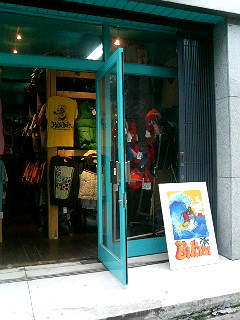
Bikini Surfboard: 渋谷区神宮前.
Jingumae, Shibuya Ward, Tokyo.
Phone: (03) 3409-5017.
On the way to the Olympic Stadium and Yoyogi Park, if you are heading from Shibuya. Despite what the name implies, they don't sell surfboards here, but rather recycled surfwear like T-shirts and sh!t. Billabong and the House of Town & Country and all that jazz. I didn't see any bikinis inside either, so don't go looking for them. Placing your trust in Japanese-English names and signs will always disappoint you. I can almost imagine when the guys who opened this store were trying to think of a name, they decided just to slam together all the surf-related English words that they knew. "What surf words do we know? -- bikini... surfboard... hey, let's call the shop Bikini Surfboard!" It would be like if a bunch of Californian guys who spoke no Japanese decided to open a sushi restaurant -- what would they call it? "Sayonara Samurai" or something like that? Or maybe just "Sayonara Sucker"!
There are of course surf-inspired and Hawaiian stores all over Japan, but this one has a strictly recycled and vintage theme. 
Open 11am to 8pm.

Chicago: 渋谷区神宮前6-31-21.
6-31-21 Jingumae, Shibuya Ward, Tokyo.
Phone: (03) 3409 5017. Web: http://www.chicago.co.jp/.
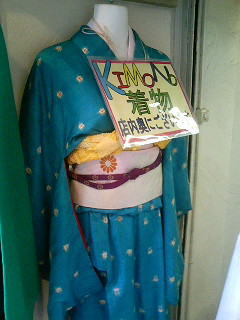
Variety of vintage goods here: T-shirts, training gear, jeans, hats, coats, kimono, haori, modern clothing made from kimono, much more. Has several stores, mostly in Tokyo. At the Harajuku branch, you can even buy a used kimono!
The complete store list is as follows:
Omotesando Store/Tokyo: 6-31-21 Jingumae Shibuya Tokyo. Phone (03) 3409 5017.
Jingumae Store/Tokyo: 4-26-26 Jingumae Shibuya Tokyo. Phone (03) 5414 5107.
Shimokitazawa Store/Tokyo: 5-32-5 Daizawa Setagaya Tokyo. Phone (03) 3419 2890.
Sapporo Store: 1-3 Nishi Minami 1 Jyou Chuou Sapporo Hokkaido. Phone (011) 219 2202.
Fukuoka Store: 1-15-35 Daimyo Chuou Fukuoka. Phone (092) 739 0165.

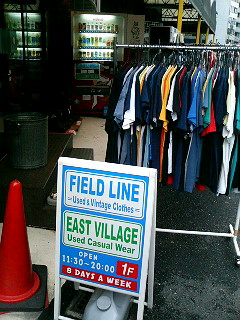
East Village/Field Line: 渋谷区神宮前6-19-16第3宇都宮ビル1F .
1st Floor Number 3 Utsunomiya Building, 6-19-16 Jingumae, Shibuya Ward, Tokyo.
Phone: (03) 3486 6716.
低価格、豊富な品揃え、高品質の古着を展開するイースト ヴィレッジ。アメカジ古着を中心としたラインナップは、ストリートの中でハズせないものばかり。ウェアだけでなく、ブーツなどフットウェアから、小物まで幅広く取り扱っている。ヴィンテージを中心とした姉妹店フィールドラインも併設おり、ともにタウンスポットが経営している。
Last time I waltzed past there was a rack of shirts out the front selling for just 100 Yen... but maybe that was because it was an end of summer sale.
Up the road from East Village you can find Mesa, another select used clothing, which boasts badges... tonnes of them. Also plenty of shoes and French hip-hop stuff on the soundsystem, ultracool Japanese staff.

E-Z shoe & clothing: 渋谷区神宮前112-16和光ビル2AF.
2A Floor Wakkou Building, Jingumae, Shibuya Ward.
Phone: (03) 3780 0494.
A small, non-descript shop on the second floor of a building on the big road linking Shibuya and Harajuku, E-Z is packed with West Coast, recycled clothes -- basketball shirts and faded jeans, etc. To be honest this is one of my fave haunts in the Jinguumae area, and it is situated not far from Tower Records, one of the regional landmarks. Plenty of dead stock shoes with an Adidas look, including live actual Adidases. There are rare trainers from countries that don’t even exist any more, such as Yugoslavia and West Germany. Expect to pay between 20,000 Yen and 100,000 Yen for a pair of shoes. Clothes much cheaper... say 2000 Yen to 10,000 Yen for Levis from the 70s or a Tshirt of Bert & Ernie, or something from the Hawaian school of thought.
E-Z shoe & clothing is open from 12noon to 8pm daily.
Located in the basement floor of the same building is Tom’s Shop Usa 古着, which is described later in this article.

Flamingo Saloon渋谷区神南.
Jingumae, Shibuya Ward, Tokyo.
There is no sign on this store and the last time I visited, only a small piece of paper stuck to the door acknowledged its name: Flamingo Saloon. Then again, it might be called Pink Flamingo,I am not quite sure. At the very least there are two stores connected to each other (same owner perhaps, part of a chain) -- Pink Flamingo and Flamingo Saloon -- and you can find one of them in Shibuya, along the road at Jinguumae from Shibuya to Harajuku. This is basically another Shibuya style vintage clothes store with a street front. Phone is (03) 3477 7376 for the Flamingo Saloon and (03) 5489 4440 for the Pink Flamingo.
By the way, if you are interested in the world of Japanese city fashion, you should click this link -- it's an online Japanese fashion magazine, and it contains a list of clothes stores in Tokyo. They have an article inside called People Like A Used Clothing, with a model shot on location in such picturesque locations as Yoyogi Park.

John's Clothing: 渋谷区神南111-5 ダイネス壱番館1F.
1st Floor Dainesu Ichiban Jinankan, 1-11-5 Shibuya Ward, Tokyo.
Phone: (03) 3464 7705.
In the same building as another classic clothes store celebrating the spirit of California, Santa Monica, and adjacent to the wellknown guitar shop, Acoustic Design. This looks like a funky little number, but it is one of only many recycled/classic clothes stores in this part of town. Why do they call it John's Clothing? I am sure that this being Japan, the owner's name is probably something like Hiroshi or Koji or something like that. Anything but John. Perhaps they called this shop "John's Clothing" because John is the stereotypical name of the Westerner -- the Anglo-American-Australian who would normally be wearing these kinds of clothes. Nonetheless, the shop is cool, so you better check it out.

More Budget ESP: 東京都渋谷区神南1-9-2Oビル1F.
1st floor 0 Building, 1-9-2 Jinnan, Shibuya Ward, Tokyo.
Phone: (03) 3461 5055.
You can find a lot of neat stuff in Shibuya... there is a whole hilly hiphop district and a big mall devoted solely to Harley Davidson apparel. The classic clothes district of Shibuya is not half as glamorous as the hiphop district, but perhaps that is in keeping with the laidback attitudes of the genre. In the middle of the district I found a store called More Budget ESP -- whether it is still there with the same name when you visit is an open question. Interestingly, More Budget is not really a classic clothes shop at all... but rather a hiphop/reggae influenced boutique. If like me you like reggae you will also like this shop. There are plenty of fliers on display giving you a good introduction to the Japanese reggae scene. For example I picked up a leaflet advertising a Reggae Dancehall night called Rocker's Paradise at Shibuya Club Camelot (every 2nd Wednesday ++ next show on 07/02/14 featuring Burn Down from Osaka, Super-G and Gladiator with sound system + 2500 Yen plus ID to get in the door.) Apart from Shibuya Club Camelot, the long running Club Asia is another good place to catch reggae and hiphop events. Also check out Club Unity. If you need to buy reggae records in Shibuya, go to Homebass Records, duel, or Rocker's Island.

Puma: 渋谷区神南1-13-4.
1st floor Harajuku Quest Building, 1-13-4 Jingumae, Shibuya Ward, Tokyo.
Phone: (03) 3401 6100.
Another Metropolis sample follows here:
Bitter rivals of adidas for 54 years, having been established by Adolf Dassler's disgruntled brother Rudi, Puma is still battling it out with the three stripes for dominance of the retro sneaker market. Puma's latest move in the war is the unveiling of the world's second Puma concept store (the first is in Santa Monica, Calif.) late last year in Harajuku. As might be expected from a concept store, this one boasts a smart, clean interior and is sparsely stocked with high-end Puma products. The Italian-designed revival line, Platinum Collection, is the mainstay of this sneaker freak's paradise, but specially selected accessories, bags and clothes from other lines do make their way into the store. If you need to get kitted out for the gym, get down to Kanda, where "concept" means high-brow, high-fashion, high prices. Those who care about what message their footwear communicates won't want to miss the hot releases due in store this season. With the resounding success of the Puma/Sparco boxing boots behind them, more dual name sneakers are in the cards, including a new Jil Sander design. This store is the only place to be seen buying that dinky gym bag, a styling T-shirt or a good ol' pair of Clydes.
The joint is open from 11am to 8pm.

Ray Beams Remodeled:  渋谷区神宮前3-24-7.
3-24-7 Jingumae, Shibuya Ward, Tokyo.
Phone: (03) 3478 5886.
According to the once informative, international (and now, sadly, defunct) w-guides site, Ray Beams Remodeled "stocks customized secondhand and old clothing. However, unlike many other "recycle" stores, Ray Beams attempts to keep the loud "hippie" chic style away from its products. Instead, simple more neutral designs are made up from a mixture of old and new materials. The result is a more casual and comfortable range of clothing. The knitwear is particularly good and there are still some more eccentric items in the form of hand-painted and sequined T-shirts. There will soon be a range of imported recycle products from LA." The nearest train stops at Meijijingumae Station, and the shop is open from 11am-8pm daily.

Santa Monica: 渋谷区神南1-11-5.
1-11-5 Jinnan, Shibuya Ward, Tokyo -- a few doors down from Tower Records, that monstrous yellow landmark.
Phone: (03) 3409 5017.
I read this somewhere: アメリカ全土から買い付けされたアイテムが不定期に入荷。サンタモニカの姉妹店の中でもレギュラーアイテムを中心に着こなしとり入れやすいアイテムが揃う。今シーズンはボア付きのGジャンやコーテュロイアイテムがおすすめ。

Shop 33: 渋谷区神宮前1-12-16和光ビル2AF.
2A Floor Wakkou Building, Jingumae, Shibuya Ward.
Phone: (03) 3780 0494.
The Harajuku store for this chain is at 5-18-8 Jingumae, Shibuya-ku (phone: (03) 5468 3133). The Kichijouji store for those out further west is in the Keyaki Building 3F 1-1-8 Minami-Chou, Kichijouji, Musashino-shi (phone: (0422) 487 926).


Source: 渋谷区神宮前渋谷区サンフォレスト森田ビル4F.
4th floor San Forest Building, Jingumae, Shibuya Ward, Tokyo.
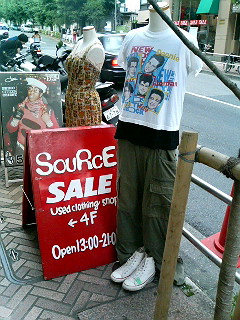
It is a steamy Sunday afternoon in August, and the streets of Shibuya are jammed with the usual packs of misfits. I stopped at a used clothes shop called Source. It is at the far end of Shibuya (actually Jingumae) near Shibuya Fire Station. In the Sun Forest Morita Building, on the 4th floor. There is the usual array of classic items for guys and girls... about 5000 Yen for most stuff. It seems more girl friendly than other shops discussed on this page. On the other hand, there is nothing in this shop special or outstanding enough to justify climbing those four flights of stairs up there (there is a lift, but still, you have to stand around waiting for it to come), and the place is so small, you could probably skip it. In this part of town there is a used clothes store every 20 meters or so, so move on folks and find a better shop!
As the sign says, open from 1pm to 9pm.

Tom's Shop: 渋谷区神宮前1-12-16和光ビルBF.
Basement floor Wakkou Building, Jinguumae, Shibuya Ward.
Phone: (03) 5456 0236.
This place used to be on the 5th floor of the 和光 building, but as of late March 2006, could be found on the more accessible basement floor. It is similar to the E-Z shoes & clothes outlet up on the 2nd floor, although the shoes are cheaper (under 5000 Yen as far as I could see.) Apart from that, there is the usual selection of vintage wear, at pretty good prices.
Open 12noon to 9pm. Across the road from ABC Mart.

We Go渋谷区神宮前-5-3ビル1-2F.
Iberia Biru 1F & 2F, 6-5-3 Jingumae, Shibuya, Tokyo.
Phone: (03) 3400 7625.
Variety vintage. T-shirts, jeans, shirts, hats, coats, you name it. Large chain with stores all over Japan. Open 10am to 9pm.


Friday, March 25, 2011

An Accident Waiting to Happen, in Cairns (Part 1)

Isn't it strange how many of the great discoveries were made by accident? Penicillin was first isolated by scientist Alexander Fleming who, returning from holiday, noticed that fungus growing feral on petri dishes in his lab killed any bacteria they came into contact with. Naddoðr, legendary Viking king, was sailing home to the Faroe Islands when he lost his bearings and got barreled on to the eastern coast of Iceland, which was then uninhabited, and unexplored. Christopher Columbus found America on the way to China and in doing so, confounded the prevailing wisdom of his age. It was totally an accident that I discovered Cairns last week, fleeing as I was the triple tragedy in Japan, or more precisely my persistent panic attacks, which have pestered me like a plague for more than two years now, plagued me like a pestilence, and promise me plenty of fresh pain in the foreseeable future. Cairns is not the kind of place I would have chosen to travel to otherwise, but destiny drove me there... destiny and the deadly Tohoku Earthquake and tsunami, which dislodged me from my Japanese home of a decade, shook me from my sloth and my slumber, and sent me packing with nothing save my suitcase and the shoes on my feet. Like all Australians I knew Cairns, I understood it was a resort on the Barrier Reef, realized that it was touristy in nature, and during my many years in Japan I had also learnt that it was popular with Japanese visitors. Not surprisingly, then, the place had never really appealed to me. It didn't feel edgy enough, or so I thought, it didn't seem exotic. It sounded, basically, the kind of place bogans went for their holidays, and I would much rather embark for Bangkok, or Berlin, or even Bali, ffs!) A few days after the great quake of March 11, with relentless aftershocks rattling my apartment in eastern Tokyo, and radiation bleeding from the breached reactors up on the beach at Fukushima (福島), I saluted Japan with a sad sayonara, and then scrambled out the door. Changed the departure date on my Jetstar Airlines ticket, informed my boss it was over, and scurried out the fucking door. Of all three actions, giving notice to my boss was actually the most awkward, which speaks sagas of the sway he had hitherto held over me. For a long time, it seemed that I would be his bitch forever, a servant in the outhouse, the kouhai to his Koresh. It just shows that when the chips are down, when your life is actually at stake, self-preservation will always victor over subservience, and submissiveness (and don't fall for their piety, even the most devout religious types secretly fear their deaths!) Stockholm Syndrome be damned... I wasn't going to die from caesium contamination! Like the earthquake itself, the break with my boss was an inevitability that was long overdue, but something which neither of us had had the heart to hasten. Fittingly, it had to be forced upon us, by fate. According to my new Jetstar booking, I was supposed to stay in Cairns for a few hours on Sunday morning, just long enough to change planes, and possibly crunch on a croissant. But then destiny intervened, once again, this time more benignly. I missed my connecting flight, and was thus free to enjoy a full day strolling the streets and shores of this captivating tropical city, the capital of the cane fields, gateway to Cape York. This is the story of how that happened, and what I discovered there. In the meantime, let's wind the clock back a few days, to that crazy and chaotic aftermath of 3/11, when I honestly feared that my life was about to end, crushed by collapsing masonry, or felled by fallout. This is the story of how I became a nuclear refugee, and how the Moving House project met its indignant demise, dumped out on the pavement with the rest of the trash. Quite a few narratives met their demise on the same day, in fact, all of them indignantly. Let's give thanks to them, now, while we can, all of them one by one! They all deserve to be honored such, after what they have given me.


Soil liquefaction brings a pond of water to the surface, on the bank of the Edo River, where the baseball teams play (Japan, 2011)
On Wednesday morning last week (March 16) my boss rang me and told me not to bother reporting to work for the next week or so, as the school would be closed on account of the radiation. When I pressed him further on exactly how long this recess would last, he conceded it could indeed be more than a week... possibly two weeks, a month, who knew? Until the crisis was over, in other words (not there was a crisis of course, and not that he used so many words (typical Japanese doublespeak in action!)) Parents were too scared to send their kids to class (he didn't say that, but that's what I inferred.) Everyone was hunkering down, as if under siege (that was his unspoken gist.) "Don't go outside, ne," he added (meaning: deadly particles might be wafting down from the reactors.) "By all means, chant to the gohonzon on your own. But we don't do gongyou today." Hanging up the phone, I reclined on my futon, imagining a whole free week ahead of me... no, not a week, possibly even a month, a whole month free of work, a month cleared of chanting,  and possibly even purged of panic too! I thought to myself: Is this not yet more proof that the Third Free Month has arrived at last, in these dying days of my life in Japan? With every day, my life is becoming more free... freedom is breaking out all over the map! Maybe I could celebrate this change in fortune, I figured, by taking a nap? Because God knows, I needed one! So I sprawled out on the mattress, inserted my earplugs, and attempted to sleep. Try as I might to suppress them, however, thoughts kept arising in my mind, unsettling thoughts: what exactly was going on up there at Fukushima, and why were people so concerned? ... what if there was a powerful aftershock while I was asleep? would I have time to save myself? ... how am I going to survive without a job, especially now that I have retired from Telephone English, and am already living off my credit card? They were, in fact, much the same thoughts which had thwarted my efforts to sleep and eat a decent meal since the great quake struck, five days previously. Unlike my panic phobias, the fears that motivated these thoughts were real, and demanded respect: from time to time an actual aftershock did arrive, a seismic jolt shifting my bookcase on its foundations, and jiggling my windchime judiciously. One of the reactors up at Fukushima had indeed blown up, and I had watched it happen on CNN, and NHK (and all the other networks). I would now be completely unemployed, with no income save Google Adsense, and Chitika. That was reality, not hyperbole. My life seemed to be crumbling around me. On top of that, I couldn't even go out for a walk!


Sleep was out of the question, so I sat up, and dug out the letter I had started writing to N. earlier in the week. Sleep deprivation had rendered me emotional, and I rapidly scribbled out a page or two about how much I missed her, how this entanglement had inspired me to appreciate her love, and how much I was looking forward to living with her in Việt Nam if I ever got out of this mess, blah blah blah. Soppy, sycophantic shit it was, and I had a feeling that it might embarrass her to read it, as she is way less sentimental about these matters than myself. But what was I going to do: this could be my last transmission before the caesium cloud descended, my last will and testament if you might! Since she never replies to my emails these days, or even answers the fucking phone, launching a letter at her was the only way I could get her attention. And this made me ponder: Why does she make herself so hard to reach? It's strange behavior considering that I am giving up my life in Japan to be with her...

The windchime was jiggling before I felt the jolt. My bookcase shifted immediately after that, and began buckling on its legs, jumping like a catfish on a pole. I bolted up from the futon, and made for the back door, and my escape pod. While I was standing there on the back step, preparing to abandon ship, I noticed an announcement flash up on the TV: a magnitude 6.0 aftershock had hit off the coast of Chiba Prefecture, beneath the Pacific floor. While it rated only a 3 (out of 7) on the subjective Shindo scale here in Edogawa Ward, over at Choushi, on the headland I walked on New Years Day, the shaking measured an alarming 6. Across the Edo River, in places like Funabashi (船橋市), vibrations were recorded at Shindo 4. I know a guy who lives over that way (Jim from Telephone English (TE)), and I wondered how he was going. Shindo 4 is pretty serious, I have only suffered it a few times in my life, all of them in Japan of course, and most of them in the past week! According to Wikipedia, at Shindo 4 "hanging objects swing considerably and dishes in a cupboard rattle. Unstable ornaments fall occasionally. Very loud noises." This aftershock, prominent as it was, triggered its own family of afteraftershocks which erupted all around the east coast, each one answering the previous one, as if they were subterranean deities communicating, stocky dwarfs ringing their hammers of iron on the bedrock beneath my feet. I stood in the doorway until the commotion died down, and then some. This game was getting old. I was over it. I had to get out.

Official advice be damned, I decided to go outside for a walk. Just to be on the safe side, I switched over to the weather channel briefly, to see which way the wind was blowing. To my delight, Tokyo seemed to be enjoying a westerly breeze. What a relief, I thought, all that Fukushima fallout is being blown out to sea! I picked up N.'s letter, put on my coat, and bundled out the door. Happy to be outside, rather than cooped up inside, watching my death on TV. It was sunny out, and the wind felt kind of strong. There weren't many people around, giving the streets an eerily apocalyptic feel.

I mailed off N.'s letter at a post office nearby, and then shopped for some groceries at the Yamaichi supermarket on the old salt route (Shinozaki Highway), in Minami-Shinozaki (南篠崎). It was a place I discovered by chance, walking home from work one magic afternoon in the summer of 2007, when life seemed fresh and full of promise. The magic was all gone today, however, and the aisles of the supermarket were deserted. None of their sushi trays, or curated cuttlefish, looked particularly enticing to me. Perhaps all the good stuff had been snapped up already. I picked up some items nonetheless, and shuffled out. Out on the street, the wind blew, menacingly. It was rather a strong breeze, stronger than the weather channel had prepared me for. Possibly it was my imagination, but there seemed to be something caustic riding on that breeze too, something biting, something even luminous. It was only until I returned home, and switched on the TV, that I realized that the wind had changed direction during my walk, and was now blowing down from the north... down from the reactors... down from the fields of death in Tohoku...

I remembered that I had Jim's phone number in my address book, so I gave him a call. I hadn't spoken to him since my abrupt disappearance from Telephone English, and I figured I owed him an explanation. As it turned out, he was flat on his back, literally, across the river in Chiba Prefecture. He told me he was working at TE on Friday afternoon when the great quake struck. The temblor was so terrifying that all the edutainers rushed downstairs to take cover on the street (which, it seems, is a typical gaijin thing to do in this situation!) The phone lines went down, so they couldn't work. But the train lines were down too, so they couldn't get home either. They ended up camping out in the office, and Jim said he did his back in trying to sleep on the hard floor. Surprisingly, he didn't seem as rattled as I was by all the aftershocks. "The earthquake is over, it's finished, we had it on Friday... what you have to worry about is the meltdown," he said. "My folks have been on the phone, telling me to get out, saying you'd have to be crazy to remain here. That is, indeed, what I am planning to do... get out."

"You're going to leave?" I asked him, feeling a little jealous.

"I will only be gone for a week or so," he replied. "Long enough for things to cool down."

"I can imagine there would be a mass exodus, if things got really dire," I said. "You probably wouldn't even be able to leave... the flights would be booked out, the highways gridlocked with traffic."

"Most Japanese would stay, because they have nowhere else to go," Jim said. "We, on the other hand... we have options."

I remembered Ken-san asking me yesterday if I planned to leave Japan. Until that point, I hadn't even considered it. I mean, I was leaving on account of my panic attacks, I had a ticket booked and all, but I hadn't considered hastening my departure due to the disaster. Now, listening to Jim talk, I felt myself brimming with resentment, and envy. How come he could leave, and I had to stay behind? Why was it that I felt so burdened by commitments, and restraints (including financial restraints), that I had to quell my natural instincts to flee? If I was a true Vagabond, I thought to myself, I could leave at any time, I would just pack up my suitcase and leave. Stockholm Syndrome be damned: I never wanted to be a resident! A true Vagabond would just get a train out to the airport, and leave. And in one blinding epiphany, talking to Jim in the radioactive breeze, that is what I decided to do! I decided to pack my suitcase, and leave.

But first, I needed to call my Mum.

Wednesday, October 20, 2010

Uniqlo, and the Japanese Rock Star Look (Revisited)

I have a colleague, a cheerfully gay American, who claims that Uniqlo is the only brand he wears. Like most gay men he is a fastidious dresser, and likes the fact you can throw together a readymade wardrobe at Uniqlo for just a few thousand Yen (this being Japan where we both reside). I don't have the kind of money he has, but my own wardrobe is about 35 per cent to 45 per cent Uniqlo derived these days, and has been ever since I discovered two たんぽぽ (Dandelion) recycled thrift stores across the river in Chiba. Most of the clothes they sell at たんぽぽ are, in fact, slightly compromised Uniqlo garments (Japanese, being Japanese, will throw out clothes if they get a coffee stain.) My wardrobe is now basically second derivative Uniqlo, with faint coffee stains or barely noticeable flaws. The only problem is, many of these items are kind of small and don't fit (me being a Caucasian and all.) Perhaps if I got my social media game happening, I might be able to buy the real thing, with the proper range of sizes to try on.

As part of their Lucky Counter campaign in the United Kingdom, shoppers can score a discount every time they mention a particular Uniqlo product on Twitter. The more you tweet about the item, the lower the price drops (down to a threshold of about 60 per cent off, according to one report I read.) Dang, if I lived in London I'd be taking advantage of that deal! The less I have to do with real cash, and the more I can make use of its derivatives, the happier I will be! Social media influence is the ultimate currency, and one day I hope to be trading in it, investing in it, paying it forward! Why don't they have these kind of campaigns in Japan? Until they arrive, I will have to keep going to たんぽぽ, or buy knock-off shit in Vietnam. They don't have Uniqlo down there yet, but it is probably just a matter of time. As The Sun Daily recently recorded: "Uniqlo, Japan’s number one fashion brand and world leader in casual wear, will open its first store in Malaysia in November in Bukit Bintang, Kuala Lumpur." 


These clothes are not quite Uniqlo, but offer a glimpse of how the Uniqlo look could be!
The next time I go to Iceland, I might wear this ensemble, which is about 35 per cent Uniqlo-derived (Japan, 2010)
Not content with being a household name in Japan, Uniqlo is on its way to conquer the world. Like Mugi, like Best Denki Uniqlo champions and epitomizes a "Japanese approach" to retail. Mass produced, but paradoxically unique... that is the Japanese approach! High quality, but (relatively) cheap, with a strong customer service ethos. That's Japanese retail in a nutshell, and it might well prove to be a major export success story for the nation. Uniqlo Singapore is the brand's fourth store in Asia, following the brand's success in China, Hong Kong and South Korea. They opened a store in Taiwan this month, and are big in the United States. One day Uniqlo might even reach the sloppily dressed shores of Australia, my native land, where a pair of jeans might cost you a few hundred dollars, if the shop assistant feels interested in serving you. I am sure it is going to cause havoc when it arrives down there. They sure need some shaking up! 

Sunday, September 13, 2009

Arco Iris (Peruvian Restaurant in Gotanda)

Of all the diasporas in the world, one of the least well known is the diaspora of Japanese people to South America. As Latin America Links has recorded: "In 1899, the Japanese government was concerned with over population and began a campaign to send Japanese to different parts of the world... 790 Japanese arrived in 1899 (in Peru) to work the sugar and cotton plantations. A significant number of them were from Okinawa..." Peru was not the only New World destination for these poor Japanese settlers: many of them ended up in the agricultural sectors of Brazil and Paraguay among other countries, all of whom were desperately short of (hu)manpower. Japanese DNA entered the racial melting pot of Latin America, but was not totally dissolved; the result is that even today distinctly Japanese communities can be found all over the continent. As the Japanese tourist Kimulog wrote on a 2006 trip to Brazil: "It was Sunday when I came to Sao Paulo first. On Sunday Sao Paulo, many stalls (Yatai in Japanese) are ranging in parks and plazas. One of them, held at Liberdage, was just like Japanese Ennichi. I could find many Japanese meals such as Yakisoba-Oobanyaki-Takoyaki-... ,and many Japanese immigrants working in stalls who can speak both Portuguese and Japanese..."

Arco Iris Peruvian restaurant in Gotanda, in the Shinagawa ward of Tokyo (Japan, 2009)
Diasporas have a habit of returning home, and in recent decades hundreds of thousands of Latin Japanese have been applying for Japanese ancestry visas, and settling in the homeland. Go to any foreigner-friendly psychiatrist's clinic or travel agency, and you will find Spanish language newspapers and magazines. I have seen census figures which show that Brazilians comprise the fourth largest ethnic group in Japan (after Koreans, Chinese and of course the native Japanese!) Those Brazilians are Nisei (second generation descendants of Japanese settlers in North and South America and other parts of the world). Peruvians are also having an impact in Japan: there is a band of Peruvian musicians who regularly make the rounds of major festivals in such places as Iriya (site of the midsummer Morning Glory festival). There is a girl who works for my boss's English school named T. who comes from Peru and looks Peruvian, although her visa says she is ethnic Japanese. My boss calls her a Nisei Japanese although she is probably not second generation at all, but third. Anyway, she wanted to introduce us to the delights of Peruvian food, which is how this adventure began.


Bland colors, excellent taste... that seems to be the dichtomy of Peruvian food
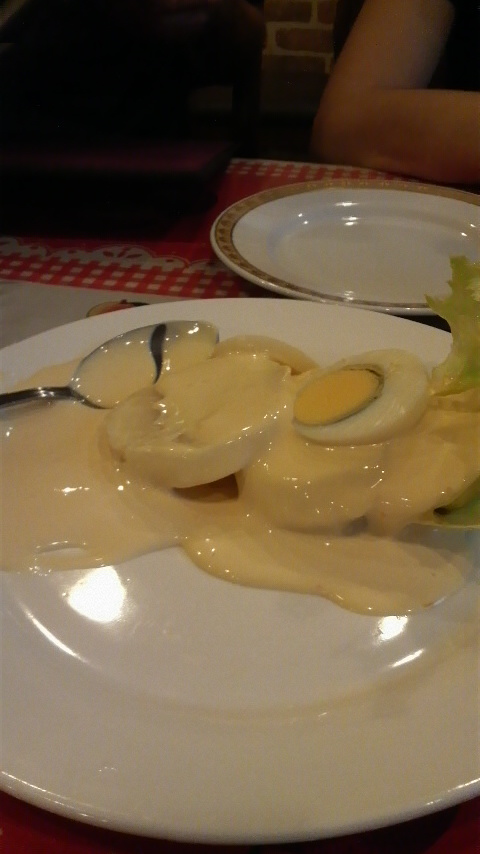
Thick slices of potato topped with egg and a winning cream, at Arco Iris (Japan, 2009)
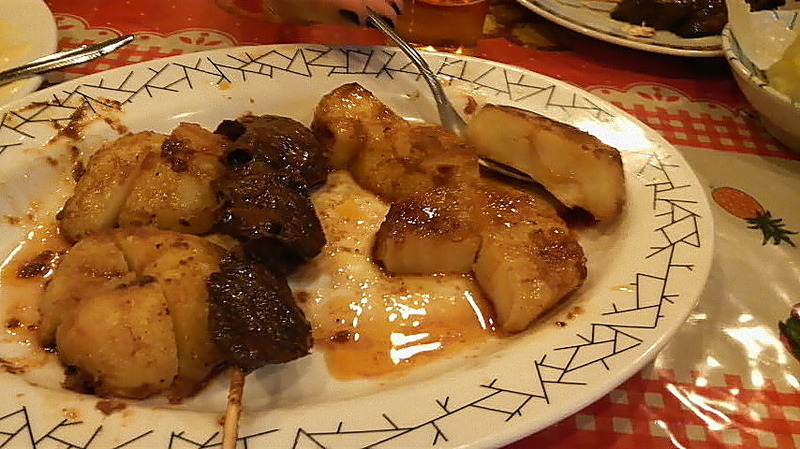
Since the loss of my principle Tokyo food sponsor Sasaki-san due to family illness, I have been confined to eating konbini cuisine, or dining in the occasional famiri resutoran, or if I have been really desperate, cooking for myself. Now I must state here that eating convenience store meals in Japan is not the full culinary disaster that it sounds: Japanese convenience store meals are no doubt the best in the world, as my Bankstown food critic Oscar told me on a subway ride home recently (Toei Shinjuku Line, Shinjuku to Bakuroyokoyama.) Oscar said he had visited a Japanese prepared meal factory himself and reported that each meal was handmade, with stringent quality controls. Every product had its own focus group. There are usually no focus groups overseeing my home cooking but it nonetheless pleases me, although I can only basically cook a handful of dishes (that could change when I move to Vietnam.) But anyway, since the loss of my principle Tokyo Food sponsor, I have been forced to turn towards... my principal. Hiroshi Kobayashi, of Kidea Eigo Akademii. Lately he has developed a penchant for taking his staff out for dinner or lunch, and then picking up the tab. Tonight's outing was ostensibly a dual birthday celebration for two of the staff, but I suspect the real reason is that Hiroshi wanted to try some Peruvian food. (As T. had assured us, Peruvian food is much loved all over South America.) The place was the Arco Iris Restaurant near Gotanda Station. Arcoiris apparently means "rainbow" in Spanish, and the name seems fitting for the rainbow colored Japan which is slowly in the making. We took our seats, ordered some drinks, and one by one the dishes were brought out for us. Fittingly enough, potato seemed to be a major ingredient here. Boiled potato, fried potato... there was even a dish which just like fried potato and tasted just like fried potato, but wasn't potato. The first dish was T.'s favorite: circular chunks of potato topped with egg in a creamy sauce. It might have looked bland, but it was the sauce what made it. As a matter of fact, it seemed to be the sauce what made it for all of the dishes that were to follow. I drank my Peruvian beers, and conversed with the lovely blonde V., from Moscow. R. from London ordered a Moscow Mule by mistake, and passed it on to me. I'll drink anything, so I took it! There was a lot of conversation flying around the table in English, Japanese, Russian and Spanish. Presently the second dish of the evening appeared: kebabs of meat (T. claimed they were skewered cows' heart), smelling like a million dollars. I had a beer in my hand, and ¥1680 in small change to my name. Luckily Hiroshi was picking up the tab for tonight!


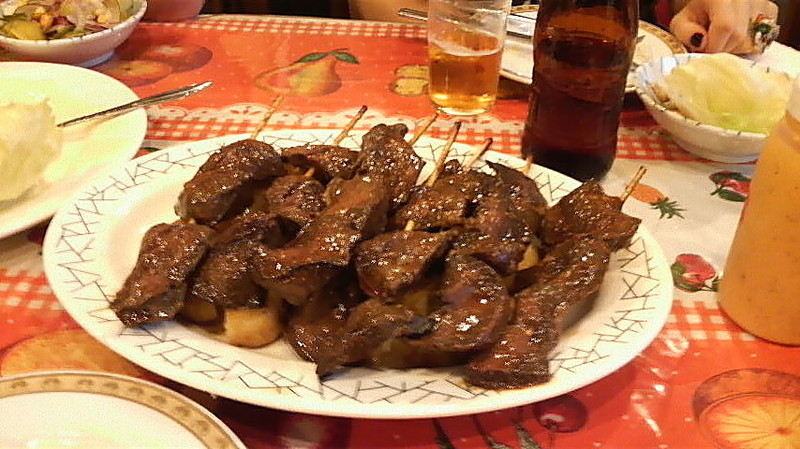
Anticucho (roasted cow heart on skewers) on a bed of potato.
Skewered cows' hearts, or so I was led to believe, laid atop a soft potato bed (Japan, 2009)
Chomp your way through all of those skewered hearts (which apparently are called anticucho in Spanish) and this is what you find: a veritable bed of juicy soft potatoes. Did I mention that there are hundreds of varieties of potatoes growing in Peru, in all manner of sizes and colors and personalities? In fact, some consider that Peru was the home of the potato, the source, the origin. Once again, as with the earlier dish, it was the sauce which made the anticucho great, it was the sauce which made it happen. I could be wrong but it seemed to me that there was some homeland Japanese influence to all this food, a Japanese taste -- let's call it aji. The way Peruvians talk about the word aji (which to them means "spice"), it makes me think that they imported it from Japan (where it means "taste"). I could be wrong in this, and I probably am. But it got me thinking.

What lay beneath the skewered hearts
The bed of beautiful potatoes lies exposed, beneath the skewered hearts (Japan, 2009) 
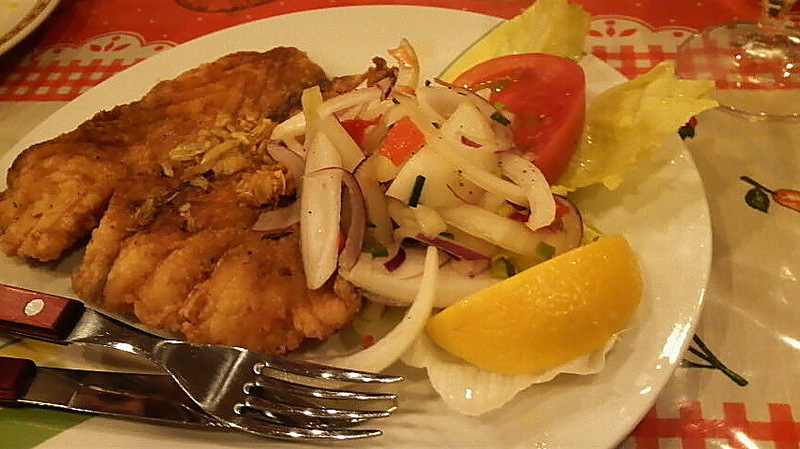
Moving away from the offal and potato theme, here is some seafood (Peru is famous for its fish, which they apparently prepare imaginatively):


Peruvian fish dish
Fish dish with salad, at the Arco Iris restaurant, near Gotanda station (Japan, 2009)
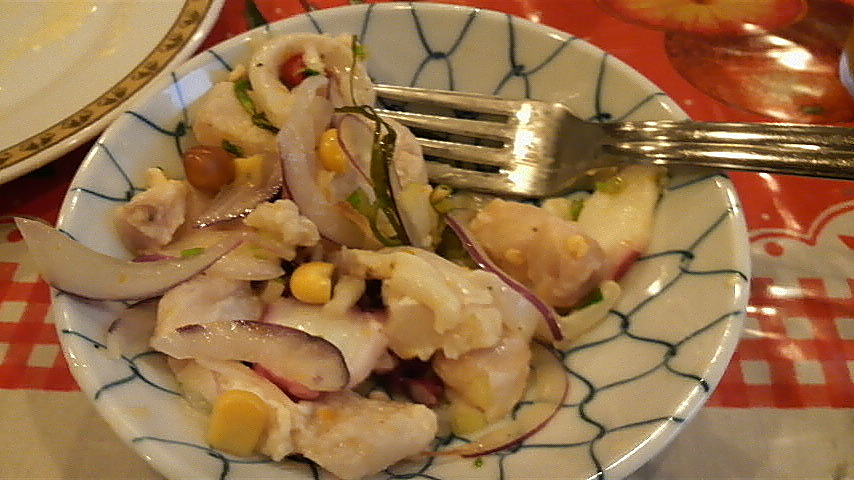
This critter here is an octopus salad:


This octopus salad could almost pass itself off as Japanese
This octopus salad ought to appeal to the Japanese palate (Japan, 2009)
Arco Iris is on the 2nd floor of the Motomiya Building (本宮ビル2F) at 1-15-5 Gotanda, Shinagawa Ward, Tokyo -- the phone number is (03) 3449 6629. A typical dining experience costs about ¥1500 per person, if you don't have a sponsor or principal to support you!

Wednesday, September 24, 2008

Autumn in Harajuku (When Topman Came to Tokes)

Clear autumn sunshine always takes me back to my first morning in Japan, November 11 2000, when I arrived at Shibuya Station all baffled and dishevelled and with literally nothing but the shirt on my back. My luggage had gone awol at Singapore's Changi Airport, and I had only a T-shirt to protect myself from the northern chill, which was steadily coming on. I walked up to Yoyogi Park looking for the youth hostel, only to find it closed. I had more luck, however, locating plenty of gorgeous garments in the greater Shibuya/Harajuku area, including a jacket appropriate for the seasonal clime. Since that time I have accumulated several layers of Harajuku clothes, and on top of that, an even thicker layer of Harajuku memories, some of the most poignant of them dating from autumn -- there is something about the crisp blue skies which really bring out the beauty of this place. Blue skies and marauding crows -- that is my image of Harajuku in autumn. Heaving crowds and steam puffing from the surrounding buildings. Venerable old ichou ginkgo trees, threatening to turn yellow. Cute girls wherever you look. Guys that could almost be girls, if they tried a little harder.


One girl holding two bags, and two girls holding hands, on one of the many promising backstreets of Harajuku (Japan, 2006)
At the end of 2006 I spent a classic series of afternoons wandering around the sunny streets, ripped thanks to my mate Maniac High (aka Dennis the Menace), taking photographs of the shops, chilling in the park, and checking out all the cute girls holding hands. That was about the era that this Shibuya shopping guide thing here came of age, and it reached its apogee in the Lesbian Christmas of Shinjuku 2 Chome (and celebrity shopping with my cousin Kel!) Since then, a lot has happened in my life, and Harajuku hasn't featured so prominently in my life. It has always been there of course, I am often there, but I have taken it for granted, and ignored it. It has become a place I pass through, on my way to other goals. I understood the potential that was there, but I had my sights set on juicier targets -- for example getting to my love in Vietnam, or making money from Adsense. Yesterday, after finishing my 9000 Yen per hour job near Harajuku Station, I walked down the famous Takeshita Avenue heading to Parco Department Store in Shibuya (to see about my debt), and found myself reveling in the amazing sun and generally Indian summer weather. I thought to myself: My god, it has been a long time I have been inspired to write about Harajuku... nearly two years! I wish I could find inspiration again, because there is so much to write about it here, all around me!


Topshop, by Topman, due to open in Harajuku on October 16 (Japan, 2008)
At that moment some lady belled me to get out of the way of her bicycle, and I looked up to see a huge white building on the other side of the road, with a sign proclaiming: TOPMAN. I hadn't realized it before, but Topman (Topshop) had made it to Japan. In fact, it is part of the legendary La Foret complex! But then again, everything makes it to Japan eventually, everything but The Simpsons of course. (They do like Columbo though, and The Sopranos. Japan introduced me to these shows.)


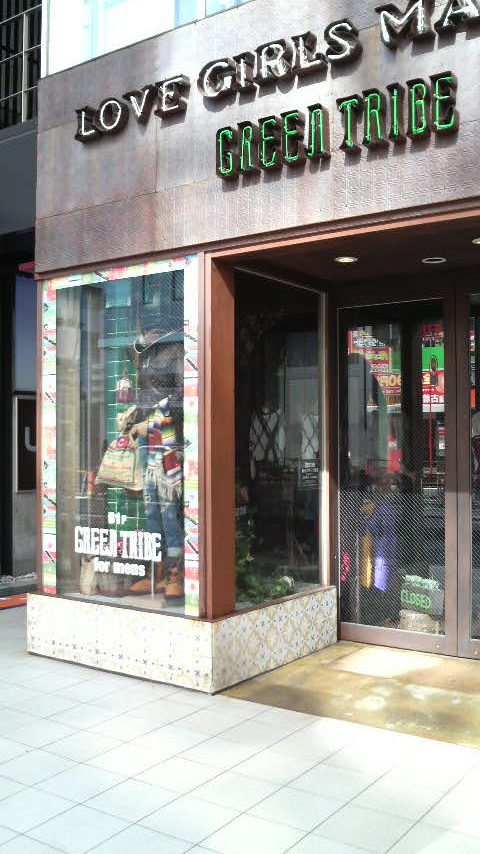
Love Girls Market branch, on the mighty Meiji Dori, near Harajuku (Japan, 2008)
On my side of the street, which I believe was the mighty Meiji Dori (明治道り), I photographed the quaint shop pictured above, called Love Girls Market / Green Tribe. This is a branch of the Love Girls Market franchise, which presents a fusion of fashion heavily influenced by ethnic styles, and has stores in Tokyo, Osaka, Kobe, Fukuoka, Sendai and Sapporo, as well as Hong Kong. You learn so much, encounter so much, just by walking through the streets of Harajuku early on a Tuesday morning! I ought to do it more often. I ought to appreciate it more often.


Related Posts Plugin for WordPress, Blogger...