Once upon a time, according to Jean Baudrillard, money had a referent, the gold standard. That ended in 1971, and since then money has become purely speculative, ballooning into the stratosphere. Bitcoin is the first attempt to retether money to the actual economy, drag it back to earth, giving it concrete value.The rise of Bitcoin will (as Lyn Alden explains) release the American dollar from the clutches of Triffin's Dilemma. It will enable the greatest debt jubilee of all time. And that jubilee is just about to start... (For more on the coming debt deflation and reinflation of money, click here.)

Memoirs of a Nomadic Soul Clawing His Way, One Mile at a Time, Around the World!
Showing posts with label philosophy. Show all posts
Showing posts with label philosophy. Show all posts
Thursday, October 27, 2022
Money Talks, Bullshit Walks
Money is the signifier that annihilates every signification. It is the first commodity to escape use value, and become a sign. Everything gets measured in money, even Bitcoin (which is the latest step in its evolution). The medium is now the message. Or, in cruder terms: "Money talks, bullshit walks."

Wednesday, August 6, 2014
Tales and Travails of the Agoraphobic Traveler
In my dream life I wouldn't be tethered to one place as I am now but would roam around the world, roam the world relentlessly, sailing like a stowaway on a galleon in the Age of Discovery. In my dream life I would not cower under Capital and all its cronies but would glide instead atop the gradients of the global gift economy, glide them triumphantly, scooping up on the way social media merits, couch surfing kudos and any Bitcoins that I can find strewn across my path, like tokens in a classic Sega game! In my dream life I would sip fruit cocktails and iced coffee on beaches where oxen wade through the waves, meditate on mountain tops, and stalk narwhal with my karmic kin beneath the arctic ice. I'd study astrology with the masters in Varanasi, India, Shi'ite morality in Qom, Iran, and the Gospel of Ayahuasca in Anyjungle, Peru, shapeshifting there with the shamans, dancing with diseases, communing with the spirits of stars. I'd recount my adventures every day online, all my expeditions and explorations, my sublime revelations, to an eager and envious audience as farflung as my passions and my ports of call. From time to time a reader might click on an ad or flick me a coin, and thus kick me one step further down the rambling road. That's the gift economy in application, the hitherto unharnessed power of popularity: my exploits today would finance my epiphanies tomorrow, and my epiphanies tomorrow would excuse me for the excesses of tonight! In this way, a perfect feedback loop is formed; like a snake swallowing its tail, the cycle never ends...
Though I like to call myself a Vagabondic, truth is I am an agoraphobic. For the past three years I have been unemployed, living with my parents in regional Australia, and confined to a small and shrinking world. Before this handicap hit me I did indeed glide around the globe, I glided around the world gleefully, domiciling in Japan for 10 years where I taught English and enjoyed all kinds of adventures, most of them legal and legit, heaps of them happy and some of them sad, all of them educational in one way or another. Every day in Japan was an adventure to be honest, an adventure and a cultural experience, as well as an initiation into the enigma of the East. If I had known, back then, that one day I would be compelled to crawl home to the sanctuary of Mum and Dad in smalltown Australia, that would have been like totally my worst nightmare... it would have been worse than a nightmare, in fact, because nightmares get awoken from eventually, while this affliction just keeps persisting on and on and on. It goes to show that fate, destiny, whatever you like to call it has a strange habit of reversing things, turning reality into dream, and dream into reality; now the Prodigal Son is home again, not because he wanted to return, but because he was forced to... and for a long time he was not particularly happy about that fact. He was pretty pissed off about it, to be blunt, and couldn't understand what had happened. He had assumed, during those long halcyon days in Old Harmony, that his Australian life had been put far behind him. As it turns out, however, his Australian life is suddenly back in front of him, back in all its hoary glory, like a sumo wrestler in a cage fight, 400 pounds of grimace and pain. And, alas, the sumo is too big for Sonic to jump this time!
Right now, I can travel only about 25 kilometers from home before I succumb to anxiety and dread. That's my Safety Zone, a circle with a radius of 25km. When I approach the edge of the Safety Zone my palms and scalp get sweaty, and my muscles seize up. The world closes in around me, and I worry that I am not really real. If I am driving a car, my zone is even smaller, I am not sure why. Maybe it is because driving is inherently more stressful??? hmmm, that sounds sensible enough. Crowds and loud noises frighten me, and coffee is a definite no-no. Although I used to travel frequently on the train, these days I can manage only one stop in either direction from my local station before I am forced to bundle out the door, hyperventilating. If I try to go two stops, I might well have a panic attack.
I have been in a lot of weird predicaments in my life, to be sure, but this predicament is the weirdest of them all: I am a traveler who is afraid of traveling, an agoraphobic traveler. Much as I pine to paddle across the Pacific, visit Vang Vieng, or shapeshift in the aforementioned Amazon, Fate has me dealt me another hand. In fact, She has placed me under virtual house arrest, for the foreseeable future at least! Lousy luck, you might say... lousy Lady Luck. Here at Vagabondic we like to delve deeper into the nature of things, however, and accept that every affliction has a spiritual meaning, a higher purpose if you like. Ian Thorpe's depression had a purpose, according to my edition of The Secret Language of Destiny: it manifested to manipulate him into diving deep into his repressed emotions. My Dad's Huntington's disease, meanwhile, might well be another kind of spiritual crisis, a lastditch intervention to coerce him into curtailing his need for control, before life pulls the plug and ends his present incarnation. Possibly my panic attacks and agoraphobia have a purpose too, possibly they are trying to tell me something. "But what on Earth could they be saying?" you might ask, and I have to agree, it is a tough question to answer. In order to find out, I believe we need to rise above our workaday ego concerns, and try to see things from a higher perspective. We need to see things from the perspective of our souls. I remember that my psychic mistress Janene used to say, during my apprenticeship, "If you can find happiness in a box, you can find it anywhere." Her premise was that even if you have just had your legs broken by a psychopath, your arms cut off, and the remainder of your body boxed in the basement, you could still be as blissed as a Buddha so long as you were plugged into the Source. Well, I am not quite at the Misery stage yet, but I definitely feel restricted, like a bird with clipped wings, or a dog on a lead, left to guard the yard all day long alone. But inside this restriction, perhaps, my future freedom resides, like the dots in a yin/yang taijitu, those phaseshifting telltales. Possibly, agoraphobia is commanding me to venerate quality over quantity, the local over the global, the trivial over the epochal, the micro over the macro. I have always been such a macrominded man, it is hard for me to be content just with the little things in life. I am going to have to learn to appreciate them, however, if I am to ever escape this mad torturer's dungeon. Furthermore, I suspect this ailment is challenging me into becoming more tenacious, more determined to achieve my dreams. Higher I is telling lower me: You are going to have fight for your dreams, fight for your right to orbit the planet... one hardearned mile at a time. And we are not talking frequent flyer miles here! This is the real deal, Marco Polo style.
Recently I discovered that my new Samsung smart phone (Galaxy Pocket Neo) automatically uploads every single photo that I take during my daily movements to Google+, where Google keeps hold of them, immortalized on the cloud. Using cues like the date, time and GPS location, Google curates my pictures into artfully arranged albums, and even sends me an email inviting me to inspect its handiwork. How cool is that? A little creepy, but cool nonetheless! When I view the photos at the end of each day I am always amazed by how much territory I managed to cover, and all of the beautiful scenes that I was privileged to have witnessed. For an agoraphobic, it is not a bad effort, and it shows that even in a small world there is still so much to see. Maybe one day Google could write blog entries for me based on where I go, who I interact with, and what music I listen to on my iPod. The Andy Warhol of tomorrow could make a new movie every day with footage culled from Google Glass, and a hectic and heroic social life. I don't have much of a social life at all these days, but I do have my Samsung smart phone, and I have a Safety Zone 50km from edge to edge. That's 1963 square kilometres of world for me to explore, and document here online! One small, hesitant step at a time, of course, with Valium always at hand...
Right at the other end of my Safety Zone, on the Pacific Ocean, slumbers the small holiday hamlet of Budgewoi. Bustling Budgewoi it ain't... the town boasts all the buzz of a game of lawn bowls, or a mufti day at a nursing home. It does have some nice bushland, however, miles of long empty beaches, and it is the outdoors stuff that has been attracting me there lately. In June I drove over there and attempted to trek the path at Weemala Wetland all the way to the sea. Although it is a short path, just a few hundred metres, I was too anxious to complete it, and I had to scurry back to the safety of the car. Six weeks later I returned and this time managed to punch through all the way to the sand, where I was rewarded with views of bitou bush and Bird Island, bobbing out of the waves. This breakthrough perked me up, and emboldened me to probe further afield, further up the coast, where I am sure plenty of natural wonders await me.
South of Budgewoi, well within my Safety Zone, Norah Head heaves itself out of the scrub and rocky coast, to become a prominent local landmark. There is a lighthouse and a few beaches in the vicinity, the most famous being Soldiers Beach, one of the many places in Australia devoted to the legend of the Anzacs. Even in the middle of winter you can find decent numbers of people here, swimming and surfing, or exercising their dogs on the sand. Looking south, other headlands loom out of the salt spray, taunting me with their proximity.
As a young man fresh out of college I worked as a cub reporter for the Wyong Shire Advocate, which had its office in Toukley, a quiet holiday town. During my second year at the Advocate my editor assigned me the round of covering the northern part of the Wyong Shire, specifically suburbs like San Remo which felt they were being neglected by the paper. One morning a week I would drive up past Budgewoi Lake and see what was going on. Frustratingly, I never managed to find many good stories. Nothing much seemed to happen in this part of the shire. Returning for a series of visits this winter, I found San Remo to be as sleepy as it ever was. There are a lot of colourful murals, however, many of which bear Aboriginal themes, and depictions of local wildlife. They make suburbia that bit more cheerful.
The town known as The Entrance is the most multicultural part of my realm, and potentially the most exciting. In summer when Lebanese women sunbathe on North Entrance Beach with their scarves and tattooed boyfriends, the place starts to resemble a baby Beirut. In the Thai restaurants on The Entrance Road, woks sizzle with the heat of Bangkok. White guys walk the streets with their Asian girlfriends. If I could hustle myself one of those, I might almost be content to live here.
In early July I rode bus #29 from Lake Haven shopping center over to North Entrance (or do they call it The Entrance North?), passing through Toukley and Norah Head on the way. My plan was to walk back the three-hour route through the depths of the Wyrrabalong National Park to Wallarah Bay Recreation Club east of Toukley, where my Dad and hopefully a few beers were waiting for me. When I dismounted from the bus near Wyuna Avenue, I was feeling a little shaky and slightly derealized/depersonalized, afraid of the blue sky and shining sun. I wasn't in the mood to hang around here on the edge of my Zone, so I commenced the walk home more or less immediately, by following Wilfred Barrett Drive which comprises a section of the busy Central Coast Highway. It wasn't so pleasant getting hammered by the passing traffic and tagged by burrs on the edge of the road, so I quickly ducked into a bicycle track which the council had constructed, leading into the national park. It was calmer and more comfortable in the bush, and I felt a lot safer, but the path presently looped back to the highway forcing me to share my journey once again with the speeding cars, trucks and buses. A few miles later I spotted what looked little more than an overgrown rut trailing back into the bush, and I decided to give it a go. The rut proved to be a more interesting alternative than either the highway or the cycleway, and it led me on a a wild voyage through the heart of the forest. I soon encountered a whole network of ruts, in fact, all of them named after the local flora: red gum, burrawangs and magenta lillypillies. The ground was sandy, and littered with seed pods. At one stage I mounted a small ridge, which granted me a stupendous view of the national park, and miles of red gums. No sign of civilization at all!
If these photos sometimes seem clumsy and clandestine, that's because they were taken furtively, on the fly. I apologize for any fingers in corners of the frame, blurriness and so on. When you are taking photos on the boundaries of your range, you don't have time to compose the scene artfully. It is rather a case of shoot and run. Nonetheless, I hope there is something Mirror Sydney about these suites, with all their attention to detail, the celebration of the minutiae, preservation of local history, and the elevation of the microcosm over the macrocosm. I hope that, as time goes by, I will get more adventurous, and push a little further against the bubble that encases me. One day I might even make it to Bateau Bay!
Though I like to call myself a Vagabondic, truth is I am an agoraphobic. For the past three years I have been unemployed, living with my parents in regional Australia, and confined to a small and shrinking world. Before this handicap hit me I did indeed glide around the globe, I glided around the world gleefully, domiciling in Japan for 10 years where I taught English and enjoyed all kinds of adventures, most of them legal and legit, heaps of them happy and some of them sad, all of them educational in one way or another. Every day in Japan was an adventure to be honest, an adventure and a cultural experience, as well as an initiation into the enigma of the East. If I had known, back then, that one day I would be compelled to crawl home to the sanctuary of Mum and Dad in smalltown Australia, that would have been like totally my worst nightmare... it would have been worse than a nightmare, in fact, because nightmares get awoken from eventually, while this affliction just keeps persisting on and on and on. It goes to show that fate, destiny, whatever you like to call it has a strange habit of reversing things, turning reality into dream, and dream into reality; now the Prodigal Son is home again, not because he wanted to return, but because he was forced to... and for a long time he was not particularly happy about that fact. He was pretty pissed off about it, to be blunt, and couldn't understand what had happened. He had assumed, during those long halcyon days in Old Harmony, that his Australian life had been put far behind him. As it turns out, however, his Australian life is suddenly back in front of him, back in all its hoary glory, like a sumo wrestler in a cage fight, 400 pounds of grimace and pain. And, alas, the sumo is too big for Sonic to jump this time!
Right now, I can travel only about 25 kilometers from home before I succumb to anxiety and dread. That's my Safety Zone, a circle with a radius of 25km. When I approach the edge of the Safety Zone my palms and scalp get sweaty, and my muscles seize up. The world closes in around me, and I worry that I am not really real. If I am driving a car, my zone is even smaller, I am not sure why. Maybe it is because driving is inherently more stressful??? hmmm, that sounds sensible enough. Crowds and loud noises frighten me, and coffee is a definite no-no. Although I used to travel frequently on the train, these days I can manage only one stop in either direction from my local station before I am forced to bundle out the door, hyperventilating. If I try to go two stops, I might well have a panic attack.
For the past three years, this Safety Zone has been my prison. Now, it wouldn't be so bad if I was stuck in New York City, Paris or Prague. In such cities you could spend a whole lifetime within a 25km radius and never get bored. That's true too for Tokyo, and Seoul; hell, it is probably also the case with Tehran! These places have density, and history, and soul (and no doubt, plenty of agoraphobic artists there trying to make the most of their handicaps, trying to turn their afflictions into art!) The location of my exile, on the contrary, is a scrap of suburbia on the edge of scrappy bush, in what could possibly be the most boring barrio of the world: the Central Coast of New South Wales, north of Sydney on the eastern shore of Australia, the western edge of the Pacific Ocean. I am sorry if I have offended the locals by dissing your 'hood such, I know you guys love it a lot up here. I have to concede the weather is nice, if repetitively so. There are a lot of nice beaches in the area, which attract hordes of holidaymakers every summer. There are never any earthquakes (well, not that often anyway!), nor are there any volcanic eruptions, nor political strife of any kind. That's partly the problem, though: nothing interesting happens! For me, a bit of danger always spices things up, like mustard on a dull cut of beef, or a hip-hop sample on an atmospheric Drum&Bass tune. This place is too vanilla, too white bread, too white trash for my tastes. If you are a fisherman, or a surfer, or a birdwatcher or tattoo artist, then the Central Coast is your paradise. If you are more interested in culture, and cuisine, and couture, then it is more likely to be your hell. That is my opinion, and I stand by it. But then I am biased, because I don't really want to be here in the first place.
 |
| For a recovering agoraphobic, even a trip to the letterbox can be a struggle... but it could also be an amazing adventure! It depends on how you look at it. (Australia, 2014) |
Recently I discovered that my new Samsung smart phone (Galaxy Pocket Neo) automatically uploads every single photo that I take during my daily movements to Google+, where Google keeps hold of them, immortalized on the cloud. Using cues like the date, time and GPS location, Google curates my pictures into artfully arranged albums, and even sends me an email inviting me to inspect its handiwork. How cool is that? A little creepy, but cool nonetheless! When I view the photos at the end of each day I am always amazed by how much territory I managed to cover, and all of the beautiful scenes that I was privileged to have witnessed. For an agoraphobic, it is not a bad effort, and it shows that even in a small world there is still so much to see. Maybe one day Google could write blog entries for me based on where I go, who I interact with, and what music I listen to on my iPod. The Andy Warhol of tomorrow could make a new movie every day with footage culled from Google Glass, and a hectic and heroic social life. I don't have much of a social life at all these days, but I do have my Samsung smart phone, and I have a Safety Zone 50km from edge to edge. That's 1963 square kilometres of world for me to explore, and document here online! One small, hesitant step at a time, of course, with Valium always at hand...
 |
| Wyong, Then and Now: Courtesy of Samsung and Google+ |
At the south-west edge of my Safety Zone lies the town of Wyong, population 3600, the seat of local government and the region's most important transportation hub. I have been catching the bus there a lot lately to see a psychologist about my agoraphobia, and challenge myself on the train. To pass the time waiting for my appointment or to celebrate a successful mission on the rails, I like to walk around and take photos of things that entice me. While I used to think that Wyong was a hole, I have been impressed lately by the number of old colonial buildings in the town. My Mum, who grew up here, knows the history of all these buildings, the families who used to live inside them, knowledge that I will attempt to preserve in the (evolving) photo essay above. Click on the link above to take a stroll through the streets of Wyong, a mile in my shoes, recorded for all time!
 |
| Walking in Weemala: Can I reach the beach? |
 |
| Norah Head: Local landmark with a lighthouse |
 |
| Sunny San Remo: A neglected suburb |
As a young man fresh out of college I worked as a cub reporter for the Wyong Shire Advocate, which had its office in Toukley, a quiet holiday town. During my second year at the Advocate my editor assigned me the round of covering the northern part of the Wyong Shire, specifically suburbs like San Remo which felt they were being neglected by the paper. One morning a week I would drive up past Budgewoi Lake and see what was going on. Frustratingly, I never managed to find many good stories. Nothing much seemed to happen in this part of the shire. Returning for a series of visits this winter, I found San Remo to be as sleepy as it ever was. There are a lot of colourful murals, however, many of which bear Aboriginal themes, and depictions of local wildlife. They make suburbia that bit more cheerful.
 |
| The Entrance: My gateway to the wider world |
The town known as The Entrance is the most multicultural part of my realm, and potentially the most exciting. In summer when Lebanese women sunbathe on North Entrance Beach with their scarves and tattooed boyfriends, the place starts to resemble a baby Beirut. In the Thai restaurants on The Entrance Road, woks sizzle with the heat of Bangkok. White guys walk the streets with their Asian girlfriends. If I could hustle myself one of those, I might almost be content to live here.
 |
| Wyrrabalong National Park: Refuge of red gums |
If these photos sometimes seem clumsy and clandestine, that's because they were taken furtively, on the fly. I apologize for any fingers in corners of the frame, blurriness and so on. When you are taking photos on the boundaries of your range, you don't have time to compose the scene artfully. It is rather a case of shoot and run. Nonetheless, I hope there is something Mirror Sydney about these suites, with all their attention to detail, the celebration of the minutiae, preservation of local history, and the elevation of the microcosm over the macrocosm. I hope that, as time goes by, I will get more adventurous, and push a little further against the bubble that encases me. One day I might even make it to Bateau Bay!
Thursday, August 8, 2013
The 7 Hindrances, and the 20% Accomplishment Rule
I might dream of conquering the world, but Reality reminds me that we rarely achieve more than just a fraction of our goals. How much of a fraction is a troubling question -- from my experience it could be a quarter, it might be just a fifth. In the summer of 2006 I was enthralled by a Utopian hope: despite my deepening debt I sincerely believed that medical trials could save me, and manifest for me the jetsetter life I was craving for. Not only would I be able to kick back in Kagoshima (鹿児島) with the cool kids, living it large, but I could use the payments from each trial to party around the planet. Of course, it never worked out that way, and Telephone English (TE) became my actual saviour. Here was evidence of the 25% Accomplishment Rule in action... I didn't qualify as a lab rat, but I was delivered from poverty just in the nick of time, and pumped full of cash. Some of my goal was realized, to be sure, but not all of it, and that was the thing. There were a few Hindrances standing in the way: love was one of them; health, another...
When I started teaching at TE I had big plans to take two months off every year and fly off to Thailand, Iceland, Australia and destinations even further afield, such as Jamaica. In the end I got stuck at my first port of call in Ho Chi Minh City, Vietnam, and most of my funds were squandered there, entranced as I was by tropical romance. I did score a short stopover in Bangkok and two trips to Australia, but much as I would have liked it, I never reached Iceland. Jamaica was completely out of the question. So, my original plan was only partly achieved (25% achieved, perhaps, or only 20%, I haven't figured out the exact percentage!) I had a lot of fun nonetheless and Nga became a cause in herself, a Baudrillardian seduction... she derailed my plans, blew my budget, and in the end I accomplished only a quarter of my aim, or even less than that (how much? how much?) In 2011 I quit TE and abandoned Japan and returned back to Australia, where I the One World Orbit was conceived. Imagining that Google Adsense could free me from employment entirely, I researched the cost of living in Indochina, which various guidebooks suggested was the cheapest region on Earth. I intended to spend three years jaunting around Cambodia, Laos, Vietnam, northern Thailand, and southern China, mucking about on the Mighty Mekong (the Great River, the River of Nine Dragons, ແມ່ນ້ຳຂອງ, 湄公河, etc, etc.) I called it the Indochinese Triennium. It would have been perfect, but my Adsense collapsed, and then I lost Indochina. All I have left is China, which is one-half of Indochina, semantically speaking, but pragmatically much less than that. It is just one-fifth of my original plan, or even a sixth. Furthermore, when I go to China I will have to work to survive, at some school like Wall Street. It sucks but it is better than nothing, and at least I will be back on the road. I can always visit Cambodia in my holidays, and plenty of other nearby nations! That is, if the Seven Hindrances give their assent.
When I started teaching at TE I had big plans to take two months off every year and fly off to Thailand, Iceland, Australia and destinations even further afield, such as Jamaica. In the end I got stuck at my first port of call in Ho Chi Minh City, Vietnam, and most of my funds were squandered there, entranced as I was by tropical romance. I did score a short stopover in Bangkok and two trips to Australia, but much as I would have liked it, I never reached Iceland. Jamaica was completely out of the question. So, my original plan was only partly achieved (25% achieved, perhaps, or only 20%, I haven't figured out the exact percentage!) I had a lot of fun nonetheless and Nga became a cause in herself, a Baudrillardian seduction... she derailed my plans, blew my budget, and in the end I accomplished only a quarter of my aim, or even less than that (how much? how much?) In 2011 I quit TE and abandoned Japan and returned back to Australia, where I the One World Orbit was conceived. Imagining that Google Adsense could free me from employment entirely, I researched the cost of living in Indochina, which various guidebooks suggested was the cheapest region on Earth. I intended to spend three years jaunting around Cambodia, Laos, Vietnam, northern Thailand, and southern China, mucking about on the Mighty Mekong (the Great River, the River of Nine Dragons, ແມ່ນ້ຳຂອງ, 湄公河, etc, etc.) I called it the Indochinese Triennium. It would have been perfect, but my Adsense collapsed, and then I lost Indochina. All I have left is China, which is one-half of Indochina, semantically speaking, but pragmatically much less than that. It is just one-fifth of my original plan, or even a sixth. Furthermore, when I go to China I will have to work to survive, at some school like Wall Street. It sucks but it is better than nothing, and at least I will be back on the road. I can always visit Cambodia in my holidays, and plenty of other nearby nations! That is, if the Seven Hindrances give their assent.
Thursday, March 21, 2013
Floating Worlds
Sick of hanging round the house, I rose early and rode Busways #90 (ticket: AUS$4.60) over to Budgewoi, on the opposite side of the lake. The cops were arresting some dude at the interchange at Lake Haven while I was waiting for my bus... typical. There was a big mob of single mums and truant teens congregated round the commotion, rubbernecking, teeheeing, bumming cigarettes... standard. It seemed like it was going to be a warm day, which is usual in this part of the world, at this time of the year. Once the bus pulled up, however, it was all air-con chilled and comfy, if somewhat claustrophobic. Pushing through the scrum, I climbed the step, paid the driver, and took my favorite seat behind the midriff exit, the one fronted with its own perspex shield. Maybe it is because it is shielded that I like it so much, it seems to offer some protection against something, I don't know what. I pulled out my iPhone and was checking the news when I noticed my old Salvation Army mate Simon stepping up on to the transport, so I gestured him over to sit with me. He obliged me cheerfully, the bus took off, and we were on our way through the dewy, sun-sparkled, spider silk-strewn streets. A little bit later, on the approach to Toukley Bridge, my drinking partner Steve boarded, and took a seat in front of me. I am not sure if he recognized me or not, but I certainly recognized him. I am starting to build up a network of Negroes up here in the Wyong Shire, 18 months after moving here, I am getting to know the scene pretty well. People wave to me when I walk the streets, they beep their horns as they drive past me. It makes me think I have been here too long, and that it is probably time to roll the dice again, and jump to a new locale. Do another Quantum Leap, and materialize into a brand new life. I have still got a year to go before the jump, but the coordinates are already being plotted, the warpdrive readied for action! Soon I will be on my merry way, winging myself to a whole different city/country/civilization, and Australia will be just a memory (again.) Anyway, I had a bit of a chat to Simon before he got off, and told him some yarns from my time in Japan in exchange for a bit of his life story. He seems like a drifter to me, a natural nomad: originally from Leichhardt in Sydney, he now works at the supermarket at Lake Haven, and is looking for a decent place to live in the vicinity. He complained about all the hoops you need to jump through to make it with the landlords these days, the character references required by real estate agents, the proof that you have a job, etc. Listening to Simon talk, I felt my resentment rise. Why do they make it so hard for nomads like us? I wondered. What's up with all this Nanny State nonsense? It's discrimination, that's what it is! discrimination against those who don't fit the regular profile! Discrimination, in other words, against people like me. Simon bundled out once we hit Toukley to attend his interview with the real estate agents, and Steve disembarked shortly afterwards. I was all on my own in my fave seat as the bus lumbered on, through the backstreets of Norahville, taking me on a nostalgia trip of my early adulthood (I used to work at the newspaper here in 1994/95). Ahead of me, blonde-haired women were sharing tips on how to rort the Housing Department, while their blonde kids ran amok up and down the aisle. It is a very blond(e) blue-eyed part of the world here, and kind of a fascistic one... a welfare fascist state, if such a thing is possible. A whole lost tribe of Britons grown up feral among the gum trees and rainbow lorikeets, DNA bleached by the relentless sun. Flotsam and jetsam of a vanished Empire, washed up on to the Antipodean shore. Quite a few people up here are on the dole, myself included. Public transport in Australia seems reserved for folks like us. This is not Japan, where CEOs are humble enough to catch the train to work. Here in Oz humility is not a virtue anymore, and the CEOs probably get around town by helicopter. We turned on to Budgewoi Road and motored along past holiday homes, caravan parks, and even the odd golf course. Fibro shacks presently yielded on the right to a long, scrub-lined beach. This was Lakes Beach, in fact, and my mission for the day was to follow it homeward, back to Norah Head, where Wallarah Road would pick me up and carry me through Toukley to the Wallarah Bay Recreation Club. Where hopefully my Dad and a couple of beers were waiting! While in the area I also wanted to have a peek at Lake Munmorah, which the satellite pics claim is up here. I like to get a mental map of the geography, wherever I am living; I like to know my way around on foot, just in case I get lost and can't find my way back home.
The satellites were right... Lake Munmorah was up here, and I found it easily enough, near the sleepy retail heart of Budgewoi. The lake was smaller than I imagined, and its shores less developed than its companions up here, such as my mistress (Budgewoi Lake). Seaweed padded the bank like a rotting carpet, encasing within in it fallen tree trunks and pieces of driftwood washed up from God only knows where, the occasional strewn bottle of beer or crumpled aluminum can, packed full of mud. The coastal plain from Tuggerah to Newcastle is riddled with lakes like this one, perforated with them, and I have often wondered how they formed. My Mum reckons they all started as bays: the western foreshores of the lakes were once beaches on the open sea, augmented by headlands and river mouths, and all the other usual Australian coastal features. Over time the bays clogged up with run-off from the rivers, and sand bars surfaced offshore, eventually linking up to create shallow lagoons within their perimeter. Having colonized the sea, land was in turn colonized by life, and the sand bars were overlaid with spear grasses, shrubs, trees, possibly even a littoral rainforest or two. Animals moved in to consume the plants or those animals which fed on them: birds, marsupials, fruit bats, frogs. Invasions washed over the region like high tides on a sandy beach, like tsunami. Four waves of human conquest followed, the last of them the Anglo-Saxon wave, settlers lured by the promise of prawns and outdoor sports, cheap housing just a few hours from the suburban sprawl of Sydney. That's the whitefella history of this region, the local Darkinyung Aboriginal people doubtless have their own creation story. Since the whitefellas won, their version became history. And so it will remain, until the whitefella settlement is itself submerged, and thrown back to the bottom of the sea. I'd say it will happen sometime before 2200, courtesy of Global Warming! Thus we have been warned; thus we will be warmed.
From the lake it wasn't that far to Lakes Beach, through an arm of somnolent suburbia. I strode past Halekulani Bowling Club with its attendant courtesy buses, crossed the channel which connects Lake Munmorah and Budgewoi Lake. Budgewoi actually means "meeting of the two waters" in the local Aboriginal language, and I wouldn't be surprised if the name sprang from this very channel, the one I was lucky to cross today. I continued over the Central Coast Highway, its asphalt surface burning hot in the sun. Waves could be heard crashing reassuringly not too distant, and there was a soothing salt smell in the air. I looked forward to being able to walk along the beach, and feel warm, soft sand between my toes. But the ocean also provokes in me a fear which is close to primal, so I was a little apprehensive about getting close to it. When I walk along the coast it feels like I am literally on the edge of the Earth, and I worry about falling off. Kind of irrational, but that is how it feels. Perhaps it is a symptom of agoraphobia.
One thing I noticed during a previous trek up here is how dramatically the vegetation changes the closer you get to the sea, plant leaves growing waxy, forests giving way to heaths and meadows where grevilleas flower in their sclerophyllus pods, and tiny blue wrens flit between the grasses, twitching like cicadas. Many people might think that the Australian landscape looks the same wherever you go but once you get to know it, and let go of your preconceptions, you will see that it actually comprises a cacophony of tiny habitats, each with their own inhabitants, noisy miners for the open spaces for example, more mysterious birds for the thicker bush. There are kingdoms built on top of kingdoms on top of kingdoms, realms on top of realms on top of realms. If you know how to read it, there is a story to be learnt here. In a burst of creativity Divinity beget the elemental realm from which emerged, from Sheer Nothing, the stars and planets, the galaxies and black holes, time and space itself. Stars burnt for billions of years, then burst into fiery supernovas, generating the heavy elements in their death throes. On rocky worlds orbiting second generation stars such as our own these elements aggregated, giving birth to the mineral kingdom, sandy beaches and mountains, volcanoes and tectonic plates, wide oceans shimmering beneath their local suns. Amazing enough, but greater glories were to come, on the planets lucky enough to be in the right place, with all the right conditions (the Goldilocks Zone): from the dexterity of carbon molecules began to order themselves, spontaneously, into life. Thus arose the vegetable kingdom, the animal kingdom, the fiefdom of the fungi... and finally the most audacious creation of all, the House of Humanity, Self-Awareness manifested directly into flesh...
As I traversed the sand drifts and scrub which bordered the ocean, I realized that the hot sun was making me thirsty. I looked out wistfully for a vending machine, but I knew I would never find one, not out here. I was on the edge of civilization, the interface of the cultivated world and the primeval nature from which it sprang. Even if there was a vending machine out here, it probably wouldn't work. This was not Japan, where green tea reprieves await you at every bend in the road, even way out in the wilds, near the summit of Mt Fuji. No, this was not Japan at all. I cut through the scrub, where volunteers had toiled to restore natural vegetation to the Pacific shore, and located some kind of path. The path (named Michael's Walk) led me to a boardwalk which floated over a patch of dry swamp. At the end of the boardwalk I found a sign describing the dune restoration project, dedicated lovingly to the memory of Julie Luff, a local resident and dunecarer.
Just a few steps on, the ocean now in sight, I was stopped in my tracks by a crucifix hanging from a paperbark tree. The crucifix was emblazoned with the mysterious name, "Shane", and accompanied by a bouquet of wilted flowers. I stood mesmerized before this makeshift shrine for a moment or two, wondering who Shane was, and what had happened to him here. Was it an accident, suicide, or death by drowning? His spirit might well still be hanging around here, haunting this sun-scorched coast.
Michael's Walk, the dedication to Julie Luff, and now Shane's tree, I thought. It seems like every square inch of land here is named after someone!
Everyone tries to leave their stamp on things, something to signify that they had been here. Dogs piss on trees, and monarchs brand their heads on to their stamps and coins. Patting the bulge in my pocket as I made my way down to the beach, I pondered: Why are the coins so heavy in Australia, so clunky, so chunky? I would like living here more if the coins were more practical. A pedantic thought, perhaps, but I believe there is symbolism in everything, even especially in the currency, in the currency that a country chooses to use. What does the Australian 50 cent coin tell you about this country, anyway: that we are clumsy people, that we're ruled by a foreign Queen? The huge coins are like the huge pills the pharmacists expect you swallow... they are not user-friendly. Not like the pills or the coins in Japan.
I took off my thongs and tumbled down to the beach, ready to commence my long walk to Norah Head. My eyes running along the shore, I tried to imagine what it would like flying over this coast in a passenger jet, headlands falling away beneath me, sandstone glinting in the sun, coal ships queued up on the approach to Newcastle, that great port to the near north. A jolt of electricity passed down my frame, adrenaline squirting up my arms, towards my hands. It was too much to think about, even to simulate it. My phobia was too strong. Mild despair gripped me, and a sinking feeling... when was I ever going to get off this rock? I remembered a month or so earlier, during an anxiety attack, I had been afraid to even look at the stars in the night sky, due to the overpowering sense of dread they engendered. To gaze upon the face of that naked immensity, that colossal emptiness, is truly a frightening thing... an entire Universe twinkling in the sky above, all those stars and floating worlds, stretching away remotely, but yet bearing their presence forcefully upon yours. That's the thing living in Australia, you see a lot of stars at night. You are dreadfully exposed. Beneath our feet, things are no less comforting. What really goes on down there, anyway?
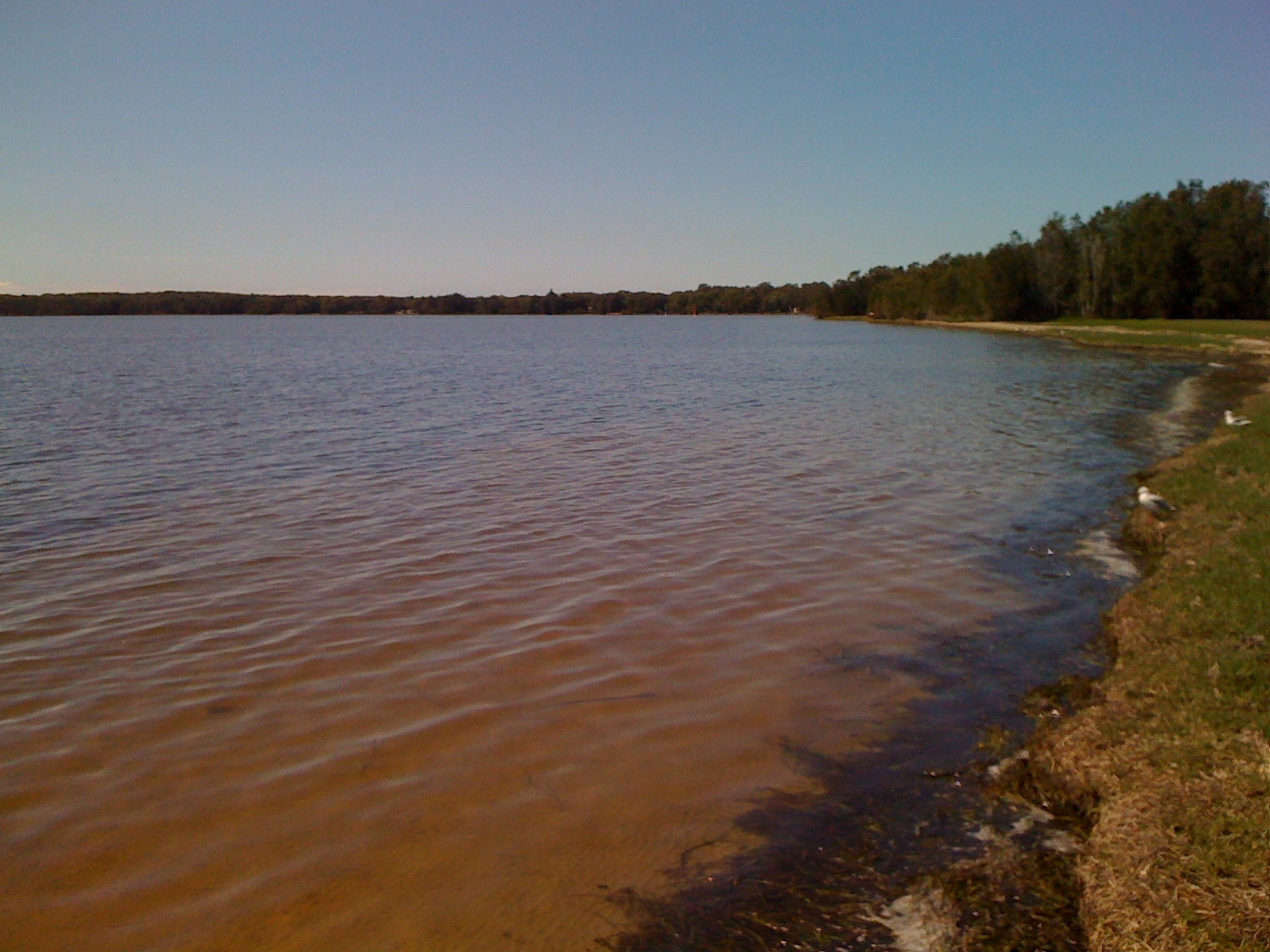 |
| Lake Munmorah, looking north and somewhat east, towards Newcastle (Australia, 2013) |
From the lake it wasn't that far to Lakes Beach, through an arm of somnolent suburbia. I strode past Halekulani Bowling Club with its attendant courtesy buses, crossed the channel which connects Lake Munmorah and Budgewoi Lake. Budgewoi actually means "meeting of the two waters" in the local Aboriginal language, and I wouldn't be surprised if the name sprang from this very channel, the one I was lucky to cross today. I continued over the Central Coast Highway, its asphalt surface burning hot in the sun. Waves could be heard crashing reassuringly not too distant, and there was a soothing salt smell in the air. I looked forward to being able to walk along the beach, and feel warm, soft sand between my toes. But the ocean also provokes in me a fear which is close to primal, so I was a little apprehensive about getting close to it. When I walk along the coast it feels like I am literally on the edge of the Earth, and I worry about falling off. Kind of irrational, but that is how it feels. Perhaps it is a symptom of agoraphobia.
 |
| Michael's Walk floats across this meadow, on the Budgewoi Beach Circuit (Australia, 2013) |
As I traversed the sand drifts and scrub which bordered the ocean, I realized that the hot sun was making me thirsty. I looked out wistfully for a vending machine, but I knew I would never find one, not out here. I was on the edge of civilization, the interface of the cultivated world and the primeval nature from which it sprang. Even if there was a vending machine out here, it probably wouldn't work. This was not Japan, where green tea reprieves await you at every bend in the road, even way out in the wilds, near the summit of Mt Fuji. No, this was not Japan at all. I cut through the scrub, where volunteers had toiled to restore natural vegetation to the Pacific shore, and located some kind of path. The path (named Michael's Walk) led me to a boardwalk which floated over a patch of dry swamp. At the end of the boardwalk I found a sign describing the dune restoration project, dedicated lovingly to the memory of Julie Luff, a local resident and dunecarer.
 |
| In memory of Julie Luff, a map of the Budgewoi Beach Circuit Walk (Australia, 2013) |
Michael's Walk, the dedication to Julie Luff, and now Shane's tree, I thought. It seems like every square inch of land here is named after someone!
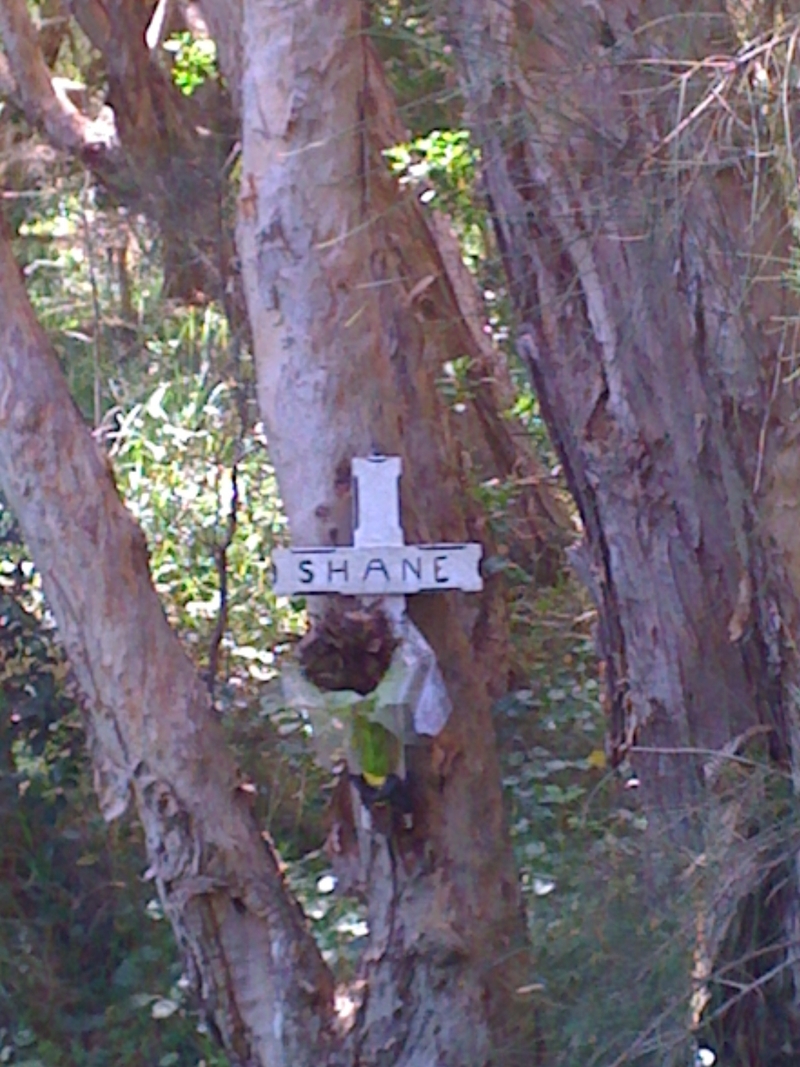 |
| Memorial to a guy named Shane (Australia, 2013) |
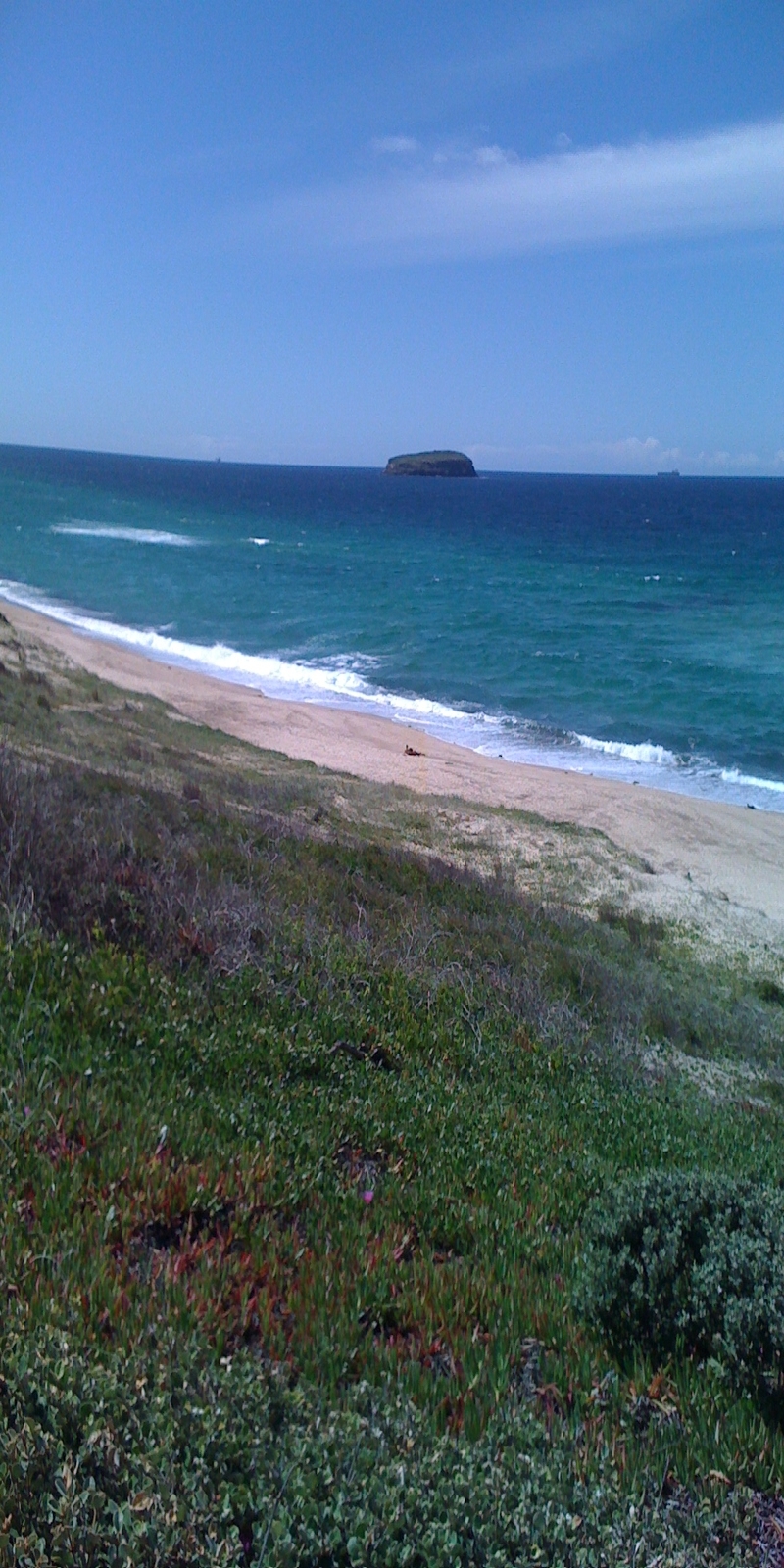 |
| Bird Island, off the Lakes Beach, in Wyong Shire, NSW (Australia, 2013) |
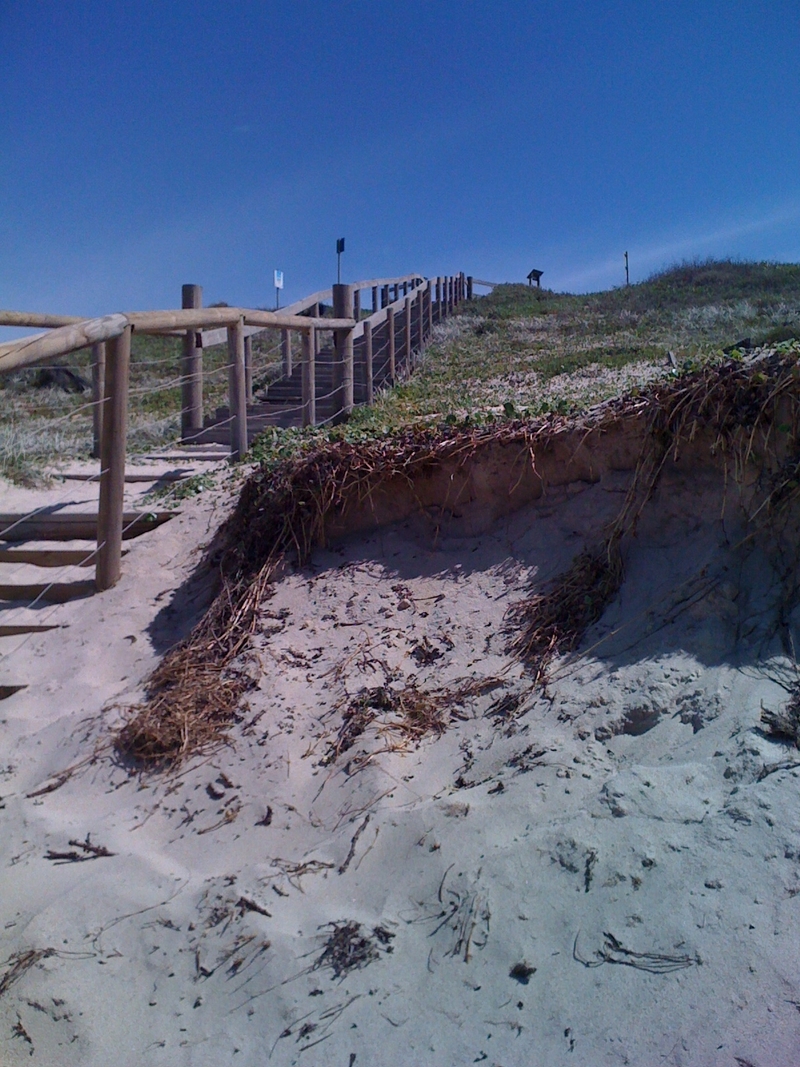 |
| Tumbling down the stairs on to the warm sands of Lakes Beach, near Budgewoi (Australia, 2013) |
Sometimes these days it feels as if I am living in a floating world, cast adrift on a rising tide. The ground beneath my feet seems solid enough, but I know that the whole continent is riding like a raft on a magma sea, creeping north, irrepressibly. Above me the sky, that infernally cheerful blue sky... what could be more steadfast than that sky you might think, what could be more dependable? But like the ground, the blue sky is a deception, a lie... you could even call it a mirage. The sun is not yellow at all, it is white, and the blueness of the sky is merely an effect, caused by the scattering of the solar radiation through the atmosphere. As Einstein boldly proclaimed, we are all trapped in our own little bubbles of relativity only rarely encountering all the other floating bubbles out there, like ships passing in the night. Rare is the man or woman intuitive enough to notice when the bubbles bounce against each other in a momentary collision, soft film walls yielding ever so slightly. Rarer still is the man or woman who can pierce the film which separates our floating worlds in a resounding pop!, and dive through the mirror from one universe into another, merging with it, breathing underwater.
Friday, March 25, 2011
An Accident Waiting to Happen, in Cairns (Part 1)
Isn't it strange how many of the great discoveries were made by accident? Penicillin was first isolated by scientist Alexander Fleming who, returning from holiday, noticed that fungus growing feral on petri dishes in his lab killed any bacteria they came into contact with. Naddoðr, legendary Viking king, was sailing home to the Faroe Islands when he lost his bearings and got barreled on to the eastern coast of Iceland, which was then uninhabited, and unexplored. Christopher Columbus found America on the way to China and in doing so, confounded the prevailing wisdom of his age. It was totally an accident that I discovered Cairns last week, fleeing as I was the triple tragedy in Japan, or more precisely my persistent panic attacks, which have pestered me like a plague for more than two years now, plagued me like a pestilence, and promise me plenty of fresh pain in the foreseeable future. Cairns is not the kind of place I would have chosen to travel to otherwise, but destiny drove me there... destiny and the deadly Tohoku Earthquake and tsunami, which dislodged me from my Japanese home of a decade, shook me from my sloth and my slumber, and sent me packing with nothing save my suitcase and the shoes on my feet. Like all Australians I knew Cairns, I understood it was a resort on the Barrier Reef, realized that it was touristy in nature, and during my many years in Japan I had also learnt that it was popular with Japanese visitors. Not surprisingly, then, the place had never really appealed to me. It didn't feel edgy enough, or so I thought, it didn't seem exotic. It sounded, basically, the kind of place bogans went for their holidays, and I would much rather embark for Bangkok, or Berlin, or even Bali, ffs!) A few days after the great quake of March 11, with relentless aftershocks rattling my apartment in eastern Tokyo, and radiation bleeding from the breached reactors up on the beach at Fukushima (福島), I saluted Japan with a sad sayonara, and then scrambled out the door. Changed the departure date on my Jetstar Airlines ticket, informed my boss it was over, and scurried out the fucking door. Of all three actions, giving notice to my boss was actually the most awkward, which speaks sagas of the sway he had hitherto held over me. For a long time, it seemed that I would be his bitch forever, a servant in the outhouse, the kouhai to his Koresh. It just shows that when the chips are down, when your life is actually at stake, self-preservation will always victor over subservience, and submissiveness (and don't fall for their piety, even the most devout religious types secretly fear their deaths!) Stockholm Syndrome be damned... I wasn't going to die from caesium contamination! Like the earthquake itself, the break with my boss was an inevitability that was long overdue, but something which neither of us had had the heart to hasten. Fittingly, it had to be forced upon us, by fate. According to my new Jetstar booking, I was supposed to stay in Cairns for a few hours on Sunday morning, just long enough to change planes, and possibly crunch on a croissant. But then destiny intervened, once again, this time more benignly. I missed my connecting flight, and was thus free to enjoy a full day strolling the streets and shores of this captivating tropical city, the capital of the cane fields, gateway to Cape York. This is the story of how that happened, and what I discovered there. In the meantime, let's wind the clock back a few days, to that crazy and chaotic aftermath of 3/11, when I honestly feared that my life was about to end, crushed by collapsing masonry, or felled by fallout. This is the story of how I became a nuclear refugee, and how the Moving House project met its indignant demise, dumped out on the pavement with the rest of the trash. Quite a few narratives met their demise on the same day, in fact, all of them indignantly. Let's give thanks to them, now, while we can, all of them one by one! They all deserve to be honored such, after what they have given me.
On Wednesday morning last week (March 16) my boss rang me and told me not to bother reporting to work for the next week or so, as the school would be closed on account of the radiation. When I pressed him further on exactly how long this recess would last, he conceded it could indeed be more than a week... possibly two weeks, a month, who knew? Until the crisis was over, in other words (not there was a crisis of course, and not that he used so many words (typical Japanese doublespeak in action!)) Parents were too scared to send their kids to class (he didn't say that, but that's what I inferred.) Everyone was hunkering down, as if under siege (that was his unspoken gist.) "Don't go outside, ne," he added (meaning: deadly particles might be wafting down from the reactors.) "By all means, chant to the gohonzon on your own. But we don't do gongyou today." Hanging up the phone, I reclined on my futon, imagining a whole free week ahead of me... no, not a week, possibly even a month, a whole month free of work, a month cleared of chanting, and possibly even purged of panic too! I thought to myself: Is this not yet more proof that the Third Free Month has arrived at last, in these dying days of my life in Japan? With every day, my life is becoming more free... freedom is breaking out all over the map! Maybe I could celebrate this change in fortune, I figured, by taking a nap? Because God knows, I needed one! So I sprawled out on the mattress, inserted my earplugs, and attempted to sleep. Try as I might to suppress them, however, thoughts kept arising in my mind, unsettling thoughts: what exactly was going on up there at Fukushima, and why were people so concerned? ... what if there was a powerful aftershock while I was asleep? would I have time to save myself? ... how am I going to survive without a job, especially now that I have retired from Telephone English, and am already living off my credit card? They were, in fact, much the same thoughts which had thwarted my efforts to sleep and eat a decent meal since the great quake struck, five days previously. Unlike my panic phobias, the fears that motivated these thoughts were real, and demanded respect: from time to time an actual aftershock did arrive, a seismic jolt shifting my bookcase on its foundations, and jiggling my windchime judiciously. One of the reactors up at Fukushima had indeed blown up, and I had watched it happen on CNN, and NHK (and all the other networks). I would now be completely unemployed, with no income save Google Adsense, and Chitika. That was reality, not hyperbole. My life seemed to be crumbling around me. On top of that, I couldn't even go out for a walk!
Sleep was out of the question, so I sat up, and dug out the letter I had started writing to N. earlier in the week. Sleep deprivation had rendered me emotional, and I rapidly scribbled out a page or two about how much I missed her, how this entanglement had inspired me to appreciate her love, and how much I was looking forward to living with her in Việt Nam if I ever got out of this mess, blah blah blah. Soppy, sycophantic shit it was, and I had a feeling that it might embarrass her to read it, as she is way less sentimental about these matters than myself. But what was I going to do: this could be my last transmission before the caesium cloud descended, my last will and testament if you might! Since she never replies to my emails these days, or even answers the fucking phone, launching a letter at her was the only way I could get her attention. And this made me ponder: Why does she make herself so hard to reach? It's strange behavior considering that I am giving up my life in Japan to be with her...
The windchime was jiggling before I felt the jolt. My bookcase shifted immediately after that, and began buckling on its legs, jumping like a catfish on a pole. I bolted up from the futon, and made for the back door, and my escape pod. While I was standing there on the back step, preparing to abandon ship, I noticed an announcement flash up on the TV: a magnitude 6.0 aftershock had hit off the coast of Chiba Prefecture, beneath the Pacific floor. While it rated only a 3 (out of 7) on the subjective Shindo scale here in Edogawa Ward, over at Choushi, on the headland I walked on New Years Day, the shaking measured an alarming 6. Across the Edo River, in places like Funabashi (船橋市), vibrations were recorded at Shindo 4. I know a guy who lives over that way (Jim from Telephone English (TE)), and I wondered how he was going. Shindo 4 is pretty serious, I have only suffered it a few times in my life, all of them in Japan of course, and most of them in the past week! According to Wikipedia, at Shindo 4 "hanging objects swing considerably and dishes in a cupboard rattle. Unstable ornaments fall occasionally. Very loud noises." This aftershock, prominent as it was, triggered its own family of afteraftershocks which erupted all around the east coast, each one answering the previous one, as if they were subterranean deities communicating, stocky dwarfs ringing their hammers of iron on the bedrock beneath my feet. I stood in the doorway until the commotion died down, and then some. This game was getting old. I was over it. I had to get out.
Official advice be damned, I decided to go outside for a walk. Just to be on the safe side, I switched over to the weather channel briefly, to see which way the wind was blowing. To my delight, Tokyo seemed to be enjoying a westerly breeze. What a relief, I thought, all that Fukushima fallout is being blown out to sea! I picked up N.'s letter, put on my coat, and bundled out the door. Happy to be outside, rather than cooped up inside, watching my death on TV. It was sunny out, and the wind felt kind of strong. There weren't many people around, giving the streets an eerily apocalyptic feel.
I mailed off N.'s letter at a post office nearby, and then shopped for some groceries at the Yamaichi supermarket on the old salt route (Shinozaki Highway), in Minami-Shinozaki (南篠崎). It was a place I discovered by chance, walking home from work one magic afternoon in the summer of 2007, when life seemed fresh and full of promise. The magic was all gone today, however, and the aisles of the supermarket were deserted. None of their sushi trays, or curated cuttlefish, looked particularly enticing to me. Perhaps all the good stuff had been snapped up already. I picked up some items nonetheless, and shuffled out. Out on the street, the wind blew, menacingly. It was rather a strong breeze, stronger than the weather channel had prepared me for. Possibly it was my imagination, but there seemed to be something caustic riding on that breeze too, something biting, something even luminous. It was only until I returned home, and switched on the TV, that I realized that the wind had changed direction during my walk, and was now blowing down from the north... down from the reactors... down from the fields of death in Tohoku...
I remembered that I had Jim's phone number in my address book, so I gave him a call. I hadn't spoken to him since my abrupt disappearance from Telephone English, and I figured I owed him an explanation. As it turned out, he was flat on his back, literally, across the river in Chiba Prefecture. He told me he was working at TE on Friday afternoon when the great quake struck. The temblor was so terrifying that all the edutainers rushed downstairs to take cover on the street (which, it seems, is a typical gaijin thing to do in this situation!) The phone lines went down, so they couldn't work. But the train lines were down too, so they couldn't get home either. They ended up camping out in the office, and Jim said he did his back in trying to sleep on the hard floor. Surprisingly, he didn't seem as rattled as I was by all the aftershocks. "The earthquake is over, it's finished, we had it on Friday... what you have to worry about is the meltdown," he said. "My folks have been on the phone, telling me to get out, saying you'd have to be crazy to remain here. That is, indeed, what I am planning to do... get out."
"You're going to leave?" I asked him, feeling a little jealous.
"I will only be gone for a week or so," he replied. "Long enough for things to cool down."
"I can imagine there would be a mass exodus, if things got really dire," I said. "You probably wouldn't even be able to leave... the flights would be booked out, the highways gridlocked with traffic."
"Most Japanese would stay, because they have nowhere else to go," Jim said. "We, on the other hand... we have options."
I remembered Ken-san asking me yesterday if I planned to leave Japan. Until that point, I hadn't even considered it. I mean, I was leaving on account of my panic attacks, I had a ticket booked and all, but I hadn't considered hastening my departure due to the disaster. Now, listening to Jim talk, I felt myself brimming with resentment, and envy. How come he could leave, and I had to stay behind? Why was it that I felt so burdened by commitments, and restraints (including financial restraints), that I had to quell my natural instincts to flee? If I was a true Vagabond, I thought to myself, I could leave at any time, I would just pack up my suitcase and leave. Stockholm Syndrome be damned: I never wanted to be a resident! A true Vagabond would just get a train out to the airport, and leave. And in one blinding epiphany, talking to Jim in the radioactive breeze, that is what I decided to do! I decided to pack my suitcase, and leave.
But first, I needed to call my Mum.
 |
| Soil liquefaction brings a pond of water to the surface, on the bank of the Edo River, where the baseball teams play (Japan, 2011) |
Sleep was out of the question, so I sat up, and dug out the letter I had started writing to N. earlier in the week. Sleep deprivation had rendered me emotional, and I rapidly scribbled out a page or two about how much I missed her, how this entanglement had inspired me to appreciate her love, and how much I was looking forward to living with her in Việt Nam if I ever got out of this mess, blah blah blah. Soppy, sycophantic shit it was, and I had a feeling that it might embarrass her to read it, as she is way less sentimental about these matters than myself. But what was I going to do: this could be my last transmission before the caesium cloud descended, my last will and testament if you might! Since she never replies to my emails these days, or even answers the fucking phone, launching a letter at her was the only way I could get her attention. And this made me ponder: Why does she make herself so hard to reach? It's strange behavior considering that I am giving up my life in Japan to be with her...
Official advice be damned, I decided to go outside for a walk. Just to be on the safe side, I switched over to the weather channel briefly, to see which way the wind was blowing. To my delight, Tokyo seemed to be enjoying a westerly breeze. What a relief, I thought, all that Fukushima fallout is being blown out to sea! I picked up N.'s letter, put on my coat, and bundled out the door. Happy to be outside, rather than cooped up inside, watching my death on TV. It was sunny out, and the wind felt kind of strong. There weren't many people around, giving the streets an eerily apocalyptic feel.
I mailed off N.'s letter at a post office nearby, and then shopped for some groceries at the Yamaichi supermarket on the old salt route (Shinozaki Highway), in Minami-Shinozaki (南篠崎). It was a place I discovered by chance, walking home from work one magic afternoon in the summer of 2007, when life seemed fresh and full of promise. The magic was all gone today, however, and the aisles of the supermarket were deserted. None of their sushi trays, or curated cuttlefish, looked particularly enticing to me. Perhaps all the good stuff had been snapped up already. I picked up some items nonetheless, and shuffled out. Out on the street, the wind blew, menacingly. It was rather a strong breeze, stronger than the weather channel had prepared me for. Possibly it was my imagination, but there seemed to be something caustic riding on that breeze too, something biting, something even luminous. It was only until I returned home, and switched on the TV, that I realized that the wind had changed direction during my walk, and was now blowing down from the north... down from the reactors... down from the fields of death in Tohoku...
I remembered that I had Jim's phone number in my address book, so I gave him a call. I hadn't spoken to him since my abrupt disappearance from Telephone English, and I figured I owed him an explanation. As it turned out, he was flat on his back, literally, across the river in Chiba Prefecture. He told me he was working at TE on Friday afternoon when the great quake struck. The temblor was so terrifying that all the edutainers rushed downstairs to take cover on the street (which, it seems, is a typical gaijin thing to do in this situation!) The phone lines went down, so they couldn't work. But the train lines were down too, so they couldn't get home either. They ended up camping out in the office, and Jim said he did his back in trying to sleep on the hard floor. Surprisingly, he didn't seem as rattled as I was by all the aftershocks. "The earthquake is over, it's finished, we had it on Friday... what you have to worry about is the meltdown," he said. "My folks have been on the phone, telling me to get out, saying you'd have to be crazy to remain here. That is, indeed, what I am planning to do... get out."
"You're going to leave?" I asked him, feeling a little jealous.
"I will only be gone for a week or so," he replied. "Long enough for things to cool down."
"I can imagine there would be a mass exodus, if things got really dire," I said. "You probably wouldn't even be able to leave... the flights would be booked out, the highways gridlocked with traffic."
"Most Japanese would stay, because they have nowhere else to go," Jim said. "We, on the other hand... we have options."
I remembered Ken-san asking me yesterday if I planned to leave Japan. Until that point, I hadn't even considered it. I mean, I was leaving on account of my panic attacks, I had a ticket booked and all, but I hadn't considered hastening my departure due to the disaster. Now, listening to Jim talk, I felt myself brimming with resentment, and envy. How come he could leave, and I had to stay behind? Why was it that I felt so burdened by commitments, and restraints (including financial restraints), that I had to quell my natural instincts to flee? If I was a true Vagabond, I thought to myself, I could leave at any time, I would just pack up my suitcase and leave. Stockholm Syndrome be damned: I never wanted to be a resident! A true Vagabond would just get a train out to the airport, and leave. And in one blinding epiphany, talking to Jim in the radioactive breeze, that is what I decided to do! I decided to pack my suitcase, and leave.
But first, I needed to call my Mum.
Sunday, July 15, 2007
The Tower of Babble
I surfaced early this stormtossed Sunday, eagerly welcoming my reconnection to the wired world. The man from Mediatti (Edogawa Cable Television -- phone 0120-281641) did indeed arrive at 11am, as the sky thundered; my contract was finally signed, 2.5 months after the first attempt. However, contrary to my expectations, the guy who handles the hardware side of the equation couldn't make it on account of the typhoon. He/she won't be able to come until Tuesday, in fact. Which means two more days of trying to avoid myself, in a world of reduced interactivity.
My computer has been in detox for like 10 or 11 weeks; I have been suffering withdrawal symptoms for just as long. There must be viruses and cookies on my computer flapping around like condemned fish on a deck, frantically trying to reconnect, and complete their programmed agenda. It makes me wonder: are there also viruses and cookies loose in my mind? Now they are in detox, they must be feeling the pinch. Are they toiling to hook up again with the Web, but are mysteriously being denied access? Access has been denied a long time now, but there are only two more days of this cold turkey left to bear.
Maybe it was a good thing the Internet was not reconnected today, because it encouraged me to go out and investigate the typhoon, which was hurling towards Tokyo. After a night of unremitting rain, I was surprised when at about noon the heavens cleared, allowing the sun to shine bright and hot. The eye of the storm wasn't supposed to pass until 6pm. I thought to myself: this seems to be a strange meteorological phenomenon, and if I go outside, I will be able to experience it. Just like my mate down in Chiba, surfing the waves... just like that mad Australian I would be meeting the typhoon halfway, and riding it. So, I hit the street, and the first thing I did, was skirt 'round the perimeter of my apartment block, and creep 'cross the carpark that it abuts. I wanted to see what my apartment looked like from the rear, but my incursion freaked out one of my neighbors, an elderly woman who lives perpendicular to my back shutters. She opened the backdoor of her house and wandered out warily, mumbling to herself. Perhaps she suspected that I was a burglar, they always accuse foreigners of something or another in this country. When I unsheathed my camera to snap a photo of my room, she gasped, her worst fears confirming. I bowed awkwardly, and apologized, "Sumimasen, ojamashimashita!" as politely as I could, wishing I spoke better Japanese. I don't think she understood me.
Bruised by my latest collision with Japanese xenophobia (why do I always end up living next door to busybodies? and by the way, I am not the only gaijin who has trouble with odd neighbors!), I swiveled around and left.
 |
| My apartment, from the rear carpark (Japan, 2007) |
I returned to the road, and discerned in the distance a tremendous chimney, at least 20 to 30 floors high, flashing through the mist. As in many parts of deterritorialized suburban Tokyo, my local monument is a waste incineration plant. Inspired by Paul Virilio's concepts of speed (and its effect on the city), I decided to walk towards it. It's good sense, after all, to be able to orient yourself by the skyline, in case you ever got lost. And as it turned out, I had gotten lost once around this tower, more than 4 years ago in another era of my Tokyo life, while I was distributing chirashi for Kobayashi-sensei. Back in those days I would never have honed in on something as utilitarian as a chimney -- but I have learnt to appreciate extreme engineering recently, it is what Japan is all about. I reasoned it would be a good way to experience not only the typhoon, but the devastation of Paul Virilio's speed -- the Japanese landscape which had been swallowed up, and cemented over, by progress. As I was to discover, this was also the perfect place to perceive the potentials of negating speed, by learning to slow down and smell the roses.
 |
| My local landmark, a garbage incineration chimney (Japan, 2007) |
It soon struck me how much greener it is here in Edogawa Ward, compared to my former locality of Taito Ward (台東区). A tiny temple lofted into view, radiating such an atmosphere of calm that I knew it was a little pocket of old harmony, in other words a piece of original Japan which had survived the explosion of speed. As I ventured on, it became more apparent that there were flotsam and jetsam of old harmony all over the place. Weeds springing verdantly from a cracked sidewalk, their flowers reflected in sputtering puddles... to me they were not vagrants but spontaneous Japanese gardens, in miniature and scattered to the margins. The real gardens of the people living on the Kyu-Edo River, every inch of their front yards hogged by azalea hedges, without a single blade of grass in sight. Totally different from the suburbs of Australia! And the weather was also different from your weather back wherever you drop from, unless you hail from the hurricane belt -- yes, the weather was pretty interesting today. The sun fought a mostly losing battle with the clouds, but every now and then it would emerge again, and transform everything into a wonderful summer's day -- for a couple of minutes at least. Then the wind and the steam and the humidity would return.

Asked if there was any merit in information society, Paul Virilio replied: "Yes, because it finally poses the question of a common language. It cannot be otherwise if there is to be world citizenship. It is Babel, moreover. What we are witnessing is not the Tower of Babel but the return of Babel. Can the world have a single language? Is this unicity of communication good or evil? Another positive point: Information will make us earthlings..."
Saturday, June 30, 2007
Greenland's Vikings, Victims of Climate Change
I have been reading a lot lately about the vanished Vikings of Greenland, how they just disappeared from the history books in the Middle Ages, never to be heard of again. I have been thinking a lot about them recently, those Europeans who for a couple of centuries eked out a civilization on the edge of the Arctic, trading in walrus ivory, worshipping in churches... they seemed to be flourishing and then one day they went MIA like the crew of the Marie Celeste, or those jet fighters swallowed by the Bermuda Triangle. It is worth pointing out at this point that I am in fact Australian, and thus hail from another European colony which was transplanted with all things Christian and European onto a barren, alien land, and left there to fend for itself. The Australian experiment worked, however -- the Greenland experiment didn't (at least not for the Vikings LOL!) Interestingly enough, Climate Change was the major culprit in the Greenland Vikings' demise -- not the Anthropogenic Global Warming we are (apparently) confronting now, but rather the Global Cooling of the Middle Ages (whose cause is still a matter of conjecture). Southern Greenland, once as verdant as its name suggests, presently chilled, then got snowploughed beneath a slowmotion avalanche of ice. The Vikings were snapfreezed out of existence; their neighbors the Inuit, who had migrated into the region at about the same time, somehow managed to adapt, and survived. Perhaps a similar fate awaits Australia in the future -- the white civilization which has ruled the roost for 200+ years will be forced to retreat from waves of heat and drought and searing fire, and the longsuffering Aborigines will crawl out from the margins to repossess their beloved homeland. History has a strange way of working like that. You never can really tell who is going to win the race, and revolutions are all too frequent. Gods hold grudges, and patiently plot their revenge. The laws of physics cannot be ignored, and neither can the science of Symbolic Exchange. Thus we have been warned! Thus we will be warmed.
Anything can happen in life, and history is full of sudden reversals. Global Warming could well be just a beat-up, the latest strain of the Armaggedonist virus whose DNA was identified in the Year 2000 bug, SARS and the Bird Flu Epidemic, and which has consistently frightened more people than it has actually harmed (infecting them not through physical germs but rather exposure to sensationalist reports on TV and the like.) I believe these hysterias are in fact media viruses, and mark a mutation of the virus from the physical world in which it has proliferated for billions of years, into the Baudrillardian mediaswamp we humans now inhabit. We're going to have a lot more media viruses in the future, that's my theory at least! Some people just love to think the world is about to end, and indeed such a deathwish is built into the mythology of the capitalist system itself. How it works is like this: somewhere in the "real" world (eg, China, Vietnam, Africa, anywhere Third World) a new virus arises in animals and kills a handful of people, triggering a pandemic alert. The media, ever hungry for a good scare story, jumps on to the case, and proclaims that the end of the world is nigh. What WHO fears is that the virus will jump the species barrier, but actually a more profound evolutionary leap is taking place: the virus is becoming digital. Panic takes on a life of its own, and becomes viral... this is how the pandemic spreads, this is what gives it energy. There's a run on flu vaccines... everyone on the streets of East Asian megacities are suddenly wearing surgical masks. Little do the masses know that it's too late, they are already infected! Their masks aren't protecting anyone, they are in fact amplifying the fear, broadcasting the infection! The best response would actually be to chill out, and ignore the doom. Or at least maintain a skeptical distance. That's what I would do, but then someone would accuse me of being irresponsible...
Look, what I am trying to say is this: Climate Change could be real, and could well be hype... but the extinction of the Greenland Vikings is a historical fact, and I find myself strangely haunted by their disappearance. Recently I thought to myself: imagine if the colonies had survived and the fjords of Greenland were now sprinkled with colorful, asymmetrical cafes and bulging nightclubs and bars; imagine if every young Greenlander today dreamed of being a poet or an anarchist or an artist or a rock musician? In other words, what if Greenland had developed into a New Iceland or a somewhat edgier, more tribal take on the Faroe Islands? Wouldn't that have been awesome, wouldn't that have been totally cool? Not politically correct to contemplate, but an interesting thought experiment nonetheless. I must confess though that Inuit Greenland has turned out pretty swinging in its own way, and the music scene is just as vibrant there as it is in Iceland, from what I hear. Nonetheless, I can't help myself from thinking: imagine if the Vikings had survived, imagine what Greenland would be like today? And I wonder: maybe the green days of Greenland are on their way back, after a long bitter winter? Spring is dawning in the Far North of the planet, and the Day of the Inuit is arrived. How I'd love to be part of it somehow. If I had any money, that is where I would be investing it!
 |
| Greenland is on the path to independence from its colonial master Denmark, and now has its own flag and a new name, Kalaallit Nunaat |
Look, what I am trying to say is this: Climate Change could be real, and could well be hype... but the extinction of the Greenland Vikings is a historical fact, and I find myself strangely haunted by their disappearance. Recently I thought to myself: imagine if the colonies had survived and the fjords of Greenland were now sprinkled with colorful, asymmetrical cafes and bulging nightclubs and bars; imagine if every young Greenlander today dreamed of being a poet or an anarchist or an artist or a rock musician? In other words, what if Greenland had developed into a New Iceland or a somewhat edgier, more tribal take on the Faroe Islands? Wouldn't that have been awesome, wouldn't that have been totally cool? Not politically correct to contemplate, but an interesting thought experiment nonetheless. I must confess though that Inuit Greenland has turned out pretty swinging in its own way, and the music scene is just as vibrant there as it is in Iceland, from what I hear. Nonetheless, I can't help myself from thinking: imagine if the Vikings had survived, imagine what Greenland would be like today? And I wonder: maybe the green days of Greenland are on their way back, after a long bitter winter? Spring is dawning in the Far North of the planet, and the Day of the Inuit is arrived. How I'd love to be part of it somehow. If I had any money, that is where I would be investing it!
Monday, December 25, 2006
Three Dimensions of Time, and the Multiverse
I dreamed about extra dimensions a great deal during my Australian life, for example whilst I was off my head with Boyd B. at our Rowntree Street kip, trying hard to impress the man they called the Wolf. I was on a New Age Spirituality tip at the time and I endeavoured earnestly to imagine what these other dimensions would be like, always picturing them as extra spaces, physically present but inexplicably invisible to my eyes, as well as my other senses. In the Fifth Dimension stars were Earths which had attained Enlightenment and Combusted, that is what they New Agers said (and like my cousin Kellie, they are still saying it now!) Of course it's wishful thinking, and I don't believe it -- ever since I moved to Japan I have become pragmatic, a realist, a disciple of Nietzsche's Here and Now. The world won't explode in the year 2012, I can feel that in my bones, but there is no need to throw out the baby with the bathwater, as the old cliché goes, and dump the entire New Age canon. Surely there is something in there worth salvaging, before that baby sinks? However content I am with my current reality, I can't get let go of the idea: Are there extra dimensions of space/time, beyond the three or four that we are all aware of? But if they exist what do they look like, and why can't we perceive them? Recently I have been wondering if I was barking up the wrong tree, by imagining the Fifth Dimension as a kind of Garden of Eden blooming less than a ℓP from our Cartesian cell. Maybe the Fifth Dimension is not a space, but a time. A plane of Time, to complement the classical field of Newtownian space. The Fourth Dimension is a line of time just as Einstein understood, the Fifth Dimension is a field, and the Sixth Dimension is... wait for it, a sphere. Or actually a Solid of Time, according to Ouspensky, who pondered such things well before I was born. As The Theory of Six Dimensions relates:
Some say there are three or four dimensions, some say more dimensions (10, 11, and 26 are current favorites of some physicists), some say there are an infinite number of dimensions. But Ouspensky's explanation of the six dimensions resolves that dilemma by showing how six dimensions are both all-inclusive and yet only partial...
In modern physics and science in general, the first three dimensions are the same as those described everywhere. But then things get a little confused. The fourth dimension, which is time, is sometimes described as space-time, which is actually the fifth dimension—as Ouspensky points out, the fact that space-time is curved requires another dimension.
The sixth dimension, all possibilities, is essentially the "multiverse" or "many worlds" interpretation of modern physics. The many worlds explanation is an attempt to explain observations of quantum phenomena that have no ordinary explanation but do have a consistent, but extraordinary, explanation. It basically goes like this: At every moment when you seem to choose among multiple possibilities, you actually choose each possibility, and different universes fork off, the one you are in now is the one in which you made the choice to read this, for example. There is another universe where you chose not to read this, another where you read part way and stopped and so on...
Monday, August 7, 2006
We're All Floating
Have you ever read a haiku poem? Not only are they fascinating compositions in themselves, as fragile as a cherry blossom, but they also open a window into the culture and the consciousness of the Japanese people.
For those who don't know, haiku comprise three nonrhyming lines of five, seven and five syllables. To our Occidental mind, they appear too fleeting and incomplete. We feel that there should be something more substantial. If we think Orientally, however, we will realize that they reveal something less... that is, the vacuum which encapsulates the core of the Japanese experience. Just like the empty gestures of the tea ceremony (茶道), they condense the essential nothingness of the Universe. This is the original meaning of the "Floating World", in my opinion at least.
The following haiku, by Matsuo Basho (松尾 芭蕉) is said to be one of the most profound achievements in Japanese literature, but is only seven words long:
"Furuike ya!
Kawazu tobikomu
Mizu no oto."("Oh -- ancient pond!
A frog jumps in,
The sound of water.")
It should be noted that the "ya" is not even a real word, and it is merely deployed as a "state breaker", a crack of Zen revelation. I studied quite a few other haiku today and most of them were deceptively simple, but yet deeply mysterious at the same time. They make me wonder about how the same patterns coil round and round and in upon themselves, conchstyle. In Europe landscaping generally entails elaborate grounds with avenues of grand elms; in Japan the traditional garden is just a raked expanse of gravel rimmed by midget brutally pruned bonsai trees. Haiku are the bonsai of the poetry world, you might say -- severely pruned and bare.
A more contemporary state breaker can be heard in the song We're All Water, written and sang by Yoko Ono, and released on John Lennon's protest album, Some Time in New York City. Ono might be a terrible singer and the whole production is shambolic, but the curious structure of the piece redeems it. Each verse is like a haiku, with three lines of five or seven syllables each, for example this one:
"There may not be much difference
Between Manson and the Pope,
If we press their smile..."
Three is not a particularly rhythmic number at the best of times, at least on a Rock record, but here it lends an exotic, enigmatic quality. Listening to Ono's song, you might find yourself hanging on, waiting for the missing fourth line. Have the courage to let go, however, and you could fall into an abyss, one that you never even noticed there right before your feet... (For more of my discoveries regarding manifestation and the void, click here.)
Monday, January 5, 2004
The Gift of Death
I was thinking recently about that Biblical verse: "For God so loved the world that he gave his own and only Son..." I suddenly realized a new interpretation of that expression: that we, as spirits, were so in love with "reality" (The Earth) that we were willing to give up our immortality, and accept a short life here. Just like Arwen did in The Lord of the Rings... she gave up her life for love. Just an idea! but if it is true, it means there is no Afterlife for us, no Blessed Realm over the ocean... because we forsook that for the privilege of incarnation.
On a bright note, my Japanese word of the day was taught to me by Masumi, after I told her about my psychic dreams -- it is masayume (正夢) or "true dream". I'm sure it will come in handy someday!
On a bright note, my Japanese word of the day was taught to me by Masumi, after I told her about my psychic dreams -- it is masayume (正夢) or "true dream". I'm sure it will come in handy someday!
Subscribe to:
Posts (Atom)
