For every six hotels I stay at going forward, one will be like Hotel Gosford, and one will be comparable to the Bayview Hotel at Woy Woy, which I have just checked out of. Yet another will be like the Ocean Beach Hotel (Nightcap at Umina), my next step on the road, where I will still be staying in a pub, but at least I will have my own toilet. The Nightcap will be grade 3, while the Metro Mirage in Newport will be one step above, at level four. Hotel Gosford has been the grungiest of my hotels thus far, partly due to its location, as well as facilities and clientele. Bayview Hotel is just as cheap as Hotel Gosford, but has a friendlier vibe, and a sunnier outlook. That might be due to its location, and the demographics of the city.
In Woy Woy the population is more gentrified, genteel, and geriatric. Local motorists stop for you when you are crossing the road, rather than beep their horn as in Gosford. There are a lot of zebra crossings... too many, in fact! I feel guilty holding up the traffic. My room was facing north, and directly opposite the Central Coast Ferries wharf on Brisbane Water, which is critical for my attempts to knock off the first two six baby steps out of the Central Coast. All things considered, it was quite cozy, though a little dated.
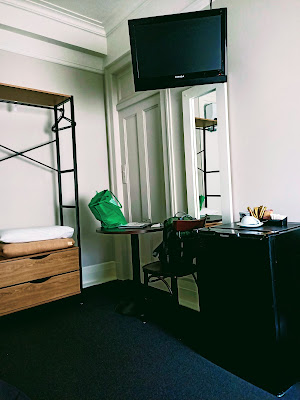
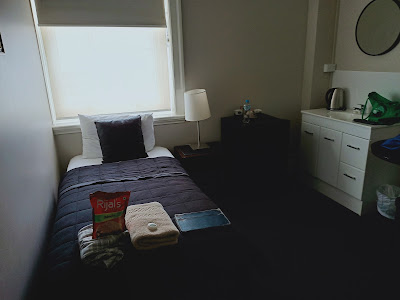
Afternoon sun in the standard Queen room at the Bayview Hotel (Australia, 2023)
The only problem was that there was no table nor chair, so I was forced to sit on the floor with my laptop resting on the side of the bed for my lessons for iTalki. And while sitting on the floor might be comfortable in Japan, where homes and hotels are often built around this discipline, Australian accommodation is not as accommodating. Carpets can be dusty and unhygienic, with none of the spring of your typical tatami mat. After a couple of hours of sitting crosslegged I would get sore legs, numb extremities, even muscular spasms. I assumed that I would get used to it eventually.
That said, I ticked off the first of the my baby steps easily enough. To be fair, I was suffering mild derealization upon arriving at Davistown, after talking to the boy with the toy brontosaurus on the boat, and the Elvis impersonator at the bus stop on Paringa Avenue, near the shops. In retrospect, my anxiety level seemed to be about 1.7 Distress Units (DU). After that early success, I was confident and complacent (which is always a dangerous combination). Unfortunately, the second baby step to Empire Bay on the other side of Cockle Channel didn't go so smoothly. It was a stormy day, and I had foolishly left my raincoat in the hotel, thinking that it wouldnt rain until evening. As soon as I arrived at the wharf, it started pelting down... (For the full report of my setback on the catamaran to Empire Bay, click here.)
How many Internet searches do you do in a typical day? During a busy session of teaching English online, I can rack up 100 queries, related to topics which my students have raised. One week I clocked in a whopping 360 searches, with terms ranging from "kiszona kapusta" to "Doctor Who time loops". They were all conducted on a single search engine (can you guess which one?)We give an awful lot of personal data away just for the privilege of using their platforms. Don't get me wrong, I love Google -- they are generous with content creators. As a basic consumer the benefits are rather scant, however. Bing will reward you with points for choosing their machine, but they must be redeemed by shopping at the Microsoft Store. If you want to be paid in cold hard cash (well, in cryptocash at least!), Presearch is the only program out there. You can earn 0.1PRE per search, with a cap of 25 searches per day.
As of December 2022, that was worth US$0.81.
Of course, it is chump change but does add up, and it is better than earning nothing at all. More importantly, your PRE gives you voting and ownership rights and the ability to build a search engine that is for the people, by the people. A Teal organization, to be precise... (For more on the Presearch search engine and Ethereum token, click here.)
Deadset in the middle of Gosford (corner of Mann and Erina Streets) rises this historic hotel, erected in 1926. The internal elevator is just as an ancient, and is said to be a museum piece. I was somewhat skeptical on my first night here on Wednesday since the hotel is a cheapie with shared bathrooms. My concerns congealed when I realized, after checking in, that there was no remote controller for my TV. It was a steamy day, and my shirt clung to my back like a cheap shower curtain. I rummaged through all the drawers, peered under the bed, even teetered on a chair to examine the top of the clothes rack. It was a trifle dusty, but there was no controller to be found there. This could be a problem.
Table and chair for lessons and a fridge, but the TV didn't seem to work (Australia, 2021)
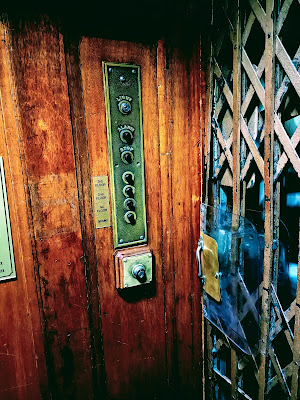
I rode the rickety lift two floors down to reception, where I reported my predicament. A great deal hung in the balance: this was my recon mission, and if the Hotel Gosford failed this first test, I would have to upgrade into something more expensive for the coming longstay. Thankfully, the lady at reception provided me another device, which she assured me would do the trick. I took the stairs back to my chambers, traversing some office space on the first floor. Something about the lift gave me a dodgy vibe, and I didn't completely trust it.
Rickety old lift at Hotel Gosford (Australia, 2021)
Returning to my room, I aimed the remote squarely at the TV, squeezed the on button. The set refused to respond, but just hung there, impassively. Damn it, I thought. I am not normally a complainer, but this was important. Something had to be done.
The second cheapest hotel in Gosford (the Ibis) cost at least $100 a night, or $3600 per month. I could survive without television for one night, of course, but how about the longstay (or the even longer stays which loomed beyond?) If the TV didn't work this time, what else might not work in the future? This was a dry run of the Escape from Oz which is due to begin in just a matter of months. It was a critical battle, one worth fighting for.
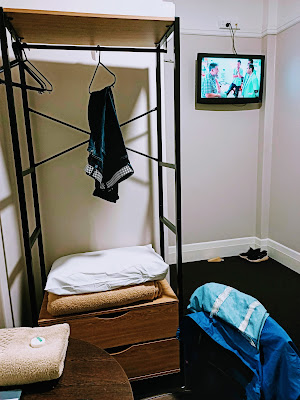
I was on my way downstairs again when I met a member of housekeeping on her rounds. I briefly informed her of my predicament, and she kindly accompanied me to my guestroom. After fingering the remote controller for a while, shuffling around the batteries, shooting from different angles, she surmised that the TV was on the blink. (That might, possibly, be why the remote was removed in the first place!) She promised to move me to another room, and new keys were delivered to me promptly. Five minutes later I had been transferred to a nearby wing, facing the Imperial Centre (behind the yellowed blind).
My new room, with remote controller and Indian snacks, at Hotel Gosford (Australia, 2021)
I performed a rapid once-over, just for the record. Air conditioner, check. Idiot box, working, and receiving both Newcastle and Sydney channels. Chair and table, comfortable enough. I didn't need them tonight, but I would once I started teaching here. Bar fridge, plugged in and chilled. Hopefully it was cold enough to freeze beer, but that was yet to be determined.
Catching a little telly before bed (Australia, 2021)
Checklist compiled, I went out, because I had better things to do than sit in my guestroom watching TV! I ate some cheese tteokbokki and kimchi at the local Korean restaurant, then downed a couple of Asahi Dry pints at the Bon Pavilion. Later that night, just before retiring to bed, I caught on the news that there was a big storm coming in. Luckily for me, I had Alfie's raincoat to protect me on my trip home tomorrow.
With all the speculation in the cryptosphere, it is liberating to come across a platform that you can use right here, right now. According to Ben Davidow, Augur is the world's first decentralized prediction market (DPN). It aims to unlock the wisdom of the masses by offering incentives for insider knowledge. Will Donald Trump win a second term as President?... that is a current question on Augur (probability: 40%). Will there be a big earthquake in Tokyo by April 2019? (probability: 2%.) The theory is, people with secret knowledge, for example Japanese seismologists, will try to exploit their private expertise, and tip off the market. Over time, Augur might answer some of our most profound questions, such as When will AI become self-aware? I would wager never.. but with such an open timeframe, there won't ever be a payday. This is the kind of market I would be ought to stay away from, for reasons that I will shortly explain.
Augur has huge potential, not just in the speculated future, but right now, and that is what attracts me to the platform. That said, the system is still a bit buggy, very much Beta, and counterintuitive for newbies. To begin with, bets are called markets (buying and selling the probability of a certain event). If you want to bet against an event, you sell shares in it (even though you don't own any shares to begin with). Once you wrap your mind around this, it gets a little easier, but there are other problems. The UI can shut down, for days at a time. With some markets it can take a lot of time getting trades through. Cancelling such orders costs more gas (though not as much as it costs to enter or exit a market). Congestion on the Ethereum blockchain can freeze you just when you are about to pounce.
In spite of these obstacles, I persist, because I can see real rewards here. Based on my exchanges so far, I am 93.75% certain that I have found the Holy Grail for bear markets such as these. And since my research has revealed that cryptocurrencies languish in bear markets 75% of their lives, Augur offers me the way to monetize this downtime. Who knows, it could help kickstart the Escape from Oz, a project which has been languishing way too long in my personal bear market... (For the full review of the Augur prediction market, click here.)
Who would have thought it: me the wannabe writer, the wordsmith, I've gone and done something completely left-field, and become a music video producer! It was never something I imagined I would be good at, or even able to attempt... but for the past couple of weeks, I have not only been making videos, but getting paid for it! Exploiting skills honed over many years of manipulating images on Gimp or Online Image Editor, and expanding my savvy to encompass Windows MovieMaker, and YouTube. I know I am not going to win any awards for these clips, or infect the world with a virus, much as my sponsor might hope so. I'm certainly not going to get rich, and neither, probably, will he. I don't really care, and I've never really gone for the viral success thing anyway. Ever since I hit "rock bottom" last month I have been looking for any excuse to escape, and clamber goat-style back up the slope which by definition must rise (since I am at rock bottom), somewhere around me, if only I can find it. One day last month, sunk deep in my funk, stranded on my desert island, I received a message from one Sam Evangelidis, an associate of Garnet Mae, asking me if I could help him out. Sam was the famous milk truck investor for Meat Pie, if my memory serves me right, and lives in the Blue Mountains west of Sydney. He wanted me to produce some videos for his songs. He has a lot of them, and most of them are pretty good.
Slaving over a hot keyboard, working for Sam Evangelidis (Australia, 2013)
This joyride here, is the third video I have made for Sam. Called Ten Cents a Ticket in My Double Bed Blanket, this is hip hop with a suburban Sydney twist. Not quite MC Kerser, but it's mean enough. Samples and a bassline which sound like something on a Drum&Bass track. Drums and bass and a delicious diva... what could be better than that? What could be better than the fact that I am involved in it?
Mumtaz is one of the most respected Indian restaurants in Ho Chi Minh City. It is also popular -- so popular, in fact, that Trip Advisor ranks Mumtaz number five out of its 267 rated restaurants in the city. At meal times the place is jammed with Indians doing business deals over the table, foreign tourists taking a clue from their Lonely Planet guidebooks, and curious locals. The restaurant is located on Saigon's "golden mile", Đưòng Bùi Viện (Bui Vien Street), in the heart of the backpacker district. It is in fact at the "Indian end" of Bui Vien Street, and there is another classic subcontinental restaurant Akbar Ali right across the road. Whereas Akbar Ali is cozy and carefree, Mumtaz seems more like a serious business and possibly even a chain in the making (there is another establishment on the Hàn River at Đà Nẵng). Whereas Ali Akbar is obviously a family affair, Mumtaz bustles with corporate efficiency. Staff wear shirts adorned with the Mumtaz name. They are happy to make recommendations from the menu, which is as authentic and extensive as an Indian restaurant menu should be... (For the complete guide to Mumtaz and other Indian restaurants in Ho Chi Minh City, click here!)
Of all the diasporas in the world, one of the least well known is the diaspora of Japanese people to South America. As Latin America Links has recorded: "In 1899, the Japanese government was concerned with over population and began a campaign to send Japanese to different parts of the world... 790 Japanese arrived in 1899 (in Peru) to work the sugar and cotton plantations. A significant number of them were from Okinawa..." Peru was not the only New World destination for these poor Japanese settlers: many of them ended up in the agricultural sectors of Brazil and Paraguay among other countries, all of whom were desperately short of (hu)manpower. Japanese DNA entered the racial melting pot of Latin America, but was not totally dissolved; the result is that even today distinctly Japanese communities can be found all over the continent. As the Japanese tourist Kimulog wrote on a 2006 trip to Brazil: "It was Sunday when I came to Sao Paulo first. On Sunday Sao Paulo, many stalls (Yatai in Japanese) are ranging in parks and plazas. One of them, held at Liberdage, was just like Japanese Ennichi. I could find many Japanese meals such as Yakisoba-Oobanyaki-Takoyaki-... ,and many Japanese immigrants working in stalls who can speak both Portuguese and Japanese..."
Arco Iris Peruvian restaurant in Gotanda, in the Shinagawa ward of Tokyo (Japan, 2009)
Diasporas have a habit of returning home, and in recent decades hundreds of thousands of Latin Japanese have been applying for Japanese ancestry visas, and settling in the homeland. Go to any foreigner-friendly psychiatrist's clinic or travel agency, and you will find Spanish language newspapers and magazines. I have seen census figures which show that Brazilians comprise the fourth largest ethnic group in Japan (after Koreans, Chinese and of course the native Japanese!) Those Brazilians are Nisei (second generation descendants of Japanese settlers in North and South America and other parts of the world). Peruvians are also having an impact in Japan: there is a band of Peruvian musicians who regularly make the rounds of major festivals in such places as Iriya (site of the midsummer Morning Glory festival). There is a girl who works for my boss's English school named T. who comes from Peru and looks Peruvian, although her visa says she is ethnic Japanese. My boss calls her a Nisei Japanese although she is probably not second generation at all, but third. Anyway, she wanted to introduce us to the delights of Peruvian food, which is how this adventure began.
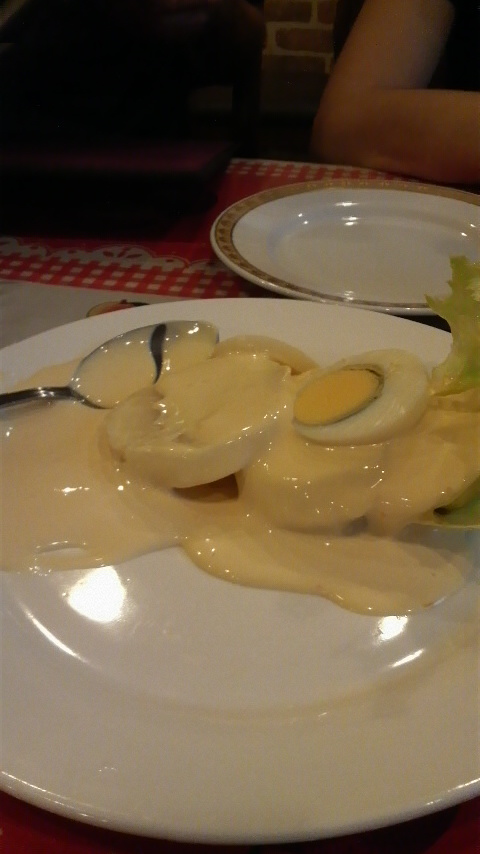
Thick slices of potato topped with egg and a winning cream, at Arco Iris (Japan, 2009)
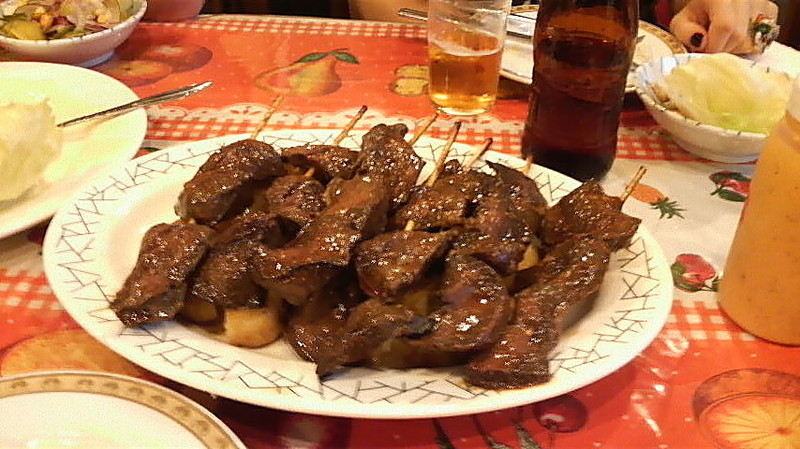
Since the loss of my principle Tokyo food sponsor Sasaki-san due to family illness, I have been confined to eating konbini cuisine, or dining in the occasional famiri resutoran, or if I have been really desperate, cooking for myself. Now I must state here that eating convenience store meals in Japan is not the full culinary disaster that it sounds: Japanese convenience store meals are no doubt the best in the world, as my Bankstown food critic Oscar told me on a subway ride home recently (Toei Shinjuku Line, Shinjuku to Bakuroyokoyama.) Oscar said he had visited a Japanese prepared meal factory himself and reported that each meal was handmade, with stringent quality controls. Every product had its own focus group. There are usually no focus groups overseeing my home cooking but it nonetheless pleases me, although I can only basically cook a handful of dishes (that could change when I move to Vietnam.) But anyway, since the loss of my principle Tokyo Food sponsor, I have been forced to turn towards... my principal. Hiroshi Kobayashi, of Kidea Eigo Akademii. Lately he has developed a penchant for taking his staff out for dinner or lunch, and then picking up the tab. Tonight's outing was ostensibly a dual birthday celebration for two of the staff, but I suspect the real reason is that Hiroshi wanted to try some Peruvian food. (As T. had assured us, Peruvian food is much loved all over South America.) The place was the Arco Iris Restaurant near Gotanda Station. Arcoiris apparently means "rainbow" in Spanish, and the name seems fitting for the rainbow colored Japan which is slowly in the making. We took our seats, ordered some drinks, and one by one the dishes were brought out for us. Fittingly enough, potato seemed to be a major ingredient here. Boiled potato, fried potato... there was even a dish which just like fried potato and tasted just like fried potato, but wasn't potato. The first dish was T.'s favorite: circular chunks of potato topped with egg in a creamy sauce. It might have looked bland, but it was the sauce what made it. As a matter of fact, it seemed to be the sauce what made it for all of the dishes that were to follow. I drank my Peruvian beers, and conversed with the lovely blonde V., from Moscow. R. from London ordered a Moscow Mule by mistake, and passed it on to me. I'll drink anything, so I took it! There was a lot of conversation flying around the table in English, Japanese, Russian and Spanish. Presently the second dish of the evening appeared: kebabs of meat (T. claimed they were skewered cows' heart), smelling like a million dollars. I had a beer in my hand, and ¥1680 in small change to my name. Luckily Hiroshi was picking up the tab for tonight!
Skewered cows' hearts, or so I was led to believe, laid atop a soft potato bed (Japan, 2009)
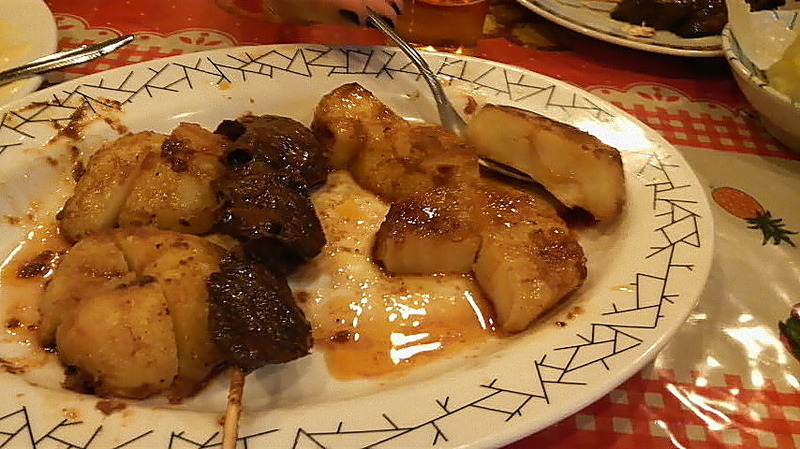
Chomp your way through all of those skewered hearts (which apparently are called anticucho in Spanish) and this is what you find: a veritable bed of juicy soft potatoes. Did I mention that there are hundreds of varieties of potatoes growing in Peru, in all manner of sizes and colors and personalities? In fact, some consider that Peru was the home of the potato, the source, the origin. Once again, as with the earlier dish, it was the sauce which made the anticucho great, it was the sauce which made it happen. I could be wrong but it seemed to me that there was some homeland Japanese influence to all this food, a Japanese taste -- let's call it aji. The way Peruvians talk about the word aji (which to them means "spice"), it makes me think that they imported it from Japan (where it means "taste"). I could be wrong in this, and I probably am. But it got me thinking.
The bed of beautiful potatoes lies exposed, beneath the skewered hearts (Japan, 2009)
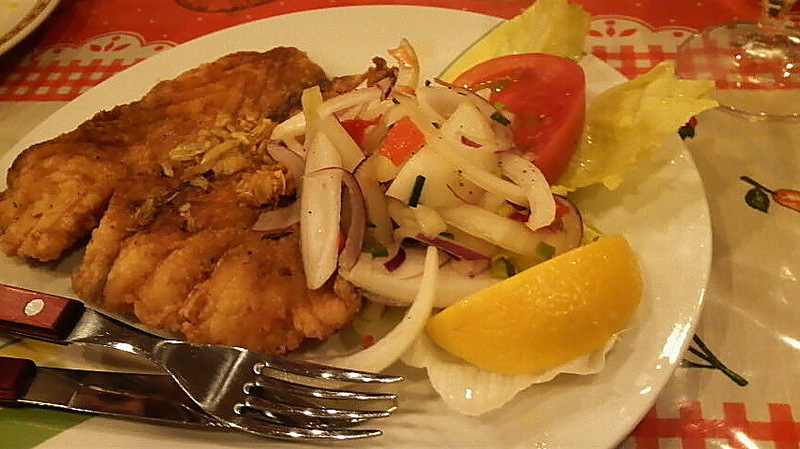
Moving away from the offal and potato theme, here is some seafood (Peru is famous for its fish, which they apparently prepare imaginatively):
Fish dish with salad, at the Arco Iris restaurant, near Gotanda station (Japan, 2009)
This critter here is an octopus salad:
This octopus salad ought to appeal to the Japanese palate (Japan, 2009)
Arco Iris is on the 2nd floor of the Motomiya Building (本宮ビル2F) at 1-15-5 Gotanda, Shinagawa Ward, Tokyo -- the phone number is (03) 3449 6629. A typical dining experience costs about ¥1500 per person, if you don't have a sponsor or principal to support you!
A couple of days ago I found myself with a lot of hours to kill inside Hồ Chí Minh City Airport, and to pass the time I bought a little book on sale there called The Cuisine Of Viet Nam (Nourishing a Culture). A nourishing little book it turned out to be, indeed -- it got me through the layover at Tân Sơn Nhất, and provided me ample food for thought, regarding the rich world of Vietnamese cuisine. One essay in the collection, written by Nguyệt Biều, concerned the spicy relative of phở -- Bún bò Huế (otherwise known as Huế noodle soup.) I did not know this until I read this book, but Huế is the food capital of Vietnam, and represents the culinary perfection of the nation. It is to Vietnam, perhaps, what Kyoto is to Japan, or Yogyakarta is to Indonesia. It is the soul of the nation. Nguyệt writes:
If one had to pick a single food which is reminiscent of Huế, it would be rice noodle soup with beef and pork. Huế residents prefer to buy their bún bò from street vendors, rather than in restaurants. Street vendors carry soft, thin white noodles (bún) and slices of beef (bò) and pork with them in two bamboo baskets hanging from a pole balanced across their shoulders.
Consumers eat this noodle dish on the sidewalk, squatting on small stools right next to a pot of boiling broth. The intense fragrance rising from the pot is the greatest advertisement for this dish.
Most street vendors in Huế come from villages outside the city such as Thủy An, Phát Lát, and Vạn Vạn. In these villages, each household has one or two street vendors. Selling rice noodles is both a way of earning a living and of carrying on a family or village culinary tradition. In the morning vendors sell to regular customers, usually in small side streets or alleys. When lunchtime is almost over, they stop selling and shop for the ingredients for the next day.
Street vendors carry one pot of broth that they can put on a portable charcoal stove, to be heated immediately. Another pot contains additional ingredients such as stewed pig trotters, grilled ground pork, beef and pork tendon, grilled crab, pig and duck blood, and thin slices of beef. On the other side of the bamboo pole is a container of fresh rice noodles and seasonings like onions, scallions, chili peppers, fish sauce, bean sprouts, banana flowers and diced lettuce. Finally, the baskets contain bowls, spoons, chopsticks, a basin for washing, napkins, toothpicks, a tank of green ginger tea, and a few stools: truly a moveable feast.
Bún bò Huế is completely unpretentious. Its charm lies solely in its fragrance. According to the women who sell rice noodles at Bến Ngự Market, the broth must be delicious above all else: clear in colour with a balance between the salty and sweet flavours of stewed beef bones, pork bones, and chicken.
Vendors tailor each bowl to the customers' desires. In the winter, customers sit next to the red-hot stove and the boiling broth, covering their bowls with their hands, slurping the broth, skewering the noodles with their chopsticks, and biting into pieces of meat. Even food connoisseurs in Hà Nội and Hồ Chí Minh City admit to a love of bún bò Huế, especially when it is served in Huế.
After my successful date with Tomomi last night, I awoke to a sunny and generally pleasant Sunday, this being one of the mildest winters on record. I had an appointment with my old salaryman friend Tanaka-san at 4pm; he wanted me to transcribe the lyrics of a Country&Western song his partner was planning to sing in Osaka (大阪). I met him at Breaks Cafe at Ueno Station, and transcribed his lyrics. After that we marched briskly through the settling cold and madding crowds, down the bleak concrete lanes, to the Himonoya Restaurant in Okachimachi (御徒町). Tanaka-san had spotted the place from the train on the Yamanote Line as he passed on his daily business, and he was keen to check it out. Naturally, the shout was on him.
Himonoya, specializing in sundried cuisine, at Okachimachi (Japan, 2006)
The servings started with a complementary cabbage -- you better believe it a whole cabbage, which we ate with a smearing of slightly spiced mayonnaise. I am not a green veg buff by any means but this cabbage tasted amazing -- "it is fresh," Tanaka-san succinctly remarked. There followed a series of sundried seafood dishes, in the himono tradition -- Tanaka-san sent one of them back to the kitchen for having too much akaimono (red stuff) inside. Apart from the fish, the menu boasted grilled nasu (eggplant) and fried duck (鴨つくね) served with what looked suspiciously like a duck's egg. Who said the Japanese weren't adventurous eaters! There were also plenty of onigiri rice balls, some of them of tremendous proportions. Scary! Naturally, a full spread of Japanese rice wine and beers accompanied the feast. I took a few photos, and sent one or two of them to Tomomi. I returned home feeling elated, basking in the afterglow. The gloom in my heart was lifting. It's funny how your life can turn around, so quickly. With a new job and a new girlfriend, I have achieved the aims of July 2006. So, let's bask for a while! Breaking free from Kidea is a longterm goal, and I have already come quite far, with 2.5 free days! Since money is the key to power I should focus on repaying my credit debt. There are too many interesting things happening in Japan to worry about the implementation of Intermediate International Vagabondancy just yet. However, I have laid the foundations of this coming phase of my life.
Have you ever read a haiku poem? Not only are they fascinating compositions in themselves, as fragile as a cherry blossom, but they also open a window into the culture and the consciousness of the Japanese people.
For those who don't know, haiku comprise three nonrhyming lines of five, seven and five syllables. To our Occidental mind, they appear too fleeting and incomplete. We feel that there should be something more substantial. If we think Orientally, however, we will realize that they reveal something less... that is, the vacuum which encapsulates the core of the Japanese experience. Just like the empty gestures of the tea ceremony (茶道), they condense the essential nothingness of the Universe. This is the original meaning of the "Floating World", in my opinion at least.
The following haiku, by Matsuo Basho (松尾 芭蕉) is said to be one of the most profound achievements in Japanese literature, but is only seven words long:
"Furuike ya! Kawazu tobikomu Mizu no oto."
("Oh -- ancient pond! A frog jumps in, The sound of water.")
It should be noted that the "ya" is not even a real word, and it is merely deployed as a "state breaker", a crack of Zen revelation. I studied quite a few other haiku today and most of them were deceptively simple, but yet deeply mysterious at the same time. They make me wonder about how the same patterns coil round and round and in upon themselves, conchstyle. In Europe landscaping generally entails elaborate grounds with avenues of grand elms; in Japan the traditional garden is just a raked expanse of gravel rimmed by midget brutally pruned bonsai trees. Haiku are the bonsai of the poetry world, you might say -- severely pruned and bare.
A more contemporary state breaker can be heard in the song We're All Water, written and sang by Yoko Ono, and released on John Lennon's protest album, Some Time in New York City. Ono might be a terrible singer and the whole production is shambolic, but the curious structure of the piece redeems it. Each verse is like a haiku, with three lines of five or seven syllables each, for example this one:
"There may not be much difference Between Manson and the Pope, If we press their smile..."
Three is not a particularly rhythmic number at the best of times, at least on a Rock record, but here it lends an exotic, enigmatic quality. Listening to Ono's song, you might find yourself hanging on, waiting for the missing fourth line. Have the courage to let go, however, and you could fall into an abyss, one that you never even noticed there right before your feet... (For more of my discoveries regarding manifestation and the void, click here.)
I must confess that I had lost hope in Sigur Rós after () came out. In comparison to Ágætis Byrjun, Sigur Rós' first major release, the () album was harder to get into: austere, funereal, blank as a pair of empty parentheses. While Ágætis Byrjun grabbed you from the get-go, and took you on a glorious adventure, () was downbeat, and deliberately intimidating. Not only did none of the tracks have names, but they all kind of sounded the same. It was disappointing, because I fancied that I had finally met my kindred spirits in this Reykjavík quartet. I feared that the Victorious Rose had withered, and died, just as I was starting to dig them. That was two years ago, and a lot of water has flowed under the bridge since then, to abuse an old cliche... I have been to Iceland, and discovered plenty of fresh talent in that creative powerhouse. Sigur Rós had played their part in my life, or so I thought, but now I required them no more. How wrong was I: all of a sudden, Sigur Rós are back, happier and more accessible than ever! Frontman Jónsi Birgisson is actually singing, in Icelandic at least! And in gratitude, I have to bow deeply, and say: Thank you. Or, more succinctly: Takk..., which is the title of their new album.
Takk, the third album released by Sigur Rós.
Last Sunday I bought the latest Sigur Rós installment Takk... and consumed it, captivated, at the old school desk in my sharehouse. It was such an exhilarating experience, I literally couldn't get out of my chair until it finished. From the opening moments of mesmerizing feedback, which suggest a sun rising over a field of lush lupines, you sense that this is going to be an upbeat record. The sun slowly morphs into the sweep of a North Atlantic lighthouse, slicing through the fog. A beam from that lighthouse swivels your way, sending out fluctuating waves that just melt you, instantaneously. All at once, I felt the melancholy of () blown away, and the curtain rise on a whole new act in the Sigur Rós saga. It was an introduction that, for me at least, called for an instant rewind. So let's rewind it, and do it properly, in this review... one track at a time! With the occasional YouTube video or other media file thrown in, once they become available.
Track 1: Takk... ("Thanks...") Like a ray of scintillating sunshine, Takk... penetrates deep into your soul, to grant you a Higher Grace. I believe there are saints in India who can enlighten you just by uttering a couple of words in your earshot, or staring you in the eye. Sigur Rós also seem to possess this ability, this Shamanic power, and all you have to do is hear their music, and be transformed! As the introduction begins, it feels like a baby is being born, descending into Being (in the fringes, meanwhile, the sonic equivalent of angelic heraldry hangs.) Why do the introductions to Sigur Rós albums always sound like childbirth? I marveled, hearing this tune play out, the second time I rewound it. Not the birth of an ordinary baby, of course, that would be too mundane. Here we are talking of angel birth!
Track 2: Glósóli ("Glowing Sole") Glosoli carries forward the euphoria of the intro, but the Fafner-frustrated bass, and restless percussion, suggests some discord... it appears our angel child has taken form, but finds her/himself forsaken in this cold world. Inexplicably, the sun has disappeared (then again, it might just be midwinter in the Land of Fire and Ice!) The bass frets round and around, locked in a holding pattern. The strings do manage to lift off though and before too long we have Jónsi ululating too, yodeling almost, his voice higher than I have ever heard before, almost operatic you might say. He sings, sweepingly:
"Nú vaknar þú
Allt virðist vera breytt
Ég gægist út
En er svo ekki neitt..."
Now you wake up, to find all is different. I look out, but see nothing. Tie my shoes so, and head for the door. Outside on the lava plain, a boy stands waiting. He is decked out in period costume, and carrying a drum. Part Pied Piper, part pirate dwarf, he seems like he's on a mission. He is on a Crusade, no less, and he is calling for volunteers. The drummer boy assembles a posse of kids as the song advances, constructing cairns, sleeping on moss beds, traversing the dark and steaming landscape, before the sun is finally located hiding over what must be the black beach of Vík in southern Iceland. The sound wells, bowed guitar building, and surging through it all is an epic feel, an incredibly epic feel, the kind you might encounter in a Homeric poem, or an Old Norse saga.
At 3:47 the bass guitar grinds into a countdown, lead guitar joining in, cascading into a crescendo which can only be called Heavy Metal, Iron Maiden in slow-mo. Jónsi rides atop the sonic blast, rejoicing:
"Og hér ert þú, fannst mér!
Og hér ert þú, Glósóli!"
On cue, the kids charge up a steep grassy slope, overtaking gulls which bob on the breeze, to the high cliff which towers over the sunlit beach. As Jónsi hollers they leap off the edge, one by one -- not to fall to their grisly deaths but rather to soar, angelic, into the citrine sky. There is an angel inside everyone of us, that is one of Sigur Rós' recurring motifs... and these kids have lights in their soles. We are Homeric heroes all, living in our own personal saga. Therefore, everything we do is worthy of epic treatment.
Track 3: Hoppípolla ("Jumping in Puddles") In an interview recently aired on MTV Japan, band members declared Takk... to be their "happy album". Critics have been predictably quick to label the record as too optimistic and orgasmic, and to question the band's sincerity. I think they are missing the point: the thing about Sigur Rós is that they do emotional music -- their range encompasses everything from ecstasy to sorrow and existential dread. That said, Hoppipolla manages to push it to 11 on the ecstasy scale, which is no mean feat. It is, allegedly, the story of some kids splashing around in a puddle and having fun (once again, a simple theme turned into an opera of epic proportions.) The result is the most beautiful song on the album, or at least one of the most accessible.
In the video posted above, homage is paid to such juvenile pursuits as tagging buildings, throwing water-bombs, and playing knock-and-run. Typical of Sigur Rós, normal roles get reversed, and the perpetrators of said acts are senior citizens, while the victims are young dudes played by the members of the band (at 1:19, for example, you can see Jónsi working behind the counter in a shop.)
Track 4: Með Blóðnasir ("With a Nosebleed") The continuation of the previous song by other means, this is also a very inspirational piece in its own right. According to an interpretation I have read online, one of the kids splashing around in Hoppipolla has injured himself/herself and gotten a nosebleed, but nobody cares because everyone is having so much fun. Loops of guitar, keyboards and glockenspiel are tossed around, with Jónsi surfing over the top. Casper on the Sigur Rós message board said: "Með Blóðnasir is just wild! if it were an actual song it'd be the best thing they've ever done!" I just wonder whether by separating this and Hoppípolla into two units, Sigur Rós have deliberately tried to make it harder for both to get commercial radio playtime. Instead of selling out, the band seem to be trying to goad commercial radio into breaking a few of its own rules, and become a bit more experimental.
Track 5: Sé Lest ("Train") Building straight off of Með Blóðnasir,the glockenspiel is isolated, playing a repeated melody that moves up in fifths all while bouncing in 16th notes. A whimsical vocal line comes over and is followed by bass, percussion and feathery strings (apparently provided by fellow Icelanders amiina). At this stage it is all starting to sound very mid-1990s Björk, as soothing as a lullaby. Near the five-minute mark, multiple tonal instruments balance against each other, with on odd bowed instrument over the back. At 6:30, curiously, we are full-fledged into a night-time polka. That's right, a freaking polka! This is cool -- only Sigur Rós could pull off a transition like that. It leaves me wondering: Is there anything this band can't do? Track 6: Sæglópur ("Sea Nitwit") After the whimsical folly of Sé Lest, Sæglópur erupts with a surprising force... you could describe it a power ballad with its piano intro, geyser blasts of bowed guitar, multiple climaxes, and the endless cries of "þú" ("you"). The trademark Sigur Rós strategy of old was to build up songs over a long time to a devastating climax, like an Mid Atlantic cataclysm. Usually they would start off sluggish and serene and at the 6th minute mark or so, the breakout would take place. That was well and good, but with this new album they have taken things to the next level. Instead of sprawling songs which turn hyper at the end, Sigur Rós have amped up the intensity... they can now pull off multiple climaxes. 11 out of 10, in the Spinal Tap tradition. And as any pornographer will tell, nothing beats milking that money shot multiple times...
Track 7: Milano ("Milan") Listening to Sigur Rós, you might find yourself wondering: What planet does this music come from? I met an American in Mumbai this year who joked that Jónsi's voice was "out of this world." I agree with him -- Jónsi is indeed an alien, an emissary from another galaxy... but that ain't surprising considering his pedigree. The truth is that Iceland itself is an alien and otherworldly place. Going to Iceland is in fact the next best thing to visiting another planet. It is built atop a dimensional fault line, a gateway between the 'branes. What happens then when Sigur Rós leave their homeland, and vacation in, say, Milan? Well, this song could be the result! It starts off slowly, as you might expect after the dramatic heights of the previous track. There is tender strings action, and a bit of piano too, revolving like a music box. As in Með Blóðnasir there is a circular structure to this song, each bar measured by a Fafner bass, which ever so slowly accelerates. Tension accumulates, as tension is wont to do. At 3:45 we finally reach bursting point, guitars thrashing, but this is a minor eruption. I guess there wasn't that much energy to release after Sæglópur. All that climaxing will exhaust you, sometimes.
Sigur Rós, somewhere in Iceland.
Track 8: Gong ("Gong") Mournful strings commence this journey, which are presently joined by guitars, drums, bass and finally a frantic piano. Jónsi is like a wolf howling at the sky, supported by a ghostly choir (quite probably, a choir of one.) Grapevine considers that this is "close to a melodic rock song, until it breaks into the big drama after the four-minute mark." In my own opinion, Gong is one kick-ass track -- a new direction for the band, a climax upon a climax, and another highlight of an album so crammed full of highlights. Track 9: Andvari ("Zephyr") Reviewers haven't cottoned on to it, but I swear this is another version of the same dirge which dragged on eight times on the () album. This is the 9th rendition of the song if I am correct, and I in my opinion it is the best. It is also the most moving moment of an already powerful album. As Gong retreats, guitars, music box and glocks pick up a sentimental melody, joined by the bass. At length Jónsi enters the fray, droning in what, suspiciously, sounds like Hopelandic, Uh-oh! you might think, remembering the bleak days of ()... Are we back on that kick? To be honest though, you don't need to understand Sigur Rós' lyrics to feel the meaning, and there sure seems to be a lot of emotion crammed into his wailing. At 1:50, Jónsi surprises me by singing (in English!) the short phrase, "I love you." Hackneyed perhaps, but it brought tears to my eyes on the first and second hearings, for there is a gratitude in his admission -- I could imagine that he was addressing me personally, or at the very least the loyal fans of the band. Giving thanks, in the true spirit of this record. I might be wrong... others claim this is a love song dedicated to his new boyfriend. I didn't even know he was gay!
Track 10: Svo Hljótt ("So Quietly")
As its name might imply, Takk...'s penultimate track starts off restrained, with somber aspirations. but soon builds into one final banger -- a tornado, geyser, or the tractor beam from a UFO in a cornfield somewhere (draw your own allusions here.) The rock bible NME claimed: "Choice cut Svo Hljótt sounds like the bit in Lord Of The Rings when Gandalf dies reinterpreted by operatic mythical winged beasts." Translated into English, the lyrics are more prosaic, but also quite revealing:
"I thank you for the hope you gave me
I thank you for the hope..."
When we are lost at sea and the sun refuses to shine, we embodied beings need a guiding star. Suddenly I realize that () was our communal long night of the soul, the wilderness we had to traverse in order to arrive at Takk..., this oasis of plenty. With Jónsi as our mad Pied Piper (or the drummer who can shatter glass with his voice.) As the magnitude of this revelation sinks in, my only rational response is to bow low and proclaim, "Thank you Sigur Rós, for the hope you gave me. Thank you for the joy." I leaned on you, and you leaned on me. What goes around comes around, and every tribute is returned.
Track 11: Heysátan ("Hay Stack") Heysátan unfolds like a hymn, each note constructing a church stone by stone, wall by wall, pew by pew. Inside this sacred place, the atmosphere is that of a wake (albeit a rather jubilant one). Jónsi is either playing the role of a priest, or a demonic choirboy. Grapevine has the last word on this fitting finale: "A refrain of key notes of one chord, we hear horns, plucked guitar and keyboards all combining for airy but understated effect. Jónsi is most clear in the vocals here, sounding, dare we say it, like an Icelandic Billy Corgan..."
Takk... is one serious mindtrip, more of a drug than an album, and it is reminiscent of the Múm works that I have reviewed on this site. The cover of the CD (pictured above), designed to resemble a yellowed Victorian novel, also recalls Múm's album covers. Difficult to say though whether Sigur Rós directly imitated Múm in this respect, or whether both bands are merely reflecting the current trends in Nordic graphic design. Whatever, this is a very Icelandic album, and for lovers of Iceland such as myself, it is great to notice all the indigenous touches on this production.
Every now and then you read a book or watch a movie which changes the way you want to live your life. It's the ultimate compliment to a work of art if it makes you want to start talking like its lead character, or model your own life on theirs. It doesn't happen very often. The last time it happened to me was when I watched Pulp Fiction in the cinema on a quiet sunny Sunday in Sydney, NSW, Australia, and I knew I had found something which connected with me. All those cheesy jokes and cheap suits and retro references! Such brutality, such splendid banality! From then, my way of living was forever changed. Recently I came upon a book which seems like an Icelandic version of Pulp Fiction, minus the gangsters and gore. Strip away Tarantino's violence and what do you get -- endless witty jokes about rock bands and TV shows. Life in the media age. This is the style of writing which dominates Hallgrímur Helgason's 1996 novel 101 Reykjavik. It is kind of like a Tarantino take on day-to-day life, like going to the shops for milk or hanging out with your buddies in the bar, and packed with thousands of reference-dropping commentaries. Ashing a cigarette leads to a reference to David Bowie, "ashes to ashes". Characters don't leave a house, but make an "Elvis exit". 101 Reykjavik is the kind of novel packed with so much 90s-style referential wordplay that, when you're finished reading, you think: "Hey, this would make a good movie." In fact, it has already been made into a movie, directed by Baltasar Kormakur, and starring Victoria Abril.
Smoking in the snow: 101 Reykjavik, by Hallgrimur Helgason.
Other reviewers have described this novel as the "pathetic narration" of an "emotionally retarded slacker whose most intimate relationship is the one he cultivates with his porn collection" (Baltimore City Paper Online.) A little bit harsh, I think -- the lead character, Hlynur Björn Hafsteinsson does indeed enjoy porn, like many folk, but that is no reason to crucify him. He is no doubt a voyeur, but I think Hlynur's absolute obsession -- his core obsession if you like -- is what he calls the "theater of the real". He likes movies, but not to follow the stories -- just to check up on what the actors are doing these days. In one scene he watches a video of live births in American hospitals. In another episode he sneaks into a bedroom where two young people are having sex, pulls up a chair and begins offering critiques! This is how he describes it:
I gradually realize this is the first documentary I've seen about the Icelandic species. And I've got to say it reminds me a bit of Icelandic movies. CHILDREN OF NATURE. There's no plot in it. No angle variation whatsoever. Looks like we're in for an epic feature. Talk about dragging it out. Start to think about the zapper in my inside pocket. Saw a nature documentary the other day about those cameramen who make wildlife movies. Some British pony-tailer who dug himself into a hole for a fortnight in the hope of catching a shot of a hare shag. But he didn't even so much as get a hard-on in those two weeks. Maybe I just don't have the patience.
The Guardian writes: "this lusciously deadpan narrative - dazzlingly translated by Brian Fitzgibbon - is more than funny. It is not so much peppered with gags as infused with a wild, anarchic take on the world that is caustically, worryingly truthful." According to this other site I found: "Hlynur (the protaganist) is a true product of our postmodern global culture. Well beyond slackerdom, he lives at home with his mother and depends on social welfare. He's a quick-witted and articulate young man, and there's nothing wrong with him -- other than a total lack of ambition, an off-kilter sense of morality, and a nagging set of existential woes. Against the backdrop of Reykjavik's storied nightlife and amid the swelling global presence of Icelandic culture, Helgason portrays with brutal honesty and humor a young man who takes uselessness to new extremes, and for whom redemption may not be an option. 101 Reykjavik is a spectacularly inventive, darkly comic tale of depraved and inspired humanity."
The story is basically this: Hlynur is living in Reykjavík, one of my favorite cities, with his mother, who later turns out to be a lesbian. His mother gets a sexy new live-in girlfriend, who Hlynur also sleeps with. "I guess now we're fucks-in-law," he muses. Apart from that, Hlynur's life revolves around going to pubs and parties, and regular trips to the unemployment office. One of the reasons I decided to buy this book was to get an insight into Iceland's storied nightlife, since I was unable to go out when I was there last. Once I started reading, I discovered that Hlynur lives an idyllic, if aimless life, just like me. But what is wrong with being lackadaisical, what's wrong with going with the flow? That's the trouble with the world, there are no many people with aims, everybody aiming for the top... I'd rather be a bottomfeeder, fill the space that others leave behind. That is my ambition, if I must be forced to use such a term. So, I guess I have this in common with Hlynur: we're both bottomfeeders. The happiness of the unemployment lines; our freedom urgent as a blue sky, as Hakim Bey might have put it. Corporate high-flyers will never understand the simple pleasures of being alive. They can have their money, and I will take my precious moments, wherever I can find them. One day I will be dead, and they will mean no more to me.
Reykjavik 101 unloads on you like a stand-up-comedian; it is dark and cynical at times, but relentlessly clever in the wordplay department. Here is a typical extract:
The Castle at midnight. Not exactly wicked. Despite the name, it is just a cellar. "The Dungeon" might have been more apt. You step down into the past. A dire bluesy little piss hole: a murky cave, phoney brickwork on the walls, complete with (fake?) swords and armour. Prehistoric rock music spurting through the speakers, a tinny sound, like the records have been dug up in some archaeological find: Black Sabbath, Deep Purple, Led Zeppelin. "Eye of the Tiger", as it happens, when we walk in, myself, Throstur and Marri. A trip down mythology lane. Feel like I am in one of those QUANTUM LEAP episodes. Ancient Greece, except everyone's wearing jackets. Bacchus behind the bar cracking his whip, the old master torturer, fat and furious, thrashing the mob -- eternal slaves to alcohol with blistering wounds on their backs -- impressively equipped: the beer taps like levers on the torture rack, the thumbscrews tightening each time they're pulled. He can afford to laugh with the arsenal he has behind him: Hot Shots on the shelf, Black Death. Juggling his bottles like guns, he levels them at his victims, metallic spirit measures screwed to the nozzles like silencers. Uncapping the beer bottles with his teeth, he hurls them into the room like grenades, shakes Molotov cocktails. Pours boiling acids into poisoned goblets, and the customers sign their credit-card slips like they were signing their own death warrants. A highly combustible situation.
One of the things I like about Iceland is that it is so small, it is easy to get the hang of it. If you have been to Reykjavík, if even for a weekend, you have probably visited half of the sites visited in this book. It is the kind of place where everybody knows everyone, and everybody experiments with everybody else's scene. After spending some time in the heavy metal Castle, Hlynur and his crew move on to a place with a totally different scene and style of music -- Duran Duran is being played. Can you imagine young people in England or America being so promiscuous about their choice of music? It doesn't happen. Later, Hlynur confesses a love of Lionel Ritchie's 80s ballad Hello. In Iceland they seem to give everything a try; they mix and match; it's a big melting pot of influences and creativity. There is none of the genre snobbery I was brought up with in Australia: "I like techno -- there's no way I am going to that headbanger crap!" contrasted with "I can't stand that techno shit. Give me music with a bit of guitar in it!"Anyway, here are some of the cooler extracts from the book, the ones which struck me as particularly funny:
We're in a queue in front of the K-bar. There's a new bouncer who obviously hasn't done his homework. Doesn't know us. I've never seen him before, apart from the tattoo on his neck. A little bit more originality, please...
Guildy is telling the story about when he met Bryan Ferry in Amsterdam. Good story. Good music. Good view. There's a kind of Polaroid atmosphere here. One that calls for instant developments. If only Rosie would shut up. He's still trying to open himself to me:
"But I've always wanted to get back into costume design. I've done everything in hair now, everything I could do really, and I want to get out of hair and maybe work in theatre or something..."
"Yeah," I say, and manage to establish some eye contact with the video presenter sitting beside me. It works. He's obviously used to this from his TV work. I think it's what they call a cue. One glance and he knows he's on, he has to say something:
"But you HAVE actually worked in the theatre before, have you not?"
Good. We've slipped into the chat-show mode at last...
I have only been to Iceland once -- it was in late summer. Very pleasant I thought it, if a little too windy at the time -- and it amazed me with the most amazing skies I have ever seen. I will always remember that crystal clear Icelandic sky -- the sun hanging like a jewel in the blue, the clouds whizzing by just hundreds of meters off the ground. One night I saw the aurora. Next time I go to Iceland (estimated late 2005 or early 2006) I want to go in the middle of winter, like January or something. I have already started my saving campaign. I want to see what real Arctic dark and cold is all about, and I want to stay a long time -- at least six weeks. Plenty of time for hanging round boozy pubs and hotsprings -- I can hardly wait!
Here is how Reykjavik in the winter is depicted by Hallgrímur Helgason:
Reykjavik on a dark winter morning: a small town in Siberia. Snow drifting in the glow of lamp posts under a dome of darkness, enshrouding a shivering salted sea of porridge and shorelines of milk curds. Masticated frozen mush around the darkness. The mountains -- heaps of ancient debris, forsaken refuse, a junkyard from heathen times, scrap iron from the Bronze Age. Hardened glacial diarrhoea, hideous mounds of mould, encircle this transient town of cards, a camping site littered with computers doomed to disappear in the next blackout.
One other site I visited (from Sweden) also provided this pithy review: "En ung manns seksuelle følelser går når han oppdager at han har hatt sex med morens lesbiske elskerinne, og at hun antageligvis er blitt gravid." I am just trying now to guess what that this means. How about: "A young man's sexual fantasies run amok after he has sex with his mother's lesbian girlfriend." After Hlynur does eventually has sex with his mother's Spanish lover, he ponders: "I guess that makes us fucks-in-law." It's a witty remark, but also full of pathos, when you think about it. And when you think about it, there's plenty of great wit and pathos in this book! And so there should be.